Bandwagon Effect — Meaning, Examples & How to Overcome It
Mind · Cognitive Biases · Social & Self-Perception family
Test yourself — can you spot the bias in each scenario? Take the Cognitive Bias Spotter Test. Jump to the test ↓
What Is the Bandwagon Effect? Simple Definition
The bandwagon effect is the tendency to adopt beliefs, preferences, or behaviours because many other people already hold them — to "jump on the bandwagon" — regardless of whether the independent evidence for those beliefs or preferences is compelling. Popularity itself becomes the reason for adoption. The more people appear to be doing or believing something, the more attractive that thing becomes, independent of its actual merit.
The term comes from American political campaigning: a bandwagon was the wagon carrying the band in a parade, and politicians who were gaining momentum invited others to ride along. By the late nineteenth century, "jumping on the bandwagon" had become a metaphor for supporting something primarily because it appeared to be winning — a usage that captures the bias precisely.
This page is part of the cognitive biases guide on our free brain training and cognitive assessment tools, alongside interactive tools covering memory, attention, reaction time, and decision-making.
Bandwagon Effect Meaning & Psychology
The psychological roots of the bandwagon effect lie in two distinct mechanisms that often operate simultaneously. The first is informational social influence: when we are uncertain about what to believe or do, other people's behaviour is genuinely useful evidence. If many people independently reach the same conclusion, that convergence is a signal worth attending to. The second is normative social influence: we want to belong, to be accepted, and to avoid the social cost of being in the minority. Both mechanisms can lead to the same outcome — adopting the majority view — but for different reasons.
The foundational laboratory demonstration of conformity as a psychological phenomenon came from Solomon Asch's experiments in the early 1950s. Asch showed that participants asked to judge which of three lines matched a standard line would give clearly wrong answers at a substantial rate when surrounded by confederates who unanimously gave those wrong answers. The social pressure of unanimity was sufficient to override direct perceptual evidence. While Asch's experiments demonstrated conformity to group pressure rather than the bandwagon effect as typically defined, they established the basic mechanism — the willingness to align with the group even against clear evidence — that underlies the broader phenomenon.
The economic framing was formalised by Leibenstein (1950), who described bandwagon, snob, and Veblen effects in consumer demand — identifying that some demand for goods is driven not by the intrinsic utility of the good but by the fact that others are consuming it. This framework captured how popularity can be self-reinforcing: the more people adopt something, the more desirable it appears to those who have not yet adopted it, regardless of the underlying quality.
Why the bandwagon effect persists
The bandwagon effect is reinforced by the fact that, in many situations, following the crowd produces acceptable outcomes with minimal cognitive effort. Using popularity as a heuristic — choosing the restaurant with the queue, buying the book on the bestseller list — often yields reasonable results and saves time. The problem arises when this shortcut is applied in contexts where majority opinion is poorly calibrated, where popular belief is driven by factors other than quality or truth, or where independent judgment would produce better outcomes than conformity.
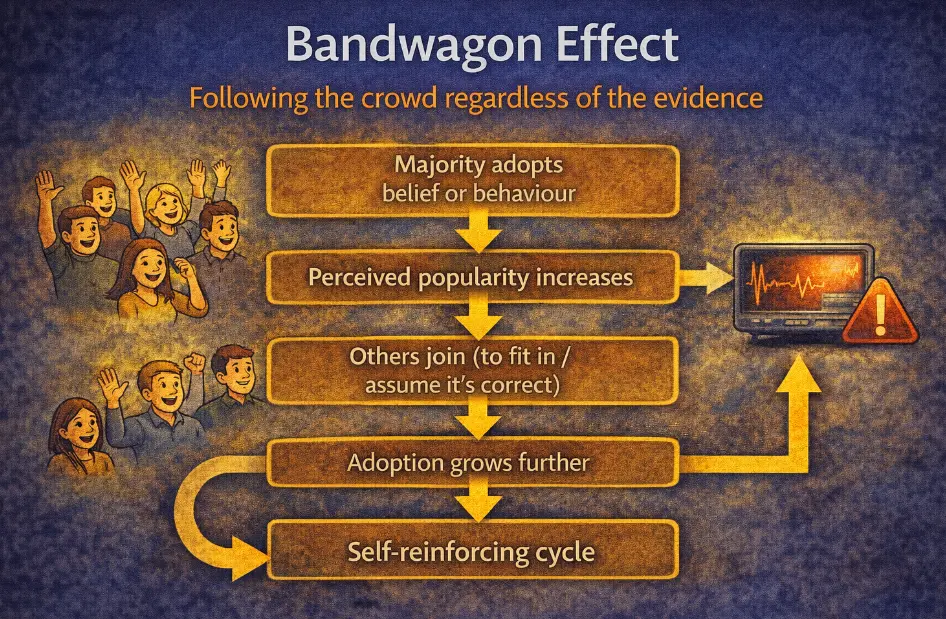
The bandwagon effect: as perceived popularity grows, more people join — creating a self-reinforcing cycle that drives adoption independent of the underlying evidence.
Bandwagon Effect in Real Life — Examples
In financial markets, the bandwagon effect is a driver of asset bubbles. When prices rise and many investors appear to be profiting, additional investors buy in — not necessarily because their independent analysis supports the valuation, but because the crowd appears to be right and missing the rally feels costly. This creates a self-reinforcing cycle in which rising prices attract more buyers, which drives prices higher still, until the cycle reverses. The dot-com bubble of the late 1990s and various cryptocurrency rallies are well-documented examples of bandwagon dynamics producing valuations that diverged sharply from fundamentals.
In politics, the bandwagon effect operates through polling and media coverage. When a candidate is shown to be leading in polls, some voters who were undecided or leaning toward another candidate shift toward the frontrunner — not necessarily because their policy positions have changed, but because they want to support a winner, because they infer that the frontrunner must have qualities they have not fully appreciated, or simply because visible momentum makes the frontrunner seem more credible.
In consumer markets, bestseller lists, download counts, star ratings, and review numbers all function as bandwagon cues. A product with ten thousand five-star reviews is perceived as more trustworthy than one with twenty reviews, even when the reviewer pool of the former may be less representative or more susceptible to manipulation. The popularity signal substitutes for independent evaluation, which is why platforms invest heavily in displaying social proof metrics.
Bandwagon Effect in Social Media
Social media platforms are purpose-built environments for bandwagon dynamics. Likes, shares, follower counts, trending labels, and viral spread all make the popularity of content highly visible, creating persistent cues that trigger bandwagon adoption. Content that is already popular attracts more attention, more engagement, and more sharing — not primarily because it is more accurate or more valuable, but because its visible popularity makes it appear credible and worth attending to.
This creates significant problems for information quality. Misinformation that gains early viral momentum accumulates the same bandwagon signals as accurate information, making it harder for individual users to distinguish between popular truth and popular falsehood by using social proof as a guide. The visibility of engagement metrics rewards content that provokes strong emotional reactions — which is not the same as content that is accurate, nuanced, or carefully reasoned.
Bandwagon Effect vs. Herd Mentality
The bandwagon effect and herd mentality are closely related but not identical. Herd mentality is the broader tendency to follow the group, driven by a mix of conformity pressure, fear of exclusion, and diffusion of individual responsibility. The bandwagon effect is more specifically the pull of perceived popularity — the sense that if enough people are doing something, it must be worth doing. Herd mentality can persist even when the size of the group is stable; the bandwagon effect is particularly driven by the perception of growing momentum and increasing adoption. Both are expressions of the same underlying social conformity mechanisms, and both interact with in-group bias — the pull of the bandwagon is stronger when the people already on it are perceived as members of your own group.
How to Avoid and Overcome the Bandwagon Effect
Identify the actual evidence, not the evidence of popularity
The core practice for countering the bandwagon effect is separating the question "how many people believe or do this?" from the question "what is the evidence for this?" Popularity is a fact about the behaviour of others; it is not, by itself, evidence about the quality, truth, or value of the thing being adopted. Making this distinction explicit — asking "why do I believe this, and is the reason actually good evidence?" — interrupts the automatic translation of popularity into credibility.
Seek out the reasoning of dissenters
If a belief or behaviour is popular, the minority who resist it have typically thought carefully about their reasons for doing so. Actively seeking out the best arguments against the popular view — not to reject the majority position automatically, but to test whether the popular position can survive engagement with its critics — improves the quality of the eventual decision. This connects to the corrective for confirmation bias: deliberately exposing yourself to disconfirming perspectives rather than relying only on the information that supports the popular view.
Form your view before checking the crowd
In situations where you have the information needed to form an independent judgment, doing so before checking what others think reduces the anchoring effect of social proof. When you already have a considered position, the popularity signal has less power to override it. When you check the crowd first, you have no independent reference point, and the bandwagon cue fills the vacuum. This is particularly applicable in consumer decisions, investment analysis, and evaluating claims where your own assessment is feasible but you habitually defer to ratings and reviews before forming it.
The Deeper Point
The bandwagon effect exploits a genuinely useful heuristic — that the aggregate behaviour of many people carries information — by applying it in contexts where the aggregate is poorly calibrated, manipulated, or simply reflecting the same bandwagon dynamics that shaped the views of earlier adopters. The result is that popularity becomes self-perpetuating, detached from quality or truth, and resistant to correction because its very scale makes it seem authoritative.
Countering the bandwagon effect does not mean reflexive contrarianism — the crowd is sometimes right, and the wisdom of crowds is a real phenomenon in specific conditions. It means developing the habit of treating popularity as one input among several rather than as a substitute for independent assessment. That more deliberate approach to social proof is harder than simply following the crowd, but it produces decisions that are better calibrated to actual evidence rather than to the behaviour of whoever jumped on the bandwagon first.
Related biases that interact closely with this one: authority bias, which similarly reduces independent critical evaluation by substituting a social signal for evidence-based reasoning; availability heuristic, which makes highly visible, frequently mentioned beliefs feel more true; and false consensus effect, which causes people to overestimate how widely their own views are shared — the mirror image of the bandwagon effect's tendency to overestimate how much the majority's view should influence one's own.
The Cognitive Bias Spotter Test below puts that understanding to work — see if you can identify the bandwagon effect and the other nine biases when they appear in realistic scenarios.