Backfire Effect — Meaning, Examples & How to Overcome It
Mind · Cognitive Biases · Belief & Motivated Reasoning family
Test yourself — can you spot the bias in each scenario? Take the Cognitive Bias Spotter Test. Jump to the test ↓
What Is the Backfire Effect? Simple Definition
The backfire effect is the proposed tendency for people to become more strongly attached to a false belief when presented with evidence that contradicts it — rather than updating their view in light of the new information. Instead of correcting a misconception, the correction backfires and makes the belief stronger.
The idea captures something most people recognise intuitively: that presenting facts to someone who believes something false does not always work, and can sometimes seem to make things worse. Whether this is a reliable, consistent cognitive bias or something more situational is a question the research has substantially revised since the concept was first introduced.
This page is part of the cognitive biases guide on our free cognitive tests and training platform, alongside interactive tools covering memory, attention, reaction time, and decision-making.
Backfire Effect Meaning & Psychology
The term was coined by political scientists Brendan Nyhan and Jason Reifler, who published a widely cited study in 2010 documenting what they described as a backfire effect in political belief correction. In their experiments, participants were shown mock news articles containing false or misleading political claims, followed by corrective information. In two of their five studies, the correction appeared to increase belief in the original false claim among participants predisposed to believe it — the correction had, in their framing, backfired. Nyhan & Reifler (2010) proposed that this occurred because corrections threatened participants' identity and worldview, triggering a defensive response that reinforced rather than reduced the false belief.
The study attracted enormous attention and was rapidly incorporated into popular understanding of why misinformation is so difficult to correct. It was cited as an explanation for the persistence of political conspiracy theories, vaccine hesitancy, and resistance to scientific consensus across a wide range of topics.
What subsequent research found
The picture became significantly more complicated as replication attempts accumulated. Multiple independent research groups failed to reproduce the backfire effect under similar experimental conditions. Large-scale studies using nationally representative samples found that corrective information generally reduced false beliefs rather than reinforcing them — the opposite of a backfire effect. Nyhan himself, in a 2021 paper in the Proceedings of the National Academy of Sciences, acknowledged that the backfire effect does not appear to explain the durability of political misperceptions and that the original findings from two studies should not have been extrapolated so broadly.
The current scientific consensus is more nuanced: corrections frequently do reduce false beliefs, the strong backfire effect seen in the original studies has not been reliably replicated, and resistance to correction is better understood as a general feature of motivated reasoning and identity-protective cognition rather than as a paradoxical effect where corrections make things worse. The underlying phenomenon — that people are resistant to updating beliefs that are important to their identity — is well established. The specific claim that corrections reliably increase those beliefs is not.
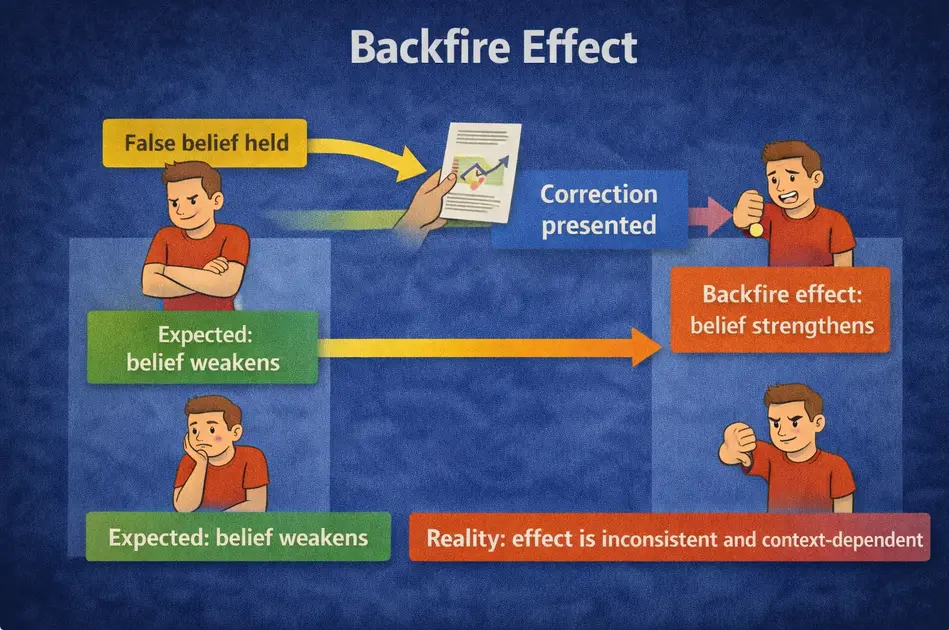
The backfire effect: when a correction is presented, the expected outcome is that the false belief weakens — but the backfire effect predicts it strengthens instead. In reality, the effect is inconsistent and context-dependent.
Backfire Effect in Real Life — Examples
Despite the replication difficulties, the intuition behind the backfire effect reflects something genuine about human psychology. People do resist corrections to beliefs that are tied to their identity, social group, or political worldview — the resistance is real even if the paradoxical strengthening is not as reliable as originally claimed.
In political contexts, voters who are corrected about factual claims made by their preferred candidates often dismiss the correction as biased rather than updating their factual beliefs. The correction fails not because it strengthens the false belief but because it is disregarded entirely — a different mechanism from the backfire effect as originally described, but one with similar practical consequences for the spread of misinformation.
In health contexts, people who are deeply committed to anti-vaccine positions sometimes respond to pro-vaccine information with increased concern about vaccine safety — a finding that has been observed in some studies, though again with inconsistent replication. The practical lesson is similar regardless of the mechanism: corrective information delivered without sensitivity to the audience's values and identity is often ineffective.
Backfire Effect in Politics and Media
The backfire effect became highly influential in political communication precisely because it seemed to explain a puzzling and frustrating pattern: the persistence of false beliefs in the face of clear factual correction. Fact-checking operations, news organisations, and political campaigns all began to reconsider their correction strategies in light of the finding.
The revised scientific picture does not mean correction is pointless — it means correction works better than the backfire effect framing suggested, while still working less perfectly than a purely rational model of belief updating would predict. Corrections do shift beliefs on average; they shift them less for people with strong prior commitments; and the conditions under which correction becomes genuinely counterproductive are narrower than the original research implied.
The spread of the backfire effect concept itself illustrates the related bias of confirmation bias: the finding was widely adopted because it confirmed a pre-existing narrative about the irrationality of political opponents, and the subsequent evidence complicating that narrative received considerably less attention.
Backfire Effect in Health and Science Communication
Health communicators were particularly concerned about the backfire effect because of its implications for public health campaigns. If correcting vaccine misinformation could make people less likely to vaccinate, then standard correction approaches would need to be fundamentally rethought. Subsequent research has been more reassuring: corrections about vaccine safety generally do not increase vaccine hesitancy, and most people update their beliefs in the correct direction when given accurate information.
Where resistance to correction is strongest, it tends to be among people for whom the belief in question is tightly bound to identity — political, religious, or social. This is not a paradoxical cognitive bias so much as a predictable consequence of motivated reasoning: when a belief functions as a marker of group membership, evidence against it is processed as a social threat rather than a factual correction.
How to Avoid and Overcome the Backfire Effect
Affirm identity before correcting
Research on effective correction suggests that affirming a person's values and identity before presenting contradictory information reduces defensive responding. When people do not feel that their sense of self is under attack, they are more able to engage with evidence on its merits. This is sometimes called self-affirmation theory, and it has found more consistent support than the backfire effect itself.
Focus on shared values rather than disputed facts
Corrections framed around values that both parties share — safety, fairness, community wellbeing — are more effective than corrections framed as factual rebuttals. If the underlying motivation for holding a false belief is identity protection, then addressing the identity concern directly is more effective than simply presenting more facts.
Be aware of your own motivated reasoning
The backfire effect, even in its revised form, is a reminder that belief updating is not a purely rational process. When you encounter information that challenges something you believe strongly — particularly something tied to your political identity or worldview — it is worth pausing to ask whether your resistance is driven by the quality of the evidence or by the discomfort of updating. Confirmation bias and the backfire effect are closely related: both describe ways in which the processing of new information is distorted by what you already believe.
Recognise that most people do update
The practical implication of the revised research is more optimistic than the original backfire effect framing suggested. Most people, most of the time, do update their beliefs when presented with accurate information — especially when corrections come from trusted sources and are delivered without attacking identity. The cases where correction fails or backfires are real but narrower than the popular understanding of the effect implies. This matters because an overcorrection in the other direction — assuming correction is always futile — would itself be a form of availability heuristic thinking, where the most dramatic cases feel more representative than they are.
The Deeper Point
The story of the backfire effect is itself a lesson in how cognitive biases operate — including among researchers and science communicators. A finding that confirmed existing intuitions about human irrationality spread rapidly and widely. Evidence complicating that finding spread more slowly and attracted less attention. The belief in a strong, reliable backfire effect persisted long after the empirical picture had become substantially more uncertain.
What remains well established is the underlying phenomenon: people do resist updating beliefs that are bound to their identity and worldview. Corrections do frequently fail. Misinformation is genuinely hard to correct. These patterns are real. The specific mechanism of corrections paradoxically strengthening false beliefs appears to be narrower and less reliable than originally claimed — but the practical challenge of changing minds in a polarised information environment is no less real for that.
Related biases that interact with this one: confirmation bias, which selectively reinforces existing beliefs against contradictory evidence; the Dunning-Kruger effect, where low awareness of one's own knowledge gaps reduces openness to correction; and in-group bias, where the source of a correction matters as much as its content.
The Cognitive Bias Spotter Test below puts that understanding to work — see if you can identify the backfire effect and the other nine biases when they appear in realistic scenarios.