Availability Heuristic — Meaning, Examples & How to Overcome It
Mind · Cognitive Biases · Information Processing family
What Is the Availability Heuristic? Simple Definition
The availability heuristic is a mental shortcut where the brain judges how likely or common something is based on how easily an example comes to mind — not based on actual statistics or data.
In simple terms: if you can think of lots of examples of something quickly, your brain concludes it must happen often. If examples are hard to recall, your brain concludes it must be rare. This works well most of the time — but it fails badly when the most memorable examples are not the most representative ones.
Test yourself — can you spot the bias in each scenario? Take the Cognitive Bias Spotter Test. Jump to the test ↓
After a widely covered plane crash, ticket sales drop — even though the overall probability of dying in a plane crash has not changed at all. People who watched the news coverage feel, viscerally, that flying has become more dangerous. That feeling is not based on statistics. It is based on how easily the image of the crash comes to mind. This is the availability heuristic at work.
The availability heuristic is a mental shortcut in which people estimate the likelihood of an event based on how quickly and easily an example comes to mind. If something is easy to recall — because it is recent, vivid, emotionally charged, or heavily covered in the media — the brain treats that ease of retrieval as evidence that it happens often. If examples are hard to retrieve, the brain concludes the event must be rare. The shortcut is fast and usually serviceable, but it systematically distorts probability judgments in predictable ways. This page is part of the cognitive biases guide on our free cognitive training platform, alongside interactive tests and tools covering memory, attention, and decision-making.
Where the Idea Came From
The availability heuristic was first described by psychologists Amos Tversky and Daniel Kahneman (1974) in a landmark paper that mapped out the heuristics people use to make judgments under uncertainty. Their core insight was that people do not calculate probabilities — they substitute a simpler question. Instead of asking "how probable is this?" they ask "how easily can I think of an example?" The answer to the second question then stands in for the answer to the first. Most of the time this works well enough. In specific, predictable circumstances, it produces large and systematic errors.
Kahneman later described this as a substitution process: the brain is asked a hard question and quietly replaces it with an easier one without flagging the switch. The person answering feels like they are estimating probability. They are actually reporting fluency of recall.
How It Distorts Judgment
Vivid events feel more probable
In one of Tversky and Kahneman's original demonstrations, participants were asked whether more words in English start with the letter K, or have K as their third letter. Most people said K is more common as a first letter. In fact, there are roughly three times as many words with K in the third position — but it is much easier to generate words that start with K (king, kitchen, knife) than words with K as the third letter (ask, awkward, bake). Ease of retrieval substituted for actual frequency, and produced a confidently wrong answer.
Media coverage warps perceived risk
Coverage of dramatic events — plane crashes, shark attacks, terrorist incidents, rare diseases — is disproportionate to their actual frequency. A study by Lichtenstein et al. (1978) asked participants to estimate the frequency of various causes of death. Causes that generate dramatic news coverage — tornadoes, floods, homicide — were consistently overestimated. Causes that kill far more people but generate little coverage — diabetes, stomach cancer, stroke — were consistently underestimated. The participants were not being irrational; they were using the information most available to them. That information happened to be heavily distorted by what journalists find newsworthy.
Personal experience dominates statistics
Someone who has personally known a person who developed lung cancer despite never smoking will weight that single vivid case more heavily than population-level statistics on smoking risk. Someone who has never been in a car accident — despite driving daily for twenty years — will feel safer driving than flying, regardless of what the numbers say. Direct, personal, memorable experience floods out abstract statistical information, because the personal experience is far more available to recall.
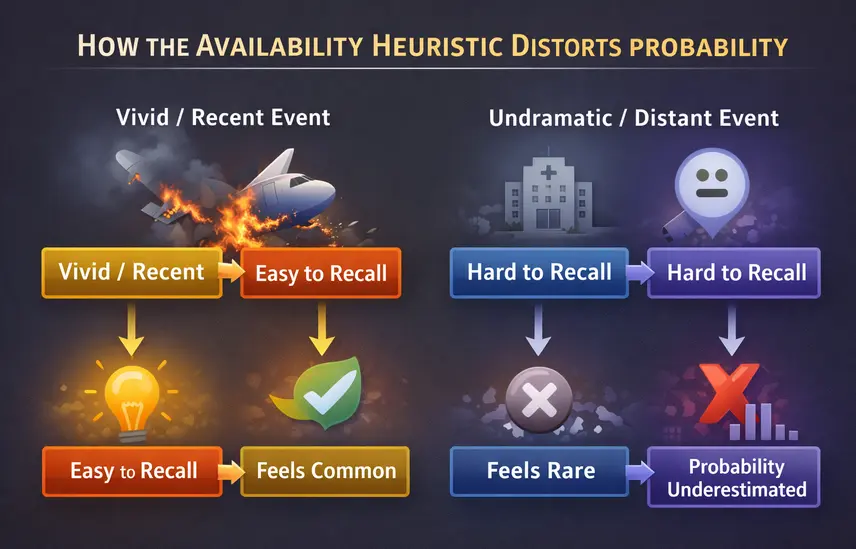
The availability heuristic distorts in both directions — vivid events are overestimated, undramatic ones underestimated, regardless of actual probability.
Where the Availability Heuristic Shows Up
In risk perception
After the September 11 attacks, Americans dramatically reduced their air travel and increased driving — a behavioural shift that, according to a study by Gigerenzer (2004), contributed to an estimated 1,595 additional road fatalities in the twelve months following the attacks. People substituted a highly available, vivid risk — terrorism on planes — for the far more statistically significant risk they accepted every time they got in a car. The availability of the plane attack image made flying feel catastrophically dangerous. The familiarity of driving made it feel safe. Neither feeling tracked the actual probability.
In financial markets
After a market crash, investors overweight the probability of another crash because the recent crash is so vividly available. After a long bull market, they underweight the probability of a correction for the same reason — crashes feel distant and abstract. This produces the well-documented pattern of investors buying high, when recent gains are most available to memory, and selling low, when recent losses dominate recall. The recency bias overlaps heavily here: both involve recent events exerting disproportionate influence on judgment, with the availability heuristic providing the mechanism that drives it.
In medical judgment
A physician who recently treated several cases of a rare condition may overestimate its prevalence and diagnose it more readily in subsequent patients with ambiguous symptoms. Conversely, a condition the physician has never personally encountered may be underweighted even when the textbook presentation is in front of them. Medical educators are aware of this: one reason clinical rotations expose students to diverse and unusual cases is precisely to populate their mental library with a wider range of available examples, reducing the distortion that comes from a narrow or unrepresentative personal case history.
In workplace decisions
A manager evaluating team performance will recall recent successes and failures far more easily than those from six months ago. An employee who made a visible mistake last week will be judged more harshly in a performance review than one whose equivalent mistake happened in February and has faded from memory. This is not deliberate unfairness — it is the availability heuristic operating on the most retrievable evidence. It is also one reason that keeping written records of performance throughout the year, rather than relying on end-of-year recall, produces meaningfully fairer evaluations.
In legal settings
Jurors who have recently seen media coverage of similar crimes, or who have personal experience with related incidents, will assign higher probabilities to guilt than those without that background. Vivid, emotionally charged testimony is weighted more heavily than dry statistical evidence — even when the statistical evidence is more probative. A study by Kahneman and Tversky (1973) showed that people routinely ignore base rate information when a vivid individual case is available — what they called the base rate neglect problem. In court, this means a compelling eyewitness account will outweigh actuarial evidence even when the eyewitness account is demonstrably unreliable.
Test yourself — can you spot the bias in each scenario? Take the Cognitive Bias Spotter Test ↓.
Why Awareness Is Not Enough
Like most cognitive biases, knowing about the availability heuristic does not make you immune to it. The substitution process — replacing "how probable?" with "how available?" — happens automatically, before deliberate reasoning begins. By the time you are consciously evaluating a risk, the availability-inflated estimate has already been generated and anchored your thinking. This connects directly to confirmation bias: the most available examples in memory tend to be the ones that already fit your existing beliefs, which means the two biases compound each other.
What does help is building the habit of asking a specific corrective question whenever you form a strong probability judgment: am I estimating this from actual data, or from what I can most easily remember? The question does not eliminate the bias, but it creates a pause that allows the slower, more analytical reasoning process to intervene before the availability-driven estimate hardens into a conclusion.
How to Avoid and Overcome the Availability Heuristic
Seek out base rates
Whenever you are making a probability judgment — about risk, about likelihood of success, about how common something is — actively look for the relevant base rate before relying on recalled examples. How often does this type of project fail, across all projects? What is the actual annual fatality rate for this activity? Base rates are boring and abstract, which is precisely why the brain deprioritizes them in favour of vivid examples. Making it a habit to find them first counteracts that default.
Widen your reference class
The distortion from availability is most severe when your personal experience or media diet has given you a narrow and unrepresentative sample of examples. Deliberately expanding the range of cases you are familiar with — reading history rather than just current news, seeking out data on outcomes rather than stories about outcomes — populates your mental library with a more representative set of examples, which reduces the distortion produced by any single vivid case.
Ask what is not being covered
Media coverage is not a representative sample of reality. It is a sample filtered through newsworthiness, which systematically favours the dramatic, unusual, and emotionally resonant. When your probability estimates are based heavily on what you have seen in the news, ask what the equivalent coverage of the common, undramatic version of the same event would look like — and whether you would ever see it. The answer is almost always no, which is itself informative about the bias in your available evidence.
Record and review
In decisions that unfold over time — performance evaluations, investment reviews, project assessments — keep written records of events as they happen rather than relying on end-of-period recall. Recent and vivid events dominate memory; systematic records give equal weight to everything that actually occurred. This is the most practical and reliable structural countermeasure available for most workplace applications of the availability heuristic.
The Deeper Point
The availability heuristic is not a failure of intelligence. It is a feature of a brain that evolved to learn from experience — and experience is, by definition, the set of events that have already happened to you or around you. The problem is that the modern information environment feeds that system with a heavily curated, sensationalism-weighted, recency-biased diet of examples that bears little resemblance to the actual statistical distribution of events in the world. The heuristic that worked well when your sample of experience was roughly representative of reality now operates on a sample that is systematically distorted.
Understanding this changes how you read the news, assess risk, evaluate people, and make decisions under uncertainty. The goal is not to ignore vivid examples — they often contain genuine information. It is to hold them alongside the base rates, ask whether they are representative, and resist the pull of fluency as a substitute for probability.
Related biases that interact closely with this one: confirmation bias, which determines which examples your brain stores and retrieves most readily; recency bias, which makes recent events disproportionately available; and anchoring bias, which explains why the first available number or estimate shapes everything that follows.
The Cognitive Bias Spotter Test below puts that understanding to work — see if you can catch the availability heuristic and the other nine biases when they appear in realistic scenarios.