Recency Bias — Meaning, Examples & How to Overcome It
Mind · Cognitive Biases · Information Processing family
Test yourself — can you spot the bias in each scenario? Take the Cognitive Bias Spotter Test. Jump to the test ↓
What Is Recency Bias? Simple Definition
Recency bias is the tendency to give disproportionate weight to recent events when forming judgments, making predictions, or evaluating performance — at the expense of older information that is often equally or more relevant.
In simple terms: what happened last week feels more important than what happened last year, even when the longer history is a better guide to the truth. The brain treats ease of recall as a signal of importance, and recent events are always the easiest to recall.
This page is part of the cognitive biases guide on our brain training platform, alongside interactive tests and tools covering memory, attention, and decision-making.
Recency Bias Meaning & Psychology
An investor who has watched the stock market rise for three years straight begins to believe that markets simply go up. They increase their exposure just before a correction, then panic-sell at the bottom — locking in losses. A manager gives a glowing performance review to an employee who had a strong final quarter, despite a mediocre first nine months. A sports analyst picks last season's champion to win again, because last season is the most vivid data point available.
In each case, recent events have been weighted far out of proportion to their actual significance in the full picture. This is recency bias — and it is one of the most consistent and costly patterns in human decision-making.
The recency effect in memory
In memory research, the recency effect refers to the well-established finding that the last items in a sequence are recalled more accurately than items from the middle. When participants are read a list of words and asked to recall them immediately, the words at the end of the list are almost always remembered best. The mechanism is straightforward — the most recent items are still held in working memory when recall begins, giving them a retrieval advantage over earlier items that have already been displaced. In everyday judgment, this translates directly into recency bias: the most recent performance, the most recent quarter, the most recent interaction are simply more accessible in memory, and that accessibility is misread as importance.
The availability mechanism
Recency bias overlaps substantially with the availability heuristic — the tendency to judge probability and importance by how easily examples come to mind. Recent events are by definition more available than distant ones: they have been more recently encoded, more vividly represented, and more likely to have been recently encountered in the media. The brain interprets this fluency of recall as a signal of relevance, which causes recent events to dominate judgment even when older data is equally or more informative.
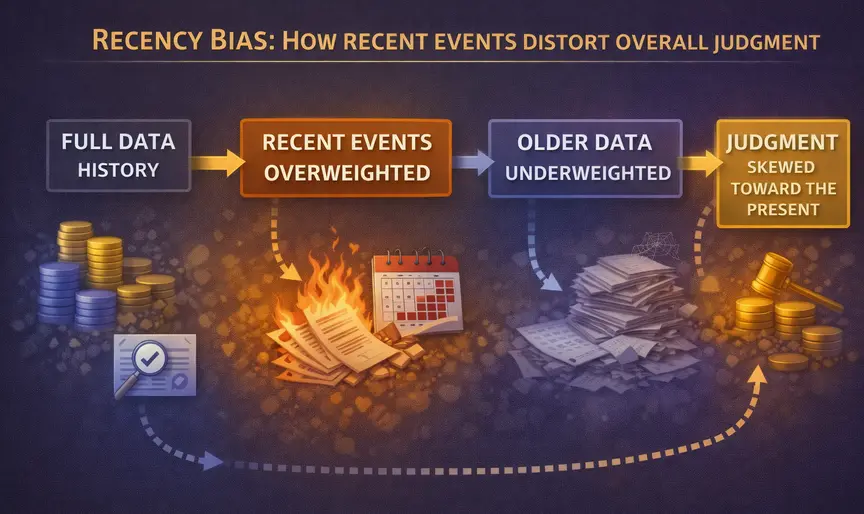
Recency bias in action — recent events burn brightest in memory while older data fades, skewing the final judgment toward the present.
Recency Bias in Real Life — Examples
Recency bias appears wherever people make judgments based on a history of events but rely primarily on what they can most easily remember. Here are some of the clearest real-world examples across different contexts.
After a widely reported crime in a neighbourhood, residents dramatically overestimate local crime rates — even when statistics show crime has been falling for years. The recent vivid event floods out the longer trend. Similarly, after a long stretch of good weather, people are genuinely surprised when a bad storm hits — not because they forgot storms exist, but because the recent run of fine weather has become the reference point for "normal." In everyday conversation, the friend who let you down last month feels less reliable than one who let you down two years ago and has been dependable ever since — even when the full track record tells a different story.
Recency Bias in Investing and Finance
Recency bias is one of the most expensive cognitive errors in financial markets. After a prolonged bull market, investors extrapolate recent gains into the future, taking on more risk than their long-term strategy warrants — precisely when valuations are most stretched. After a crash, they do the opposite: extrapolating recent losses, selling at depressed prices, and sitting out the early stages of the recovery.
A study by Greenwood and Shleifer (2014) found that investor expectations of future stock returns are strongly positively correlated with recent returns — the opposite of what rational long-term valuation models would predict. Investors feel most optimistic precisely when historical patterns suggest caution is warranted, and most pessimistic precisely when long-term data suggests opportunity.
This also explains the persistent pattern of investors buying high and selling low. Buying feels safe after a sustained rise — recent gains are vivid and available. Selling feels rational after a sustained fall — recent losses dominate memory. Both decisions are driven by recent data overriding the longer-term picture. This closely overlaps with anchoring bias: the most recent price becomes the reference point from which all future movement is judged, compounding the distortion.
Recency Bias in the Workplace
The end-of-year performance review is structurally vulnerable to recency bias. Managers evaluating twelve months of work are disproportionately influenced by the last four to six weeks — the period most vividly accessible in memory. An employee who performed strongly through most of the year but had a difficult final month will often receive a lower rating than their full-year performance warrants. The reverse is equally true: a strong final quarter can paper over a weak first three quarters in a way that a systematic review of the full data would not support.
Hiring decisions are affected too. Interviewers who meet multiple candidates in sequence are disproportionately influenced by the most recent candidate when making their final assessment — because that candidate is most vivid at the moment of decision. Within a single interview, the impression the candidate creates in the final minutes often carries more weight than the overall pattern of their responses across the full conversation.
Recency bias also shapes how teams are evaluated after project outcomes. A project that went smoothly for eleven months but hit a visible problem at the end tends to be remembered as a troubled project. One that struggled throughout but finished on a high note tends to be remembered as a success. This connects to the peak-end rule — the psychological finding that experiences are judged primarily by their most intense moment and their ending, not their average.
Recency Bias in Marketing and Consumer Behaviour
Marketers exploit recency bias deliberately. Products positioned as "new," "just launched," or "trending now" benefit from the implicit assumption that recent equals better. A brand that has recently received press coverage feels more relevant than one that has been consistently excellent for years with less recent visibility. Customer satisfaction surveys sent immediately after a positive interaction capture a very different picture than surveys sent a month later — not because the product has changed, but because the most recent interaction dominates recall.
In advertising, the last ad a consumer saw before making a purchase decision receives the most attribution — a phenomenon known as last-click attribution in digital marketing — even when earlier touchpoints did more of the persuasive work. Recency bias means that what a customer most recently experienced carries the narrative of their entire relationship with a brand, which is why customer service at the end of a relationship matters disproportionately to long-term perception.
Recency Bias in Sports
Pundits, bettors, and fans systematically overweight recent form when predicting future performance. A team that has won its last five matches is treated as transformed; a team that has lost its last three is treated as broken. The statistical reality — that recent streaks have limited predictive power beyond what the underlying quality of the team already suggests — is routinely ignored in favour of the narrative that recent results tell us something fundamental. Odds on sports betting markets consistently reflect this: teams in form are underpriced relative to base rate expectations, and teams out of form are overpriced, because the market aggregates the recency-biased judgments of bettors.
Test yourself — can you spot the bias in each scenario? Take the Cognitive Bias Spotter Test ↓.
Recency Bias vs Related Biases
Recency bias is closely related to the availability heuristic but is not identical to it. The availability heuristic is driven by ease of recall generally — vivid, emotionally charged, or heavily covered events are overweighted regardless of when they occurred. Recency bias is specifically driven by temporal proximity — recent events are overweighted because of when they happened, not necessarily because they are more dramatic. A quiet, undramatic recent event will still be overweighted by recency bias even if the availability heuristic would not flag it.
It also interacts with anchoring bias: recent information often functions as the anchor from which all subsequent evaluation proceeds, meaning the two biases can compound each other. The most recent data point sets the reference frame, and anchoring prevents sufficient adjustment away from it — producing a double distortion particularly pronounced in performance reviews and investment decisions.
How to Avoid and Overcome Recency Bias
Extend your time horizon deliberately
When making any judgment that involves historical data — investment performance, an employee's track record, a team's results — explicitly review the full available history before forming an assessment. Set a rule: no evaluation based on less than twelve months of data where twelve months are available. The act of pulling up the full dataset, rather than relying on what comes to mind, counteracts the retrieval advantage that recent events enjoy.
Use base rates and long-run averages
Rather than extrapolating from recent trends, anchor your expectations to long-run base rates. What is the historical average return for this asset class over twenty years? What is the historical win rate for teams with this underlying quality, regardless of recent form? Base rates aggregate across the full history rather than privileging the most recent portion of it.
Record events continuously
In any domain where you will need to make a retrospective judgment — performance reviews, project assessments, clinical evaluations — record significant events as they happen rather than relying on end-of-period recall. Written records give equal weight to events from across the full period; memory does not. This is the simplest and most reliable structural countermeasure available for recency bias in professional settings.
Ask what you would have said six months ago
Before finalising any judgment heavily influenced by recent events, ask yourself: what would my assessment have been six months ago, before the recent data came in? If your current view is substantially more optimistic or pessimistic than it was then, ask whether the underlying fundamentals have actually changed enough to justify that shift — or whether you are simply responding to the most recent data points.
The Deeper Point
Recency bias is, at its core, a feature of a memory system designed to prioritise actionable, current information over historical data. In a world where conditions change rapidly and recent experience is the most reliable guide to the immediate environment, this is often adaptive. The problem arises in domains where the relevant signal is distributed across a long time horizon — financial markets, human performance, risk assessment — and where the most recent data point is a small and often unrepresentative sample of the full picture.
Understanding recency bias does not eliminate it — the retrieval advantage of recent events is built into how memory works. But it changes how you structure your evaluation processes, what data you deliberately pull up before making judgments, and how much weight you give to your intuitive sense that recent trends will simply continue.
Related biases that interact closely with this one: the availability heuristic, which provides the retrieval mechanism that drives recency bias; anchoring bias, which locks judgment to the most recent reference point; and confirmation bias, which ensures that recent events consistent with existing beliefs are remembered more vividly than those that contradict them.
The Cognitive Bias Spotter Test below puts that understanding to work — see if you can catch recency bias and the other nine biases when they appear in realistic scenarios.