Confirmation Bias: Definition, Examples & Psychology
Mind · Cognitive Biases · Information Processing family
Test yourself — can you spot the bias in each scenario? Take the Cognitive Bias Spotter Test. Jump to the test ↓
You have probably noticed that two people can read the same article, watch the same debate, or review the same set of data — and walk away with completely opposite conclusions. Each is certain the evidence supports their existing view. Neither is lying. Neither is deliberately ignoring what they saw. This is confirmation bias in action, and it is one of the most pervasive and consequential cognitive biases ever documented.
Confirmation bias is the tendency to search for, interpret, favor, and recall information in a way that confirms or supports beliefs you already hold. It operates across every domain of human judgment — politics, medicine, investing, science, and personal relationships — and it does so largely without our awareness. The uncomfortable truth is that the smarter and more knowledgeable you are, the better equipped your brain is to construct justifications for what you already believe. This page is part of the cognitive biases guide on Cognitive Train, alongside interactive tests and training tools covering memory, attention, and decision-making.
The Three Mechanisms
Confirmation bias is not a single process. Researchers have identified three distinct mechanisms that reinforce each other and make the bias particularly difficult to overcome.
Selective search for information
When people are given the opportunity to gather information before making a judgment, they systematically seek out evidence that would confirm their current hypothesis rather than evidence that could disprove it. The foundational demonstration of this comes from Peter Wason's 2-4-6 task (1960): participants were given the sequence "2-4-6" and told to discover the rule behind it. Almost everyone hypothesized "even numbers increasing by two" — and then only tested sequences that fit that hypothesis, like 4-6-8 or 10-12-14. Almost nobody tested 1-2-3, which would also fit the actual rule (any ascending sequence). They were not looking for the truth; they were looking for confirmation.
Biased interpretation
Even when people are exposed to identical information, they interpret it differently depending on prior beliefs. A landmark study by Lord, Ross, and Lepper (1979) showed participants — half pro-capital punishment, half against — two studies on the deterrent effect of the death penalty. Both groups rated the study that supported their position as more methodologically rigorous, and both came away from the same mixed evidence more convinced than before. The same data made both sides more extreme, not less. The raw information was identical; what each group saw in it was not.
Selective recall
Memory is not a recording device. It is reconstructive, and it is shaped by the same bias as search and interpretation. In a study by Snyder and Uranowitz (1978), participants read a story about a woman's life, then were told she was either heterosexual or lesbian. When asked to recall details, each group remembered the facts that fit the label they had been given — and misremembered or forgot the ones that didn't. The story had not changed. Their memory of it had.
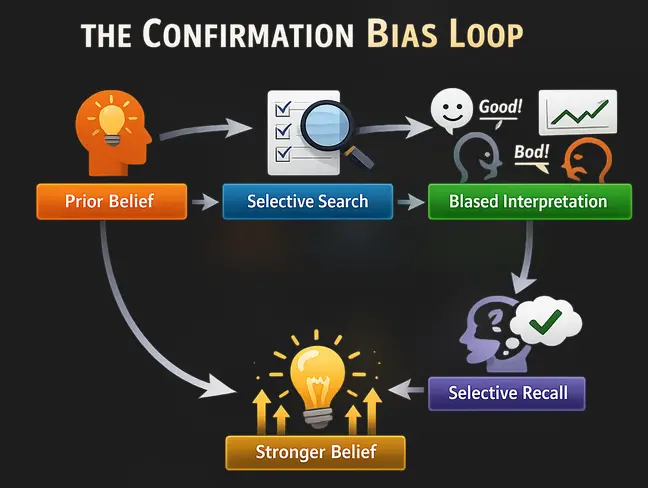
The confirmation bias loop — each stage reinforces the next, and the cycle ends where it began: with a belief that is now stronger than before.
Why the Brain Does This
Confirmation bias is not a design flaw. It emerged because the brain is an efficiency machine, not a truth machine. Processing all available information equally, without any prior framework, would be computationally overwhelming. Using existing beliefs as a filter dramatically reduces that load — and in most everyday situations, your existing beliefs are probably correct enough that the filter does more good than harm.
There is also a social dimension. Maintaining consistent beliefs signals reliability and group loyalty. In a tribal environment, changing your mind too readily — especially under outside pressure — could be read as weakness or betrayal. The bias toward consistency is not just cognitive; it is deeply social.
Finally, there is the role of motivated reasoning: the tendency to reason not toward the most accurate conclusion, but toward the conclusion that is most emotionally satisfying. When a belief is tied to identity — political, religious, professional, or personal — the drive to defend it becomes far more powerful than the drive to evaluate it honestly. Kunda (1990) called this motivated reasoning, and documented how people unconsciously adjust their standards of evidence depending on whether the conclusion they are reaching is one they want to be true.
Where Confirmation Bias Shows Up
In the news and media
Imagine two people watching coverage of the same political speech. One supporter walks away thinking "that was clear, decisive leadership." One critic walks away thinking "that was evasive and contradictory." Neither is inventing their reaction — each is genuinely responding to the parts of the speech their attention was drawn to. Recommendation algorithms accelerate this by surfacing content that provokes engagement — and agreement, outrage, and validation all provoke engagement far more reliably than uncertainty does. This connects directly to how the availability heuristic operates: the events you are most exposed to become the events you believe are most common.
In investing and financial decisions
In 2000, many investors were so convinced by the story of the dot-com boom that they interpreted every piece of bad news — rising losses, collapsing revenue, failed business models — as a temporary blip on the way to inevitable success. Analysts who raised concerns were dismissed as not understanding the "new economy." The data was available to everyone. The interpretation was controlled by belief. This is why confirmation bias is closely linked to the sunk cost fallacy: the more you have invested in a belief, the higher the psychological cost of abandoning it.
In medicine and diagnosis
A patient comes in with fatigue, weight gain, and cold intolerance. The doctor suspects depression and orders no thyroid tests. The patient is treated for depression for six months without improvement — because the actual cause was hypothyroidism, which produces nearly identical symptoms. Clinical confirmation bias like this occurs when a physician forms a preliminary diagnosis early and then interprets all subsequent information through that lens. A review published in BMJ Quality and Safety found that diagnostic error — much of it driven by premature closure around an initial hypothesis — accounts for roughly 40,000 to 80,000 deaths annually in the United States alone.
In personal relationships
You have a new colleague and within the first week you decide they are not very competent — based on one fumbled presentation. For the next six months, every mistake confirms what you already think, and every success is explained away as luck or someone else's contribution. Meanwhile, a colleague who formed a positive first impression of the same person has been collecting the opposite set of evidence from the same observable reality. First impressions are sticky partly because of the halo effect and partly because confirmation bias actively prevents the disconfirming evidence from accumulating that would revise them.
In criminal justice
Once investigators settle on a suspect, confirmation bias can shape every subsequent step — what evidence gets collected, which witness accounts are weighted, how ambiguous forensic results are interpreted. The Innocence Project, which has exonerated over 375 wrongfully convicted people through DNA evidence, has identified tunnel vision — investigators and prosecutors focusing only on evidence that confirmed guilt — as one of the most consistent contributing factors across cases. The bias does not require malice. It only requires the normal human tendency to see what you expect to see.
Test yourself — can you spot the bias in each scenario? Take the Cognitive Bias Spotter Test ↓.
Why Awareness Is Not Enough
Here is the finding that most people find genuinely unsettling: knowing about confirmation bias does not make you significantly less susceptible to it. Scopelliti et al. (2015) found that bias awareness improved the ability to recognize bias in others, but had little measurable effect on one's own decision-making. You become better at spotting it in other people. You do not become meaningfully better at catching it in yourself.
The reason is that the bias operates below deliberate reasoning. It shapes which information you notice, how you categorize it initially, and what your gut reaction is — all before the slower, more analytical part of your brain has a chance to intervene. By the time you are consciously reasoning about a piece of evidence, the bias has often already done its work. Awareness tells you the problem exists. It does not change the underlying machinery.
This is not to say awareness is useless — it is the necessary first step. But it must be paired with structural habits and active practice to have a meaningful effect on actual decisions. This is precisely why the Cognitive Bias Spotter Test uses real-world scenarios with immediate feedback — recognizing the bias in concrete situations, not just in the abstract, is what begins to build genuine resistance.
How to Counter It
Actively seek disconfirming evidence
Before concluding that evidence supports your view, ask: what would evidence against this view look like, and have I actually looked for it? If you believe a new hire is underperforming, actively seek examples of their successes before forming a final judgment. If you believe a stock is undervalued, spend as much time reading the bear case as the bull case. The impulse to confirm is automatic; the search for disconfirmation has to be deliberate.
Consider the opposite
A well-documented technique involves generating the strongest possible case for the position you are inclined to reject. This is not about abandoning your view — it is about stress-testing it. If you are about to dismiss a colleague's proposal, spend five minutes writing down the three strongest reasons it might succeed. If those reasons turn out to be substantial, your dismissal should probably be revised.
Pre-mortem analysis
Before committing to a decision, imagine you are looking back from twelve months in the future and it turned out to be completely wrong. What went wrong? What evidence did you miss? What warning signs did you explain away? This exercise — developed by psychologist Gary Klein — bypasses the defensive reasoning that makes post-hoc evaluation so difficult, because it depersonalizes the error before it happens.
Slow down on confirming evidence
The brain applies more critical scrutiny to evidence that challenges existing beliefs than to evidence that supports them. You carefully read studies that contradict your position; you skim studies that confirm it. The practical counterweight is to apply the same skeptical questions to confirming evidence: Who funded this? What is the sample size? What alternative explanations exist? The standard should not change based on whether you like the conclusion.
Seek out genuine disagreement
Not performative disagreement from sources that ultimately share your conclusions, but genuine engagement with the most rigorous version of opposing arguments. If you hold a strong view on any contested topic — nutritional science, economic policy, a business strategy — find the most credentialed, most carefully reasoned critic of that view and engage with their actual argument, not a paraphrase of it.
The Deeper Point
Confirmation bias is not just a cognitive curiosity. It is the mechanism by which people maintain confidence in their beliefs in the face of mixed or contradictory evidence — and therefore one of the primary reasons that beliefs resist revision even when the evidence against them is substantial. It explains why intelligent, informed people can look at the same world and arrive at entirely different conclusions, each convinced the other is ignoring obvious facts.
The goal is not to become a belief-free reasoning machine. It is to hold your beliefs a little more loosely, examine evidence a little more honestly, and recognize when the satisfying click of confirmation might be doing more work than the evidence itself warrants.
Related biases worth understanding alongside this one: the availability heuristic, which controls which evidence your brain makes most accessible; anchoring bias, which shapes how your first piece of information frames everything that follows; and Dunning-Kruger, which explains why those most susceptible to motivated reasoning are often most confident in their conclusions.
The Cognitive Bias Spotter Test below puts that to the test — see if you can catch confirmation bias and the other nine biases when they appear in realistic scenarios.