Checker Shadow Illusion Explained: Why Two Identical Squares Look Completely Different
Color & Brightness Illusion · Lightness Constancy · Created 1995
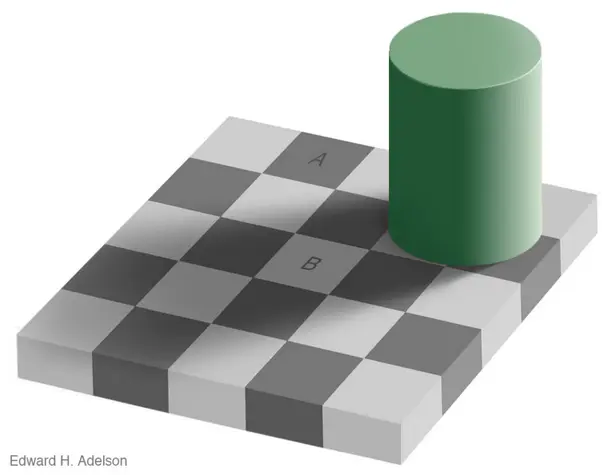
Adelson's checker shadow illusion (1995). Square A appears dark gray and square B appears light gray — but they are exactly the same shade. Your brain compensates for the shadow so aggressively that it overrides what your eyes actually receive. Image: Edward H. Adelson, MIT.
Look at squares A and B on the checkerboard above. One is clearly darker than the other. You would bet money on it. But they are identical — the same shade of gray, the same pixel values, the same amount of light reaching your retina. You can hold a finger over the boundary, isolate both squares, and confirm this for yourself. Then remove your finger, and the illusion snaps right back. Knowing the truth changes nothing. The checker shadow illusion, created by Edward H. Adelson at MIT in 1995, is arguably the most convincing demonstration that your visual system does not show you what is actually there — it shows you what it thinks should be there, based on a lifetime of assumptions about how light and shadow behave. This page is part of the Optical Illusions resources available through brain training at Cognitive Train and the Mind Training Hub.
The reason the illusion works — and the reason it keeps working even after you've proven the squares are identical — is that it exploits one of the most important features of human vision: the ability to perceive surfaces as having stable properties regardless of lighting changes. This process, called lightness constancy, is what allows you to see a white shirt as white whether it's in direct sunlight or deep shade. It is essential for recognizing objects in a constantly changing visual environment. The checker shadow illusion is what happens when this otherwise useful system gets the calculation wrong.
What Is the Checker Shadow Illusion?
The checker shadow illusion consists of a checkerboard pattern with alternating light and dark squares, partially covered by a shadow cast by a cylinder. Two specific squares are labeled: square A sits on what appears to be a dark square in direct light, and square B sits on what appears to be a light square within the shadow. The two squares are physically identical in luminance — they reflect the same amount of light. But square A looks dramatically darker than square B.
Adelson created this image not as a puzzle or trick, but as a research tool to demonstrate the mechanisms of lightness constancy in visual processing. He published it through MIT's Perceptual Science Group in 1995, and it quickly became one of the most widely cited optical illusions in cognitive science — appearing in textbooks, research papers, and public science demonstrations worldwide.
Why Does the Checker Shadow Illusion Work? The Neuroscience
The illusion exploits at least three mechanisms that your visual system uses simultaneously when processing a scene:
Lightness constancy and shadow discounting. This is the primary mechanism. Your brain does not simply record the amount of light arriving at each point on the retina. Instead, it tries to figure out what each surface would look like under neutral lighting — a computation called estimating surface reflectance. When the brain detects a shadow (using cues like soft edges, consistent darkening, and plausible geometry), it automatically "discounts" the shadow's effect, mentally brightening everything inside it. Square B is inside the shadow, so the brain compensates by scaling its perceived lightness upward. The result: a gray square that should look gray gets perceived as much lighter than it actually is.
Simultaneous contrast. Each square is surrounded by neighbors of different luminance. Square A, which sits in the light, is surrounded by lighter squares — making it look darker by comparison. Square B, inside the shadow, is surrounded by darker squares — making it look lighter. This local contrast effect amplifies the difference that lightness constancy has already introduced.
Scene interpretation and 3D structure. The checkerboard pattern, the cylinder, and the soft-edged shadow all combine to create a coherent 3D scene interpretation. Your brain reads this as a real object casting a real shadow on a real surface. That scene interpretation is what activates the full lightness constancy machinery. Remove the 3D cues — flatten the shadow edge, eliminate the cylinder — and the illusion weakens dramatically. Adelson himself noted this: the illusion depends on the visual system treating the image as a scene, not as a flat pattern.
Research on the neural basis of lightness constancy has shown that this processing happens remarkably early. MacEvoy and Paradiso (2001), publishing in the Proceedings of the National Academy of Sciences, found that neurons in the primary visual cortex (V1) already show responses consistent with lightness constancy — their firing rates track perceived lightness rather than raw luminance. This suggests the compensation is not a late cognitive judgment but is built into early visual architecture, which is exactly why you cannot override it by knowing the answer.
Real-World Examples of Shadow Compensation
Object recognition across lighting conditions. You recognize a friend's face whether they're standing in sunlight or sitting in a dimly lit restaurant. You see a red car as red whether it's parked in shade or under a streetlight. This is lightness and color constancy at work — the same system the checker shadow illusion exploits. Without it, every change in lighting would make familiar objects look unfamiliar.
The Dress (2015). The viral photograph that divided the internet — some people saw a blue and black dress, others saw white and gold — was driven by the same underlying mechanism. Different viewers' brains made different assumptions about the illumination in the scene, leading to dramatically different color interpretations of the same pixels. It was the checker shadow illusion applied to an ambiguous real-world photograph.
Photography and digital design. Photographers and designers regularly encounter situations where colors or brightness levels that are physically identical on screen look different because of surrounding context. Understanding shadow compensation is essential for anyone working with visual media — what looks "correct" to the brain and what is physically accurate are often different things.
Plate size and food perception. The Delboeuf illusion — where the same portion looks larger on a small plate and smaller on a large plate — relies on a related contextual mechanism. Both illusions demonstrate that the brain evaluates visual properties relative to context, never in isolation.
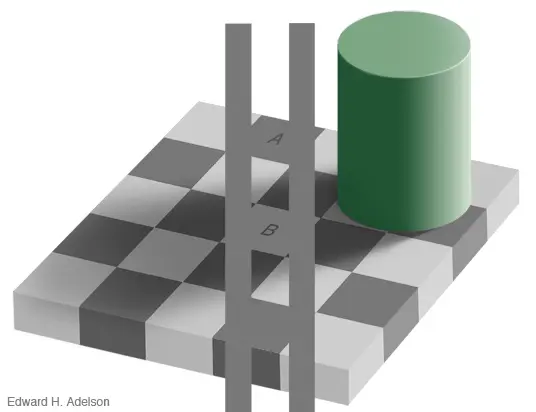
The proof: connecting squares A and B with uniform gray strips reveals they are identical. Yet the moment you see the full image again, the illusion returns instantly — your conscious knowledge cannot override the automatic processing. Image: Edward H. Adelson, MIT.
Checker Shadow Illusion vs Similar Illusions
Checker shadow illusion vs Hermann Grid — the Hermann Grid, where ghostly gray dots appear at white intersections, is also a brightness illusion, but it operates through a different mechanism: lateral inhibition between neighboring neurons in the retina. The checker shadow illusion is far more complex, involving scene interpretation, shadow detection, and lightness constancy — higher-level processes that the Hermann Grid does not require.
Checker shadow illusion vs Ponzo illusion — the Ponzo illusion distorts perceived size using depth cues, while the checker shadow illusion distorts perceived brightness using shadow cues. But both share a common principle: the brain uses contextual information to "correct" what it sees, and those corrections can be wrong. The Ponzo illusion exploits size constancy; the checker shadow illusion exploits lightness constancy. Together they show that constancy mechanisms — systems that normally keep perception stable — are the very systems that produce the most powerful illusions.
Checker shadow illusion vs Ebbinghaus illusion — both illusions involve context changing the perception of identical stimuli, but in different domains. The Ebbinghaus illusion uses surrounding object sizes to distort perceived size; the checker shadow illusion uses surrounding luminance and shadow context to distort perceived brightness. Both demonstrate the same fundamental principle: the brain never evaluates any visual property in isolation.
Can You Overcome the Checker Shadow Illusion?
No — and this is one of its most striking features. Unlike some ambiguous figures (like the Necker cube) where you can train yourself to flip between interpretations, the checker shadow illusion is completely resistant to cognitive override. You can measure the squares, confirm they are identical, understand the neuroscience, and look again — the illusion is exactly as strong as it was before you knew anything.
This resistance to correction tells researchers something important about where the processing occurs. If the illusion were a judgment error — a mistake in reasoning about what you see — then knowing the truth should weaken it. The fact that it doesn't indicates the processing happens at a level that conscious thought cannot access. The research by MacEvoy and Paradiso supports this: lightness constancy appears to be computed in V1, before conscious visual awareness has formed. By the time you "see" the squares, the compensation has already happened.
Adelson himself put it clearly: the visual system is not designed to recover the true intensity of light at each point in the image. It is designed to break the image apart into layers — the surface properties (what color is this thing?) and the illumination (what light is falling on it?) — and then report the surface properties while discarding the illumination. The checker shadow illusion succeeds because the visual system does exactly what it is supposed to do — it just happens that, in this case, doing it correctly produces the wrong answer.
Explore more illusions: Ponzo Illusion · Müller-Lyer Illusion · Ebbinghaus Illusion · All Optical Illusions