Delboeuf Illusion
The portions are exactly identical, but the smaller plate can make its serving look more substantial.
Look at the two plates below. Which one appears to contain more spaghetti?
The serving on the smaller plate may look larger, fuller, or more generous because it reaches almost to the plate’s edge. The serving on the much larger plate can look less substantial because it is surrounded by a broad area of empty plate.
But the portions are not merely similar. The same exact image of the spaghetti and sauce was duplicated at the same pixel size and placed on both plates. Only the plate size and surrounding space differ.
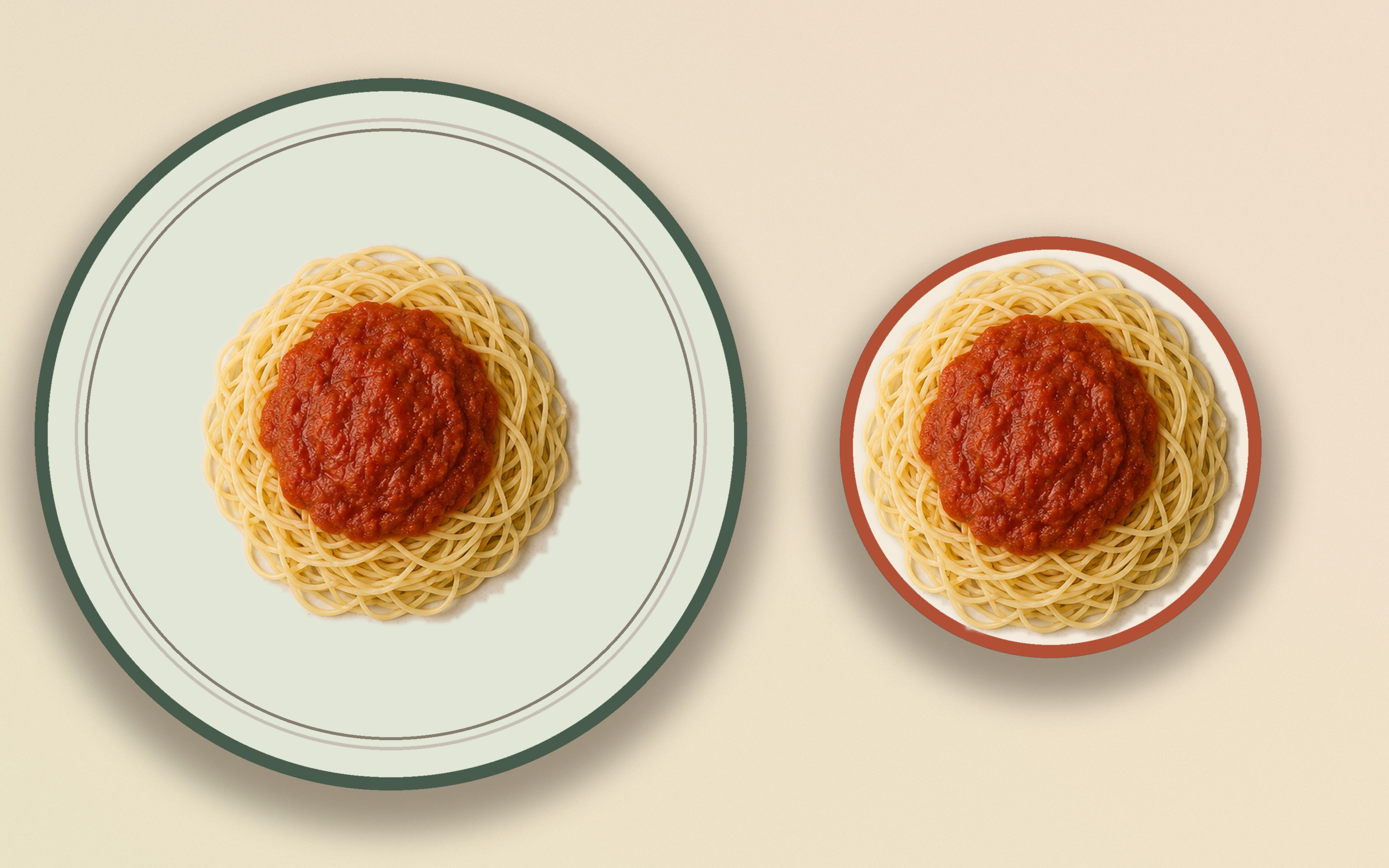
This is a real-world version of the Delboeuf illusion. The amount of food acts as the central target, while the plate edge acts as the surrounding contour.
Your visual system does not evaluate the serving independently. It also considers how much of the plate the food occupies, how close the rim is, and how much empty space remains around the portion.
Why the Smaller Plate Can Make the Portion Look Larger
On the smaller plate, the spaghetti sits very close to the surrounding rim. The serving fills most of the visible plate, so it appears relatively substantial.
On the much larger plate, the identical portion occupies a far smaller percentage of the available surface. The wide empty border makes the serving seem more modest by comparison.
The plate therefore becomes an unintended measuring frame. Instead of judging the portion only by its physical dimensions, the brain judges it partly by its relationship to the surrounding boundary.
This is the same basic principle demonstrated by traditional Delboeuf figures, which place identical circles inside rings of different sizes. The target does not change, but the context around it does.
Spacing Is Central to the Illusion
The effect depends strongly on the distance between the target and its surrounding boundary.
When a ring or plate rim sits close to the target, the two can be grouped perceptually. The target may appear larger because its perceived size shifts toward the nearby surrounding contour. This is often described as assimilation.
When the surrounding boundary is much farther away, the large empty space emphasizes how small the target is relative to its container. This produces a stronger size contrast.
In a psychophysical study of the Delboeuf illusion, apparent-size errors changed systematically as researchers altered the relationship between the central target and its surrounding ring.
The illusion is therefore not caused by the general presence of a plate or circle. Its strength changes with target size, surrounding diameter, gap width, contrast, and viewing scale.
How Context Helps Vision
Using surrounding objects as reference points is normally helpful.
A container tells you how much space an object occupies. A doorway helps you estimate whether something will fit through it. Nearby edges provide information about scale, distance, and boundaries.
The visual system uses these relationships because objects rarely appear alone. Most things are seen inside environments filled with frames, surfaces, containers, and neighboring shapes.
The Delboeuf illusion exposes the downside of that strategy. The plate offers a scale reference, but the reference is misleading when two identical portions are placed on surfaces of very different sizes.
Research comparing Delboeuf and Ebbinghaus displays has linked illusion strength to the separation between targets and surrounding contours after considering how visual space is represented in the cortex.
Test Your Visual Scanning Speed
The Delboeuf illusion shows how surrounding context can interfere with a basic visual judgment. Cognitive Train’s Symbol Search Test asks you to scan a target group and decide quickly whether any matching symbol appears among a larger set of distractors:
Why Plates Are a Useful Demonstration
Food portions make the illusion easier to connect with everyday life.
A portion on a small plate can look plentiful because it approaches the plate’s edge. The same portion on a much larger plate may look sparse because most of the surface remains visible.
Research on plate design and portion perception found that plate rim width and rim coloring affected estimates of how much food was present.
This supports the idea that diners do not judge food quantity from the portion alone. The surrounding plate can become part of the visual comparison.
However, visual estimation and actual eating behavior are not identical. Plate size may influence how a serving looks, but appetite, habits, food type, expectations, and many other factors also affect consumption.
Where the Delboeuf Illusion Came From
The illusion is named after Belgian psychologist and philosopher Joseph Rémi Léopold Delboeuf.
Delboeuf described related geometric illusions in 1865 while studying how people judge distance, magnitude, and spatial relationships.
His best-known demonstration uses a central circle surrounded by another circle. Changing the size or spacing of the outer ring changes how large the inner target appears.
A historical overview and reference to Delboeuf’s original work are available through Michael Bach’s visual-illusion archive.
How It Differs From the Ebbinghaus Illusion
The Delboeuf and Ebbinghaus illusions both make identical targets look unequal by changing their surroundings.
In the Ebbinghaus illusion, the target is surrounded by several separate circles. Large surrounding circles usually make the target look smaller, while small surrounding circles make it look larger.
The Delboeuf illusion uses one continuous enclosing boundary. In the plate version, that boundary is the rim of the dish.
Because the target and surround are concentric or nearly concentric, the amount of empty space between them becomes especially important.
Can Color Change the Effect?
The basic Delboeuf illusion does not require color. It can be produced with simple black circles and outlines.
However, plate color, contrast, decoration, and rim visibility may change how clearly the boundary is perceived and how strongly it groups with the portion.
In research using Delboeuf-like displays, investigators examined apparent size alongside changes in perceived lightness. The results indicated that size and lightness judgments can interact under some conditions.
For that reason, the strongest test of the plate illusion would use identical portions, similar lighting, and plates that differ mainly in diameter.
How to Check the Portions Directly
Cover the plate rims so that only the food remains visible. The difference should weaken because the misleading surrounding frames are gone.
You could also crop the food portions from the image and place them side by side against the same background.
In this demonstration, that comparison is especially direct because both servings come from the same duplicated image asset. Their noodles, sauce, shape, and dimensions match exactly.
The same conflict between appearance and measurement occurs in the Jastrow Illusion, where two identical curved pieces continue to look unequal because of how their edges are positioned.
What the Delboeuf Illusion Reveals
The Delboeuf illusion shows that perceived quantity is relational.
Your brain does not see only the food. It also sees the plate, the rim, the empty space, and the proportion of the surface that the portion occupies.
That contextual comparison can make one of two identical servings appear larger, fuller, or more satisfying before a single bite has been taken.
For more examples of changing size, misleading context, distorted lines, and impossible geometry, browse the full Optical Illusions guide. Cognitive Train’s brain tests explore perception, attention, processing speed, and reasoning, while its free brain training tools offer more ways to challenge visual judgment.