Widened Eyes Body Language: Meaning, Psychology & What It Really Signals
Eye Signals · Threat Detection · Fear / Surprise family
Think you can read body language? We've included a Body Language Test at the bottom — see how well you read the full range of nonverbal cues. Jump to the test ↓
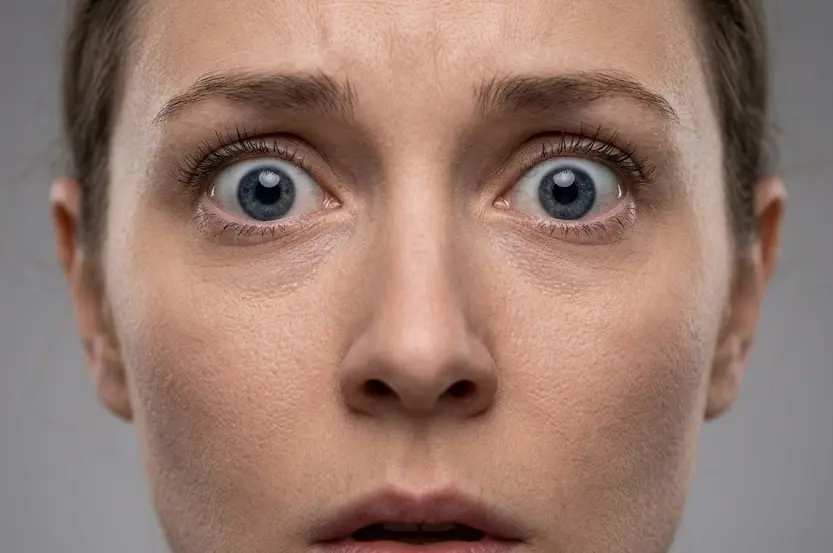
Widened eyes — upper eyelids raised, whites visible above and below the iris, mouth slightly open. The visual system opening to maximum before the conscious mind has finished assessing the threat.
Eye widening is one of the most immediately readable signals the human face produces. When the upper eyelid rises and the whites of the eye become visible above or below the iris, the face is broadcasting a specific message to everyone within viewing range: something unexpected, alarming, or significant has entered the environment. The signal is fast, largely involuntary, and cross-culturally consistent — which is why it registers so immediately and unmistakably in social interaction. Understanding what it actually means, and what distinguishes its different forms, is what separates accurate body language reading from guesswork. This page is part of the body language resources available through Cognitive Train and the Mind Training Hub.
What widened eyes signal is not simply emotion — it is a shift in the visual system's operating mode. The eyes widen to take in more light, expand peripheral vision, and speed up threat-relevant processing. The expression serves both the person producing it and the people observing it simultaneously. That dual function — sensory and social — is what makes eye widening one of the most evolutionarily significant signals the face produces, and one of the most important to read correctly.
What Do Widened Eyes Mean? The Psychology Behind It
Eye widening is driven by the levator palpebrae — the muscle that raises the upper eyelid — activating under autonomic and emotional arousal. As the eyelid rises, more of the sclera (the white of the eye) becomes visible, the visual field expands, and the eye's ability to detect movement and stimuli in the periphery increases. This is not merely cosmetic: the widening of the eyes is a functional change in the visual system that genuinely improves threat detection by expanding the range of what the person can see. Research by Lee, Susskind, and Anderson (2013) demonstrated that fear-based eye widening enhanced target discrimination in the expresser's available visual periphery by 9.4% — a meaningful improvement in the ability to detect threats at the edges of vision, where they are most likely to first appear.
The social function is equally significant. The same study showed that the increased sclera exposure produced by eye widening enhanced observers' ability to discriminate the expresser's gaze direction — making it easier to rapidly identify where the perceived threat is located. The widened eyes serve as a high-contrast gaze signal that directs the attention of everyone nearby toward the same source of danger. The fear expression does not merely communicate internal emotional state; it actively recruits the threat-detection resources of all observers within visual range. The two functions — expanding the individual's own visual field and directing others' attention to the threat — operate simultaneously and were likely co-selected over evolutionary time because both conferred survival advantages within social groups.
At the neural level, the amygdala is specifically responsive to widened eyes and sclera exposure. As reviewed in research examining the neural basis of fear perception, the amygdala is particularly responsive to the amount of white sclera visible in another person's eyes — the physical feature that most distinguishes the fear expression from other emotional displays. This responsiveness is rapid and operates below conscious awareness: the brain registers and responds to widened eyes before deliberate recognition of the expression has occurred. Eye widening triggers threat-assessment processing in observers automatically, which is why it is so immediately compelling even when the specific cause of the alarm is not yet known.
What Do Widened Eyes Mean in Different Contexts?
Fear and threat detection — the primary and most recognizable context for eye widening is fear. When the threat-detection system activates, the eyes widen as part of a coordinated response that also includes the brow drawing together and downward (in active threat), the nostrils flaring, and the mouth opening slightly. The full fear expression combines wide eyes with a drawn brow, horizontal mouth, and taut skin — creating a face that broadcasts both alarm and vigilance simultaneously. The widened eyes are the dominant element because they are visible from the greatest distance and trigger the fastest response in observers. A person whose eyes widen during a conversation while every other feature remains controlled has experienced an involuntary alarm response that they are attempting to manage — the eyes often break before the rest of the face does.
Surprise — surprise also produces eye widening, and the two expressions are frequently confused. The key distinction is in the brow: in surprise, the brows rise high and rounded without drawing together, the forehead shows horizontal creases, and the mouth opens in a slack rather than taut configuration. In fear, the brows rise but also pull inward and together, producing a distinctive angular shape with vertical lines between them. Both expressions widen the eyes for the same functional reason — something unexpected has entered awareness and the visual system is maximizing its information intake — but surprise does not carry the threat valence of fear and resolves more quickly once the unexpected stimulus is identified as non-threatening. The two expressions can appear almost identical in a still image; the surrounding context, the speed of onset, and what follows are usually what distinguish them.
Shock and disbelief — a slower, more sustained form of eye widening appears in response to information rather than physical threat: an unexpected revelation, a piece of news that contradicts expectations, or a social situation that violates anticipated norms. This eye widening is less explosive than the fear or startle-linked version and tends to appear alongside a more frozen, still quality in the rest of the face — the person has registered something significant that has not yet been processed. The eyes open wide and remain wide while the cognitive system works to integrate the new information. This is the eye widening of disbelief: the visual system's attempt to take in more information about something that does not yet make sense.
Awe and intense interest — at lower intensities, eye widening signals heightened engagement and information-seeking rather than alarm. The eye-widening cluster in emotional expression research is associated with mental states related to information sensitivity — including awe, anticipation, and strong interest — precisely because the underlying function (expanding the visual field to take in more) applies equally to positive and negative arousal. A person whose eyes widen while listening to an idea, viewing something extraordinary, or encountering something deeply impressive is showing the same visual-system response as someone alarmed — but the surrounding signals will distinguish the valence clearly. Wide eyes with relaxed brows, open expression, and a slight forward lean signal positive engagement; wide eyes with tensed brows, tightened jaw, and raised shoulders signal threat.
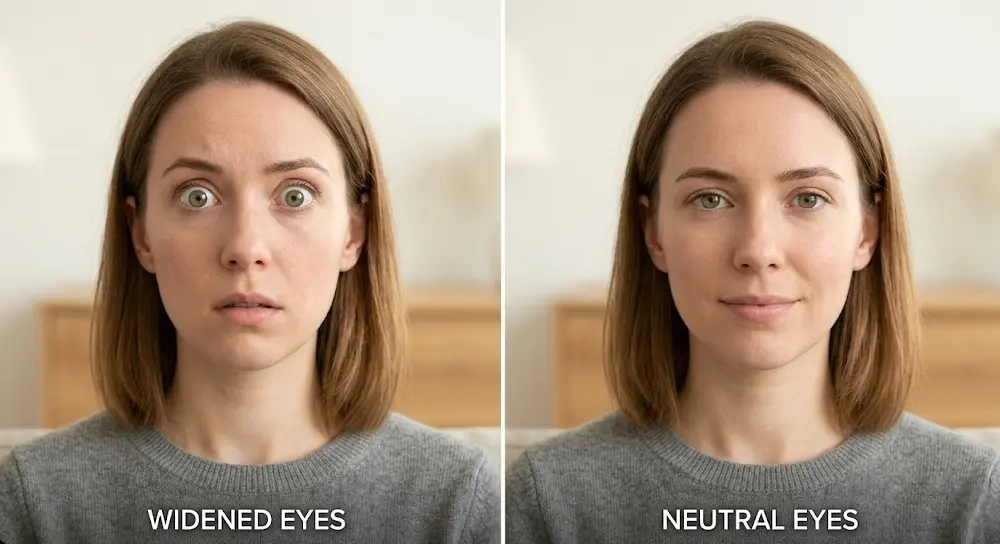
Left: widened eyes — brows raised, whites fully visible, mouth slightly open, expression alarmed. Right: neutral eyes — eyelids relaxed, calm composed expression. The same face, different states of the threat-detection system.
Widened eyes broadcast alarm before the mouth has formed a word. The Body Language Test below ↓ trains you to read eye signals alongside the full range of facial expressions and postures.
Widened Eyes vs Similar Signals
Widened eyes vs brow furrow — the brow furrow and widened eyes frequently appear together, but they carry different information and can appear independently. The brow furrow signals active cognitive processing — concentration, confusion, or directed threat assessment. Widened eyes signal the initial alarm response — the visual system opening before the threat has been fully processed. When both appear together, the face is showing both the alarm (eyes) and the processing of what caused it (brow). When eyes widen without a brow furrow, the response is more likely surprise or awe than active threat. When the brow furrows without eye widening, the person is thinking hard or feeling suspicious, but has not been startled or alarmed. The combination of both produces the classic fear display that is most recognizable across cultures.
Widened eyes vs startle reflex — the startle reflex is faster than eye widening and involves the opposite eye movement: during the startle, the eyes close as part of the protective blink. Eye widening follows the startle once the eyes reopen and the visual system shifts to threat-scanning mode. The sequence in a genuine startle-to-fear transition is: explosive eye closure (startle blink) → rapid eye reopening to maximum width (threat scan) → sustained widened eyes (monitoring). What observers typically see and identify as the fear expression is the post-startle phase — the eyes already reopened and scanning — rather than the blink itself, which is too fast to register consciously in most contexts.
Widened eyes vs pupil dilation — both widened eyes and pupil dilation are involuntary responses to emotional arousal, and both involve the visual system opening to take in more information. But they operate at different scales and are driven by different mechanisms. Eye widening is a muscular response — the levator palpebrae raising the eyelid — that is visible from across a room. Pupil dilation is a smaller, autonomic response — the iris muscles expanding the pupil — that requires much closer observation to detect. Both track arousal, but pupil dilation is a more continuous and fine-grained signal that operates across the full range of emotional engagement; eye widening is a more threshold-dependent signal that tends to appear only when arousal crosses into the alarm or strong interest range. When both are present simultaneously, the full visual system is in high-arousal mode.
Widened eyes vs jaw drop — eye widening and jaw drop frequently co-occur as components of the same surprise or shock expression, but they can also appear independently. The jaw drop specifically signals that the person has been caught off guard by something — the mouth falling open is a component of the information-gathering posture that includes eye widening, nostril flaring, and a halt in ongoing behavior. Eye widening can appear without jaw drop when the alarm is more controlled or when the person is actively managing their expression while unable to suppress the eye response. Jaw drop without eye widening is rare in genuine surprise and tends to indicate a performed or exaggerated expression rather than an involuntary one.
How to Spot Widened Eyes Accurately
The most important calibration point for reading widened eyes is the individual's baseline eye aperture. People vary significantly in their natural resting eye opening — some individuals naturally show more sclera than others due to anatomy rather than emotional state. What matters diagnostically is not the absolute amount of white visible but whether the eyes have widened relative to the person's own resting baseline in the same context. An eye that has expanded noticeably from its resting position in response to a specific stimulus is informative. An eye that simply shows a relatively open aperture as the person's natural anatomy is not.
Speed of onset is a critical differentiator. Genuine involuntary eye widening in response to threat or surprise is rapid — the eyelid rises faster than deliberate expression production. Performed or exaggerated eye widening for social effect (feigned surprise, theatrical alarm) tends to have a slower, more controlled onset and a more symmetrical, held quality. Genuine eye widening also tends to be brief at its peak, with the eye either sustaining at width if the threat persists or beginning to narrow as assessment proceeds. An eye expression that arrives at its widest point slowly and holds there for an unusually long time is likely more deliberate than reflexive.
Cluster reading provides the full picture. Widened eyes alongside a startle response, raised shoulders, and self-touch in the aftermath indicate a genuine threat response that has moved through its full arc. Widened eyes alongside a relaxed brow, open mouth, and forward lean indicate positive surprise or awe. Widened eyes alongside a frozen, still quality in the rest of the face indicate the shock of unexpected information — cognitive processing has halted temporarily while the new information is integrated. The test below develops exactly this skill: reading not any single signal but the full cluster of what the face and body are expressing simultaneously.
How Much Body Language Can You Read?
Widened eyes are among the fastest and most honest signals the face produces — but reading them accurately means distinguishing fear from surprise, genuine alarm from performed expression, and knowing what the brow, mouth, and body are doing alongside them. The test below covers the complete range of expressions, gestures, and postures with detailed explanations after every answer.