Startle Reflex Body Language: Meaning, Psychology & What It Really Signals
Reflexive Responses · Threat Detection · Fear / Surprise family
Think you can read body language? We've included a Body Language Test at the bottom — see how well you read the full range of nonverbal cues. Jump to the test ↓
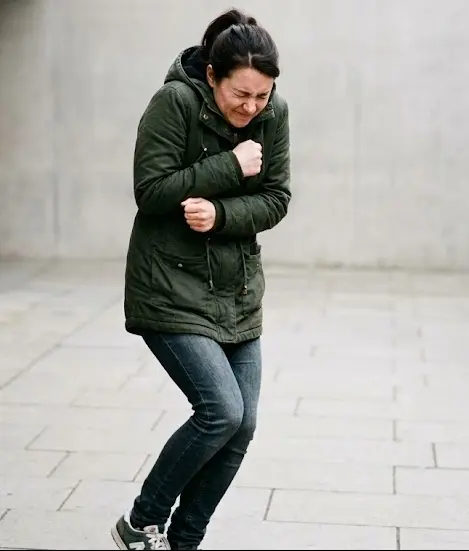
Startle reflex — shoulders raised, head ducked, body contracting. The brainstem responding to threat before the conscious mind has registered what happened.
The startle reflex is the fastest involuntary response the human body produces. Before conscious awareness of a threat has formed, before the mind has identified what the stimulus was or decided how to respond, the brainstem has already fired a cascade of protective muscle contractions moving from the face downward through the entire body. The eyeblink fires within 20 to 40 milliseconds of a sudden stimulus. The head moves within 60 to 120 milliseconds. The shoulders jerk within 100 to 121 milliseconds. The whole sequence is complete before a person is aware it has happened. No amount of preparation, training, or willpower can fully suppress it — the startle reflex bypasses every layer of conscious control. This is what makes it uniquely informative as a nonverbal signal: it is the body's unfiltered response to perceived threat, produced entirely below the level of deliberate communication. This page is part of the body language resources available through Cognitive Train and the Mind Training Hub.
What the startle reflex reveals is not simply that a person was surprised. The magnitude, the direction, and the emotional context of the startle all carry information. A person in a fear state startles more intensely than a person in a neutral or positive state — the same stimulus produces a larger response when the nervous system is already primed for threat. The startle also reveals what the person perceives as threatening: which direction they orient toward, which stimuli trigger a strong response, and how quickly the body returns to baseline after the reflex fires. Reading the startle accurately means understanding it not as a simple on/off reaction but as a continuous signal about the state of a person's threat-detection system.
What Does the Startle Reflex Mean? The Psychology Behind It
The startle reflex is a brainstem-level defensive response — one of the oldest and most conserved reflexes in mammalian biology. Its function is protective: in the milliseconds before the conscious mind has assessed a sudden stimulus, the body has already begun contracting around its most vulnerable structures. The eyes close to protect the visual system. The head drops and pulls forward to protect the back of the neck. The shoulders rise to protect the throat and sides of the neck. The trunk flexes forward. The arms move inward. The knees bend slightly. Each component of the sequence has a specific protective function, and the entire cascade is controlled not by the cortex but by the brainstem's reticular formation — a region that predates emotional processing by evolutionary timescales.
As documented in peer-reviewed research on startle reflex modulation by Lang, Bradley, and Cuthbert, the eyeblink fires within 30–80 milliseconds of stimulus onset — the first and most stable element in the sequence — followed by a descending flexor wave that moves through the head, neck, shoulders, arms, and down through the trunk to the knees. This cascade is not coordinated by conscious intention — it is a fixed-action pattern hardwired into the nervous system and present from birth.
The psychological significance of the startle extends well beyond the reflex itself. Research by Lang, Bradley, and Cuthbert (1990) established that the startle response is directly modulated by emotional state: the same objective stimulus produces a significantly larger startle when a person is in a fearful or aversive emotional context, and a smaller startle when they are in a pleasant or approach-oriented state. The nervous system amplifies the reflex when it is already primed for threat, and dampens it when the current emotional context signals safety. This means that how intensely a person startles is not only a function of the stimulus — it is a readout of their current emotional and threat-assessment state.
What Does the Startle Reflex Mean in Different Contexts?
The standard protective startle — in everyday contexts, the startle reflex fires in response to any sudden, unexpected stimulus that the nervous system has not had time to anticipate: a loud noise, an unexpected movement at the edge of vision, a sudden physical contact. The full display — eyes closing, head dropping, shoulders rising, body contracting briefly — appears and then dissipates within seconds as the cortex identifies the stimulus as non-threatening and the nervous system returns to baseline. In this context the startle is purely functional: protection first, assessment second. The direction the head orients toward immediately after the reflex — the orienting response that follows — indicates where the nervous system has localized the source of the threat.
Heightened startle in anxious or fearful states — when a person is already in a state of elevated anxiety, threat anticipation, or fear, the threshold for triggering the startle is lowered and the magnitude of the response to any given stimulus is increased. A person who is afraid will startle more dramatically at stimuli that would produce only a minor response under neutral conditions. This amplification is not under conscious control — it reflects the state of the threat-detection system directly. In practical reading of body language, a person who startles intensely or repeatedly at minor stimuli, or who takes longer than expected to settle after a startle, is displaying physical evidence of an elevated threat state that may not be visible in any other channel.
Directed startle — what the body orients toward — immediately following the protective contraction of the startle, the body typically produces an orienting response: the head turns, the eyes redirect, the body angles toward the source of the stimulus. This post-startle orientation is informative in its own right. A person who startles and orients consistently toward a specific individual, object, or area of the room is indicating — without deliberate communication — where their nervous system is concentrating its threat monitoring. The startle identifies that a threat-detection event occurred; the orienting response identifies where the perceived threat is located.
Suppressed or reduced startle — some individuals show a reduced startle response or appear to suppress the visible components of the reflex. Habituation — repeated exposure to the same stimulus — gradually reduces the magnitude of the response. Trained individuals (military, law enforcement, combat athletes) can reduce the behavioral visibility of the startle through repeated exposure and deliberate conditioning, though the physiological component — the underlying muscle activation — cannot be eliminated entirely. A very flat startle response in a high-threat context, rather than indicating calm, can reflect dissociation, emotional numbing, or extreme habituation. The absence of a startle where one would be expected is itself a signal worth attending to.

Left: full startle reflex — shoulders raised, head ducked, body contracted, eyes closed. Right: composed baseline — shoulders level, body open and relaxed. The contrast shows the full range of what the threat-detection system produces at its extremes.
The startle cannot be faked or suppressed — it is the brainstem speaking directly. The Body Language Test below ↓ trains you to read reflexive signals like this alongside the full range of facial expressions and postures.
Startle Reflex vs Similar Signals
Startle reflex vs surprise — surprise and the startle reflex are frequently confused but are neurologically distinct. Surprise is an emotion — it involves cognitive appraisal, conscious recognition that something unexpected has occurred, and the characteristic facial expression of raised brows, wide eyes, and open mouth sustained for a moment while the person processes what they have encountered. The startle reflex is a brainstem reflex — it fires before appraisal occurs, involves protective contraction rather than open widening, and dissipates before emotional processing has produced a response. The startle closes the eyes; surprise opens them. The startle contracts the body; surprise keeps it open. A person can be startled without being surprised (if they anticipated a loud noise but still flinched), and surprised without being startled (if they encounter something unexpected but non-threatening).
Startle reflex vs freeze response — the freeze response is a sustained immobility produced when the threat-detection system assesses that neither fight nor flight is currently viable. The startle is instantaneous and brief; the freeze can persist for seconds or longer. The startle involves rapid, explosive muscle contraction; the freeze involves sudden cessation of movement. Both are limbic-driven and involuntary, but they represent different threat-response strategies: the startle is the body's first-fraction-of-a-second protection against sudden impact; the freeze is the body's attempt to avoid detection by a predator or threat that has already been identified. In high-stress situations, the startle often triggers and then transitions into a freeze if the nervous system determines that flight or fight is not immediately possible.
Startle reflex vs backward lean — the backward lean is a deliberate or semi-deliberate increase of distance from a discomforting stimulus — slower, directional, and sustained. The startle is explosive, bilateral, and momentary. The backward lean reflects aversion or resistance; the startle reflects threat detection. Both involve withdrawal from a stimulus, but at entirely different timescales and with entirely different levels of conscious involvement. A backward lean can be observed, noted, and partially managed by the person producing it. A startle cannot.
Startle reflex vs self-touch (neck, face) — self-touch appears after a stress event, as the body attempts to regulate its own arousal. The startle appears at the moment of the stress event, as the body attempts to protect itself from it. Both are involuntary responses to stress, but at different points in the timeline: the startle is the acute protective response; self-touch is the subsequent regulation of the arousal the startle produced. When a startle is followed immediately by neck or face touching, the sequence reads as: threat detected (startle) → stress response managing itself (self-touch). The two signals together give a more complete picture of both the initial threat response and the emotional aftermath.
How to Spot the Startle Reflex Accurately
The startle itself is rarely missed — the explosive contraction is visible even when a person is attempting to appear calm. What requires more careful observation is what comes immediately after: the orienting response, the recovery speed, and the behavioral pattern that follows. A person who startles and recovers immediately, returning to full composure within two to three seconds, is showing a nervous system that assessed the stimulus as non-threatening and returned to baseline efficiently. A person who startles and remains in an elevated state — scanning the room, keeping the shoulders slightly raised, showing a brow furrow after the reflex has passed — is showing a nervous system that has not fully cleared the threat assessment.
The magnitude of the startle relative to the stimulus is the most informative element. A large startle to a minor stimulus indicates an already-elevated threat state — the person's nervous system was primed before the stimulus arrived. Tracking what preceded the startle, and what specifically triggered it, gives more information about the internal state than the reflex itself. A person who startles when their name is mentioned in a specific context, or when a particular topic is introduced, is providing precise information about where their threat-detection system is concentrated — information they may be carefully managing in every other channel of communication.
Cluster reading provides the full picture. A startle followed by a freeze indicates that the threat assessment has not resolved. A startle followed by self-touch indicates active stress regulation in the aftermath. A startle followed by an immediate attempt to laugh it off or explain it away indicates that the person is managing how the reflex was perceived — the social response layered on top of the physiological one. The test below develops exactly this skill — reading not the reflex in isolation but the full sequence of what the body produces before, during, and after the startle fires.
How Much Body Language Can You Read?
The startle reflex is one of the body's most honest signals — but reading it accurately means tracking what triggers it, how intense it is, and what the body does in the seconds that follow. The test below covers the complete range of expressions, gestures, and postures with detailed explanations after every answer.