Pupil Dilation Body Language: Meaning, Psychology & What It Really Signals
Eye Signals · Autonomic Responses · Arousal / Interest family
Think you can read body language? We've included a Body Language Test at the bottom — see how well you read the full range of nonverbal cues. Jump to the test ↓
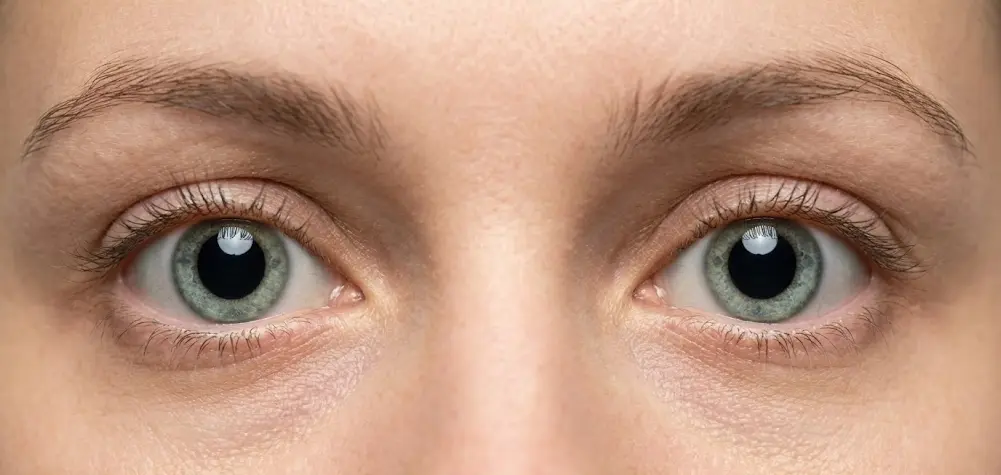
Dilated pupils — the dark centre of the eye expanding to fill more of the iris. The autonomic nervous system registering high emotional load before a conscious response has formed.
Pupil dilation is one of the most honest signals the human body produces. Unlike facial expressions, posture, or gesture — all of which can be deliberately managed — the size of the pupil is controlled by the autonomic nervous system rather than conscious intention. A person cannot voluntarily dilate or constrict their pupils. When emotional stakes rise, when arousal increases, when the nervous system registers something worth paying close attention to, the pupils expand automatically. This makes pupil dilation uniquely informative: it reflects internal state directly, with no filter of deliberate communication between the stimulus and the response. This page is part of the body language resources available through Cognitive Train and the Mind Training Hub.
What the pupil is signaling is not a specific emotion — it is the intensity of emotional engagement. Research has consistently shown that pupil dilation tracks arousal rather than valence: the pupils expand in response to stimuli that matter emotionally, regardless of whether the emotional content is positive or negative. Fear, attraction, excitement, and disgust can all produce dilation. The key variable is not whether the experience is pleasant or unpleasant but whether the nervous system has registered it as significant. Understanding this distinction is essential to reading pupil dilation accurately in practice.
What Does Pupil Dilation Mean? The Psychology Behind It
The pupil is controlled by two competing muscle groups in the iris: the dilator muscle, activated by the sympathetic nervous system, and the sphincter muscle, activated by the parasympathetic nervous system. When emotional arousal increases, sympathetic activity rises, the dilator muscle is engaged, and the pupil expands. As established by Bradley, Miccoli, Escrig, and Lang (2008) in their systematic investigation of the pupil as a psychophysiological measure, pupillary increases are reliably larger when participants view emotionally engaging stimuli — pleasant or unpleasant — compared to neutral content. The pupil does not distinguish between approach and avoidance states; it distinguishes between emotional engagement and non-engagement. A neutral stimulus that produces no emotional response produces minimal dilation. A stimulus that produces strong emotional engagement — regardless of whether that engagement is positive or negative — produces measurable expansion.
Among the most influential early work on pupil dilation as a nonverbal signal is the research of Hess and Polt (1960), who documented that pupil size increases accompany the viewing of emotionally toned or interesting stimuli — establishing the foundational insight that the pupil provides a continuous, involuntary readout of the emotional significance a person assigns to what they are looking at. Subsequent research has substantially refined this picture: it is arousal level, not hedonic valence, that drives dilation, and the effect operates regardless of whether the person is consciously aware of the emotional response it reflects.
What Does Pupil Dilation Mean in Different Contexts?
Attraction and interest — the most widely recognized context for pupil dilation is interpersonal attraction. When a person encounters someone or something they find genuinely appealing, the autonomic nervous system responds with increased sympathetic activity and the pupils expand. This dilation is involuntary and cannot be consciously produced — which is precisely what makes it a more reliable signal of genuine interest than any deliberate expression of enthusiasm. The dilation associated with attraction tends to be sustained as long as the person or object of interest is present and visible, rather than appearing as a brief spike before returning rapidly to baseline. Notably, this effect operates equally for any source of strong positive interest — an attractive person, a compelling idea, a desired outcome — because the underlying mechanism is arousal, not romantic attraction specifically. The pupils are responding to the intensity of emotional engagement, not its particular flavor.
Fear and threat — pupil dilation is a core component of the fear response. When the threat-detection system activates, the sympathetic nervous system increases arousal throughout the body and the pupils expand significantly — the visual system maximizing its light intake to sharpen threat assessment across the full environment. Fear-related dilation tends to be rapid in onset, often appearing alongside other components of the fear response: the startle reflex, an elevated and drawn-together brow furrow, and widened eye aperture. In a social context, a person whose pupils dilate sharply when a specific topic is raised, or when a specific individual enters the room, is displaying physiological evidence of an elevated threat response that may not be visible in any other channel. They may be managing every other aspect of their presentation — maintaining a steady voice, a neutral face, controlled posture — while the pupils register the nervous system's true assessment.
Cognitive effort and mental load — pupil dilation also responds to cognitive demand independently of emotional content. Mental arithmetic, working memory tasks, and effortful processing all produce reliable pupil dilation. This means that in conversation, a person whose pupils expand while formulating an answer may be reflecting cognitive effort rather than emotional arousal — they are working harder to construct the response. Reading this correctly requires attention to baseline and context: dilation that appears consistently during cognitively demanding tasks is different from dilation that appears specifically in emotionally charged exchanges. The former reflects mental load; the latter reflects emotional engagement. The two are distinguishable by pattern — cognitive dilation tends to track the difficulty of specific tasks and return to baseline quickly; emotional dilation tends to track the presence of emotionally significant stimuli and persist while they remain.
Pupillary contagion — dilation as a social signal — pupil dilation does not only reveal internal state; it also functions as a social signal that influences the people observing it. Research has documented the phenomenon of pupillary contagion: when adults view a person with dilated pupils, their own pupils dilate in response. As demonstrated by Fawcett et al. (2017), this mirroring effect is present even in 4- to 6-month-old infants — reflecting a transfer of arousal that operates below conscious awareness and appears early in social development. In adult interactions, the social consequences of pupil dilation extend further: research by Kret, Fischer, and De Dreu (2015) found that participants trusted interaction partners with dilating pupils and withheld trust from partners with constricting pupils, with dilation mimicry predicting trust between in-group members. The pupils of the person you are reading are simultaneously influencing your own nervous system's state. This bidirectional effect makes pupil dilation unusual among body language signals: it is not merely a signal that one person sends and another receives, but a channel of physiological synchrony that operates between people simultaneously.
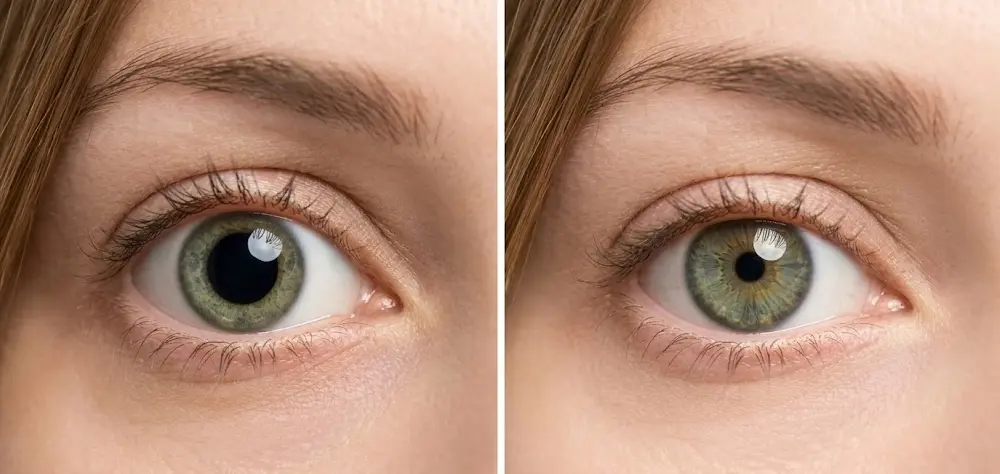
Left: dilated pupils — the dark centre expanded, signaling high arousal or strong emotional engagement. Right: constricted pupils — minimal dark centre, signaling low arousal or disengagement. The same eyes, reflecting different internal states.
Pupil dilation cannot be faked — it is the autonomic nervous system speaking directly. The Body Language Test below ↓ trains you to read eye signals alongside the full range of facial expressions and postures.
Pupil Dilation vs Similar Signals
Pupil dilation vs eye contact — eye contact is a deliberately managed signal: a person chooses to hold or break gaze based on social intention. Pupil dilation occurs within the gaze and is entirely unchosen. A person making sustained, deliberate eye contact with constricted pupils is performing engagement without the underlying arousal that genuine interest produces. A person making intermittent or avoidant eye contact while showing dilated pupils may be experiencing significant arousal toward the person they are avoiding looking at — the behavioral channel is managing the signal while the physiological channel continues to broadcast it. The two signals can contradict each other precisely because one is under voluntary control and the other is not, and when they contradict, the involuntary signal is typically more accurate.
Pupil dilation vs blushing — both blushing and pupil dilation are involuntary autonomic responses that cannot be suppressed. Blushing is driven primarily by social self-consciousness — the sympathetic nervous system responding to the experience of being evaluated by others. Pupil dilation is driven by emotional arousal more broadly — attraction, fear, interest, cognitive engagement. When both appear together, the combined cluster indicates both high emotional arousal and acute social self-awareness: the person is strongly affected by the current stimulus and is also acutely conscious of being seen having that response. Both signals are equally unsuppressible, which makes them among the most reliable indicators available in live reading — the more a person tries to conceal the response, the more evident the effort to conceal it becomes.
Pupil dilation vs forward lean — the forward lean is a semi-voluntary approach signal: the person moves their body toward what interests them, and while this movement is not always consciously chosen, it operates at a level of behavior that can be noticed and managed. Pupil dilation is fully involuntary and operates at a level the person cannot observe in themselves — they cannot feel their own pupils expanding. When a person leans forward and simultaneously shows dilated pupils, the two signals are congruent: both the behavioral and the physiological channels are registering approach motivation. When a person leans back while showing dilated pupils, the behavioral channel is signaling withdrawal while the physiological channel continues to register engagement — indicating the person is attempting to suppress or conceal a response their nervous system is still producing.
Pupil dilation vs self-touch (neck, face) — self-touch reflects the nervous system managing a stress response after it has been triggered. Pupil dilation reflects the triggering moment itself — the point of heightened arousal. Both are involuntary, but they operate at different points in the response sequence. Dilation appears at the moment of emotional engagement; self-touch appears as the body attempts to regulate the arousal that followed. When both appear together, they map the full arc of a stress or arousal event: the pupil signals when the nervous system was activated; the self-touch signals that the activation was significant enough to require active management in the aftermath. The sequence gives both the trigger and the consequence visible in the body simultaneously.
How to Spot Pupil Dilation Accurately
The most significant practical limitation on reading pupil dilation is luminance. Pupils constrict in bright light and expand in dim light regardless of emotional state — which means that comparing pupil size across different lighting environments is meaningless. Accurate reading requires a consistent lighting baseline: tracking whether pupil size changes within the same environment and the same lighting conditions, in response to specific stimuli, topics, or people. A pupil that expands when a specific individual enters the room — in unchanged lighting — is providing meaningful information. A pupil that appears large because the conversation is taking place in a dimly lit space is providing information about the environment, not about the person's emotional state.
Baseline comparison is equally critical. People vary naturally in resting pupil size, and individual differences are significant. The diagnostic information is not in the absolute size of the pupil but in the change from that individual's own baseline. A pupil that expands noticeably when a specific question is asked, when a particular topic is introduced, or when a specific person enters the room — compared to the same person's resting state under the same conditions — is providing meaningful information. A single snapshot of pupil size without a comparison baseline tells you relatively little. The change is the signal, not the absolute measurement.
Cluster reading provides the full picture. Dilated pupils alongside a forward lean, open posture, and relaxed expression suggest genuine interest or attraction. Dilated pupils alongside a brow furrow, raised shoulders, and an elevated startle response suggest fear or active threat assessment. Dilated pupils alongside a backward lean and reduced behavioral engagement suggest an internal state the behavioral channel is attempting to manage or conceal. The pupil establishes the level of arousal; the rest of the face and body — the expression, the muscle tension, the orientation — determines what kind of arousal is being experienced. Reading the pupil in isolation gives you intensity. Reading it within the full cluster gives you meaning. The test below develops exactly this skill: reading not any single signal but the full simultaneous broadcast of what the body is expressing.
How Much Body Language Can You Read?
Pupil dilation is the body's most honest signal of emotional engagement — but reading it accurately requires understanding arousal vs valence, lighting baselines, individual differences, and what the rest of the face is doing alongside it. The test below covers the complete range of expressions, gestures, and postures with detailed explanations after every answer.