Survivorship Bias — Meaning, Examples & How to Overcome It
Mind · Cognitive Biases · Decision & Action family
Test yourself — can you spot the bias in each scenario? Take the Cognitive Bias Spotter Test. Jump to the test ↓
What Is Survivorship Bias? Simple Definition
Survivorship bias is the tendency to focus on the people, companies, or things that made it through a selection process — the "survivors" — while overlooking those that did not, leading to false conclusions about what causes success.
In simple terms: you only see what survived. The failures, the dropouts, the companies that closed, the funds that were shut down — these are invisible by the time you are looking. So you study the winners, find what they have in common, and conclude that those traits cause success — without ever checking whether the losers had those same traits and failed anyway.
This page is part of the cognitive biases guide on our brain training and assessment platform, alongside interactive tests and tools covering memory, attention, and decision-making.
Survivorship Bias Meaning & Psychology
The most famous illustration of survivorship bias comes from World War II. The statistician Abraham Wald was asked by the US military to help determine where to add armour to bomber aircraft. The military had collected data on bullet holes in planes that returned from missions and proposed adding armour to the areas most frequently hit. Wald pointed out the error: the data only included planes that had survived. The areas with the most bullet holes were precisely the areas where a plane could take damage and still return. The areas with few or no bullet holes were likely where damage was fatal — those planes never came back. The correct conclusion was the opposite of what the data appeared to show: armour should go where the returning planes were not hit.
This insight captures the structure of survivorship bias precisely. The sample available for analysis is not a random sample — it is a sample filtered by survival. Any conclusions drawn from it will be systematically distorted in the direction of whatever it takes to survive the filter.
Why the brain falls for it
Survivorship bias is driven by the same mechanism as the availability heuristic — the tendency to judge probability and importance by how easily examples come to mind. Survivors are visible, documented, celebrated, and discussed. Failures are invisible, undocumented, forgotten, and rarely discussed. The brain cannot reason about what it cannot see, and what it cannot see is precisely the half of the picture that would correct its conclusions.
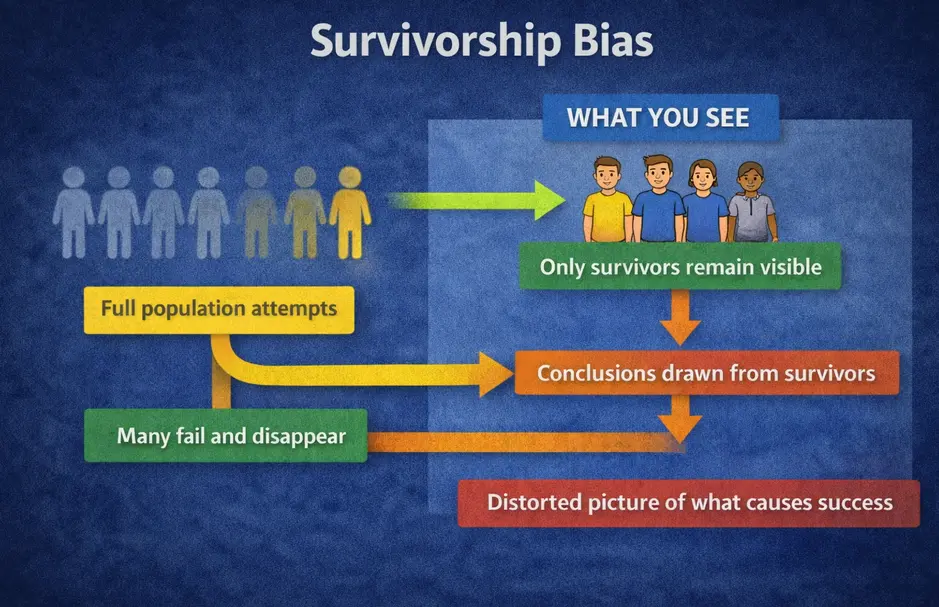
Survivorship bias in action: the full population attempts something, many fail and disappear, only survivors remain visible, and conclusions drawn from that visible minority produce a distorted picture of what actually causes success.
Survivorship Bias in Real Life — Examples
Survivorship bias is everywhere once you start looking for it. Old buildings are assumed to be well-constructed because the poorly constructed ones have already fallen down — you only ever see the ones that lasted. Classic rock is considered better than modern music because only the very best tracks from past decades are still played, while an equivalent proportion of forgettable material has simply disappeared. "They don't make things like they used to" is almost always a survivorship bias statement: the things from the past that you are comparing modern products to are the subset that survived long enough to be remembered.
Self-help and success literature is structurally saturated with survivorship bias. Biographies of successful entrepreneurs describe the traits, habits, and decisions that accompanied their success. But these same traits, habits, and decisions were also present in the entrepreneurs who failed — they are simply not the subject of bestselling books. Waking up at 5am, journaling, practising gratitude, and maintaining a morning routine are not validated as causal by the fact that successful people do them; what would validate them is evidence that people who do these things succeed at a higher rate than those who do not, including the people who did them and still failed.
Survivorship Bias in Investing and Finance
Survivorship bias is one of the most consequential and well-documented distortions in financial analysis. Mutual fund performance databases almost universally suffer from it: funds that perform poorly are closed or merged into other funds, and their records disappear from the database. Studies that analyse the historical performance of funds in the database are therefore analysing only the funds that survived — which are, by definition, not the worst performers. This produces systematic overestimation of the average historical returns of actively managed funds.
Research has consistently found that survivorship bias inflates reported mutual fund returns by one to two percentage points per year — a difference that compounds substantially over long investment horizons and makes active management appear more competitive with passive index strategies than it actually is. Brown et al. (1996) were among the first to formally quantify this distortion, demonstrating that studies using only surviving funds dramatically overstate actual investor returns.
The same bias affects hedge fund performance data, private equity return figures, and venture capital success statistics. The headline returns in each of these asset classes are calculated from funds and portfolios that still exist — the failures have been quietly removed from the sample. When the full population of attempts is included, average returns typically fall substantially.
Survivorship Bias in Business and Entrepreneurship
Startup advice is among the most survivorship-biased content in existence. The advice dispensed by successful founders is drawn from what they did — but what they did was also done by thousands of founders who failed. "Follow your passion," "move fast and break things," "hire slowly and fire quickly" — these maxims describe what successful founders did, not what causes success. The founders who followed their passion into bankruptcy, moved fast and broke their company, or hired and fired their way to a dysfunctional team are not the ones giving keynote speeches.
This does not mean successful founders have nothing useful to say. It means that their advice needs to be evaluated against the base rate — how often did people who followed this advice succeed, including all the people who followed it and are no longer in business? Without that denominator, any pattern observed in survivors is uninterpretable as causal evidence.
The same problem affects business school case studies, which overwhelmingly feature successful companies. Students learn the strategies of Apple, Amazon, and Google — without systematic exposure to the strategies of equally ambitious companies that pursued similar approaches and failed. The result is an education that teaches the characteristics of survivors as if they were recipes for survival.
Survivorship Bias in History and Science
Historical survivorship bias shapes which events, ideas, and figures we know about. The texts, artworks, and buildings that survive to be studied are not a random sample of what existed — they are the ones that were valued enough to be preserved, copied, and protected. Ancient Greek philosophy appears to be of remarkably high quality partly because only the works considered most worth preserving were copied through the medieval period; the works that were not copied have vanished. We are reading the survivors of a centuries-long selection process and drawing conclusions about the intellectual character of an entire civilisation.
In science, publication bias is a well-documented form of survivorship bias: studies with positive or statistically significant results are far more likely to be published than studies with null results. The published literature therefore overrepresents positive findings, making effects appear more reliable and consistent than they actually are across all studies conducted. This is one driver of the replication crisis in psychology and medicine — the published record is a survivorship-biased sample of all the research that was actually done.
How to Avoid and Overcome Survivorship Bias
Ask who is missing from the sample
The single most important habit for countering survivorship bias is to ask, before drawing any conclusion from a data set or a set of examples: who is not in this sample, and why? What happened to the companies that tried this strategy and failed? What happened to the funds that no longer appear in this database? What happened to the people who followed this advice and did not succeed? The answer to these questions changes the denominator in every success rate calculation and often changes the conclusion entirely.
Seek out failure data deliberately
Success stories are abundant and easy to find. Failure data requires active effort to locate, because failures are typically underdocumented, unsought, and structurally invisible. In investing, this means looking for databases that include defunct funds. In business analysis, it means reading about failed companies with the same attention given to successful ones. In personal decision-making, it means seeking out people who tried what you are considering and did not succeed — and understanding why — before drawing conclusions from those who did.
Compare base rates, not just examples
Any individual success story is consistent with almost any causal story you want to tell about it. What matters is the base rate: out of all the people who did X, what proportion succeeded? This requires including the failures in the calculation. When base rates are available — as they often are for investment strategies, startup outcomes, and educational paths — they should take precedence over individual success narratives as evidence about likely outcomes.
Be especially sceptical of self-selected samples
Survivorship bias is strongest in self-selected samples — where the people or entities in the sample have already passed through a filter before you observe them. Testimonials, case studies, published research, award winners, and profiled entrepreneurs are all self-selected in some way. The stronger the filter, the more distorted the picture. Whenever a sample has passed through a visible success filter before reaching you, treat it as a highly unrepresentative slice of the full population.
The Deeper Point
Survivorship bias is not a failure of analysis — it is a failure of observation. You cannot reason correctly about a population from which most of the data has been removed before you ever had a chance to see it. The problem is structural: the world presents you with survivors because survivors are what remain, and the disappearance of failures is self-concealing. Nobody announces that their fund has been closed, their startup has failed, or their strategy has stopped working. The absence of evidence is itself a form of evidence — but only if you know to look for it.
Understanding survivorship bias changes how you read success stories, how you evaluate advice, how you interpret historical data, and how you assess the performance of any strategy, person, or institution that has been selected for your attention precisely because it succeeded. The question is never just "what did the winners do?" It is always: "what did everyone do, and how many of them won?"
Related biases that interact closely with this one: the availability heuristic, which makes survivors more memorable and vivid than failures; confirmation bias, which causes us to notice and remember the evidence that survivors provide while ignoring the missing failure data; and anchoring bias, where the visible success story anchors our expectations for what outcomes are achievable.
The Cognitive Bias Spotter Test below puts that understanding to work — see if you can catch survivorship bias and the other nine biases when they appear in realistic scenarios.