Gambler's Fallacy — Meaning, Examples & How to Overcome It
Mind · Cognitive Biases · Probability & Randomness family
Test yourself — can you spot the bias in each scenario? Take the Cognitive Bias Spotter Test. Jump to the test ↓
What Is the Gambler's Fallacy? Simple Definition
The gambler's fallacy is the mistaken belief that if a random event has occurred more frequently than expected over a given period, it is less likely to occur in the future — or vice versa. After a coin lands heads five times in a row, the fallacy is the feeling that tails is now "due." After a roulette wheel lands on red several times consecutively, the fallacy is the conviction that black is more likely on the next spin.
It is also known as the Monte Carlo fallacy, after a famous incident at the Monte Carlo Casino in 1913 where a roulette wheel landed on black 26 consecutive times and gamblers lost millions betting on red, convinced each time that the streak must end. The wheel, of course, had no memory of its prior results and no obligation to balance them.
This page is part of the cognitive biases guide on our free cognitive tests and brain training tools, alongside interactive apps covering memory, attention, reaction time, and decision-making.
Gambler's Fallacy Meaning & Psychology
The psychological basis of the gambler's fallacy was identified by Tversky & Kahneman (1971) as a consequence of the representativeness heuristic — the tendency to judge the probability of an event by how well it matches a mental prototype. People believe that a short sequence of random events should look like a representative sample of the underlying process. A fair coin should produce roughly equal numbers of heads and tails — and when it has not done so recently, the mind expects a correction.
The critical error is treating independent events as if they were connected. Each flip of a fair coin, each spin of a roulette wheel, and each roll of a die is statistically independent of all prior outcomes. The coin has no memory. The probability of heads on the next flip is always 0.5, regardless of how many heads or tails preceded it. But the mind, looking for pattern and balance in sequences, interprets a streak as a deviation from the expected distribution that the sequence must now correct.
Why the brain does this
The gambler's fallacy reflects a genuine misunderstanding of randomness. Random sequences do not look the way people expect them to. Genuinely random sequences contain more streaks — more consecutive repetitions of the same outcome — than most people would generate if asked to create a random-looking sequence by hand. When people are asked to produce random coin-flip sequences, they alternate between heads and tails far too often compared to actual random sequences, because they are applying the representativeness heuristic: a truly random sequence "should" alternate frequently. When a real random sequence then produces a streak, it looks non-random and triggers the expectation of a correction.
This connects directly to the availability heuristic: the mental image of "what a random sequence looks like" is driven by an intuitive prototype rather than by actual statistical properties of randomness.
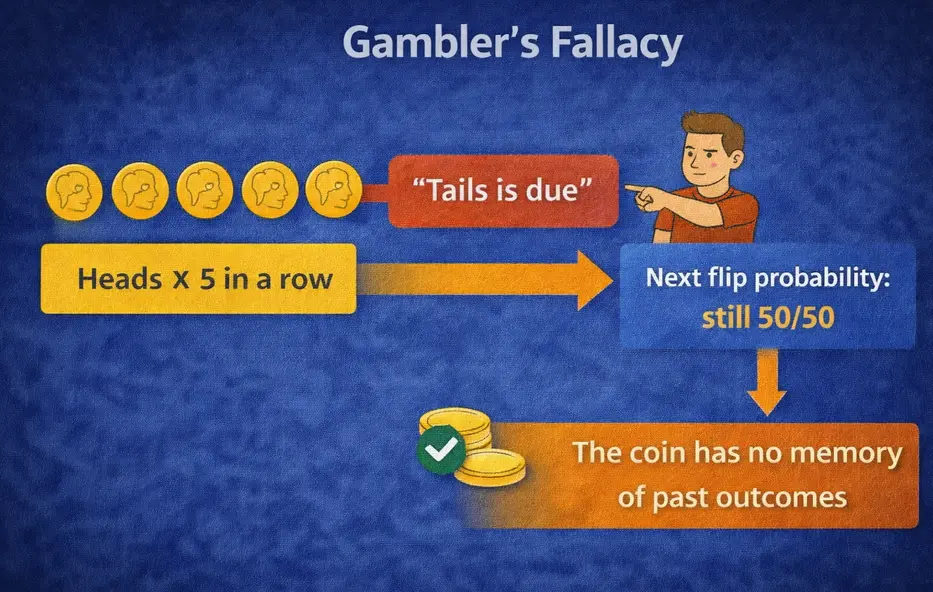
The gambler's fallacy: after heads five times in a row, "tails is due" feels certain — but the next flip is still 50/50. The coin has no memory of past outcomes.
Gambler's Fallacy in Real Life — Examples
The gambler's fallacy operates wherever people encounter sequences of random or near-random events. In sports, fans and commentators routinely speak of a player being "due" for a hit after a run of misses, or a goalkeeper being "due" to let one in after a string of saves. In lottery play, many people deliberately avoid numbers that have appeared recently, on the basis that they are less likely to come up again — when in fact each draw is independent and every combination has an equal probability.
In everyday decision-making, the gambler's fallacy shapes how people interpret streaks of good or bad luck. A run of good outcomes in any domain — job interviews going well, investments performing, decisions working out — is often followed by a heightened expectation of reversal, even when the underlying probabilities have not changed. Conversely, a run of bad outcomes generates the feeling that things are "due to turn around," which can lead to persisting with failing strategies longer than is rational.
Gambler's Fallacy in Investing and Finance
Financial markets are fertile ground for the gambler's fallacy, though the situation is more complex than in pure games of chance because markets are not fully random — past performance does carry some information about future performance in certain contexts. The fallacy operates when investors assume that a stock that has risen for several consecutive periods is "due for a correction," or that a stock that has fallen repeatedly is "due to recover," without any fundamental basis for either belief beyond the streak itself.
After a run of positive trading days, some investors reduce their positions expecting a reversal purely on the basis of the streak rather than on any change in the underlying value or conditions. After a losing streak, the same investors may hold positions expecting mean reversion that may never come. In both cases, the decision is driven by the gambler's fallacy — the belief that the sequence must balance itself — rather than by analysis of the actual probabilities involved.
This interacts with the recency bias in an interesting way: recency bias causes people to overweight recent outcomes when forming expectations, while the gambler's fallacy causes them to expect those recent outcomes to reverse. The two biases can pull in opposite directions, and which one dominates depends on how the sequence of outcomes is framed and interpreted.
Gambler's Fallacy in Gambling
In actual gambling, the fallacy is most costly when it leads players to increase their bets after a losing streak on the assumption that a win is imminent. This is the basis of the Martingale betting system — doubling your bet after each loss on the theory that you must eventually win and recover your losses. The mathematical reality is that each bet remains independent, and doubling your stake after losses simply magnifies the damage when the inevitable long losing streak occurs. Casinos remain profitable in part because the gambler's fallacy encourages players to continue betting and to increase stakes in exactly the circumstances where it is least rational to do so.
Gambler's Fallacy vs Hot Hand Fallacy
The gambler's fallacy has a mirror image: the hot hand fallacy, which is the belief that a person who has been successful recently is more likely to succeed again — that success breeds success in sequences where it actually does not. A basketball player who has scored on several consecutive shots is assumed by fans and sometimes by teammates to be "hot" and more likely to score again, even when the statistical evidence for this is weak.
The two fallacies are superficially opposite — the gambler's fallacy predicts reversal after a streak, the hot hand fallacy predicts continuation — but they share the same root: the belief that recent outcomes carry information about the next outcome in sequences where they actually do not. Which fallacy dominates appears to depend on whether the outcomes are perceived as being generated by a random process (triggering the gambler's fallacy) or by a skilled agent (triggering the hot hand fallacy).
How to Avoid and Overcome the Gambler's Fallacy
Internalise statistical independence
The core correction for the gambler's fallacy is a genuine understanding of statistical independence — the principle that the outcome of one event does not change the probability of the next event when the events are independent. A coin that has landed heads ten times in a row has a 50% probability of landing heads on the eleventh flip. The streak does not change this. Repeating this principle explicitly when you notice the fallacy activating — "this event is independent of prior outcomes, so the streak carries no information about what comes next" — is more effective than simply trying to suppress the intuition.
Distinguish random processes from skill-based ones
The gambler's fallacy is most damaging when applied to genuinely random processes. Many real-world sequences are not purely random — skill, strategy, and underlying conditions do carry forward. The critical question is whether the sequence you are observing is actually independent or whether there are causal factors that make recent outcomes genuinely predictive of future ones. Being clear about which type of process you are dealing with reduces the scope for the fallacy to mislead.
Focus on base rates, not streaks
When making probability judgments about any event, the relevant question is the base rate — the underlying long-run frequency of the outcome — not the recent history of outcomes. If the base rate probability of an event is 30%, it remains approximately 30% regardless of whether the last five outcomes were positive or negative. Anchoring to the base rate rather than the streak is the correct statistical approach and directly counters the representativeness-based reasoning that drives the gambler's fallacy. This connects to the same principle recommended for countering availability heuristic errors: replace intuitive frequency estimates with actual data.
The Deeper Point
The gambler's fallacy reveals a fundamental feature of human intuition about randomness: we expect randomness to look balanced in the short run, when in fact it does not. True randomness produces streaks, clusters, and imbalances that feel non-random precisely because they are uncommon in the mental prototype of what randomness should look like. The mind's model of chance is systematically wrong in the direction of expecting more alternation and more short-run balance than randomness actually produces.
This has consequences well beyond gambling. Any domain where random or near-random processes produce sequences of outcomes — medicine, sports, investing, hiring, weather — is vulnerable to the gambler's fallacy distorting interpretation and decisions. The streak feels meaningful; the expectation of reversal feels rational; and the underlying statistical independence of successive events is consistently underweighted relative to the pattern the mind is trying to find.
Related biases that interact closely with this one: the availability heuristic, which generates the intuitive prototype of what randomness should look like; recency bias, which overweights recent outcomes in probability judgments; and confirmation bias, which selectively attends to the evidence that streaks are about to reverse once the expectation has formed.
The Cognitive Bias Spotter Test below puts that understanding to work — see if you can identify the gambler's fallacy and the other nine biases when they appear in realistic scenarios.