Moon Illusion
The Moon near the horizon appears larger than the Moon high in the sky, even when both create the same-sized image.
Compare the two moons below. The one near the mountains, houses, and road may appear larger than the isolated Moon in the open sky.
They are exact copies. Their diameter, crater pattern, color, and brightness are identical.
The only meaningful difference is their visual context. One Moon appears at the end of a detailed landscape, while the other floats in an almost empty sky.
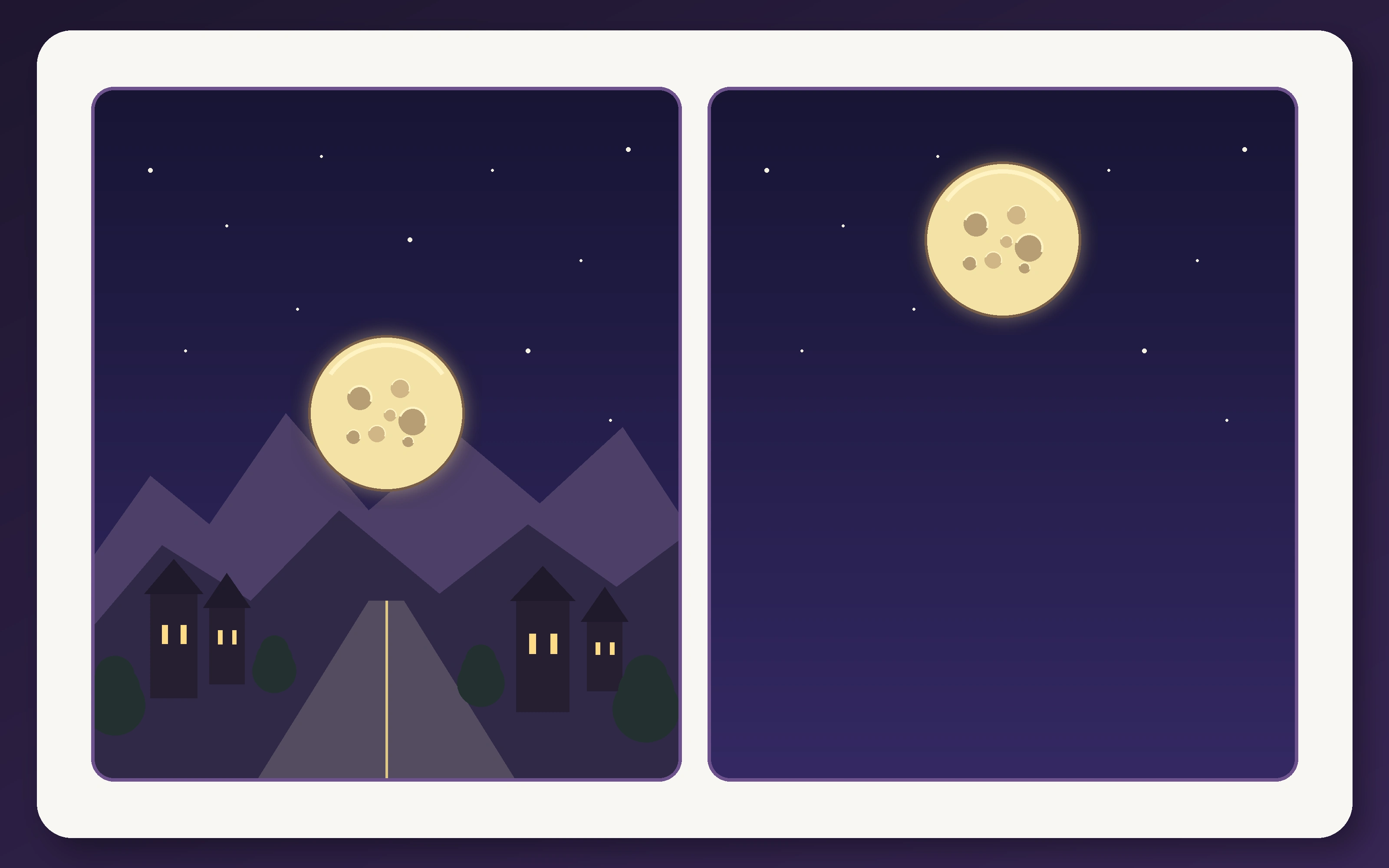
This is the Moon illusion, the familiar experience in which the real Moon looks unusually large while rising or setting and noticeably smaller when it is high overhead.
The dramatic difference is perceptual. The Moon does not suddenly shrink as it climbs through the sky.
What Is Actually the Same?
The two moon images in the demonstration were created from one graphic and pasted without resizing.
Each disk occupies the same number of pixels from edge to edge. The crater positions also match exactly.
In the real sky, the Moon’s angular diameter changes gradually because its distance from Earth varies over its orbit. That slow variation is different from the immediate apparent enlargement associated with placing the Moon near a horizon.
A photograph taken with the same camera and focal length does not reproduce the enormous change many people experience visually. The horizon may make the Moon look dramatically larger to you while the photographed disk remains approximately the same width.
The Proof: Measure the Diameter
The proof image places matching gold circles and crosshairs around both moons.
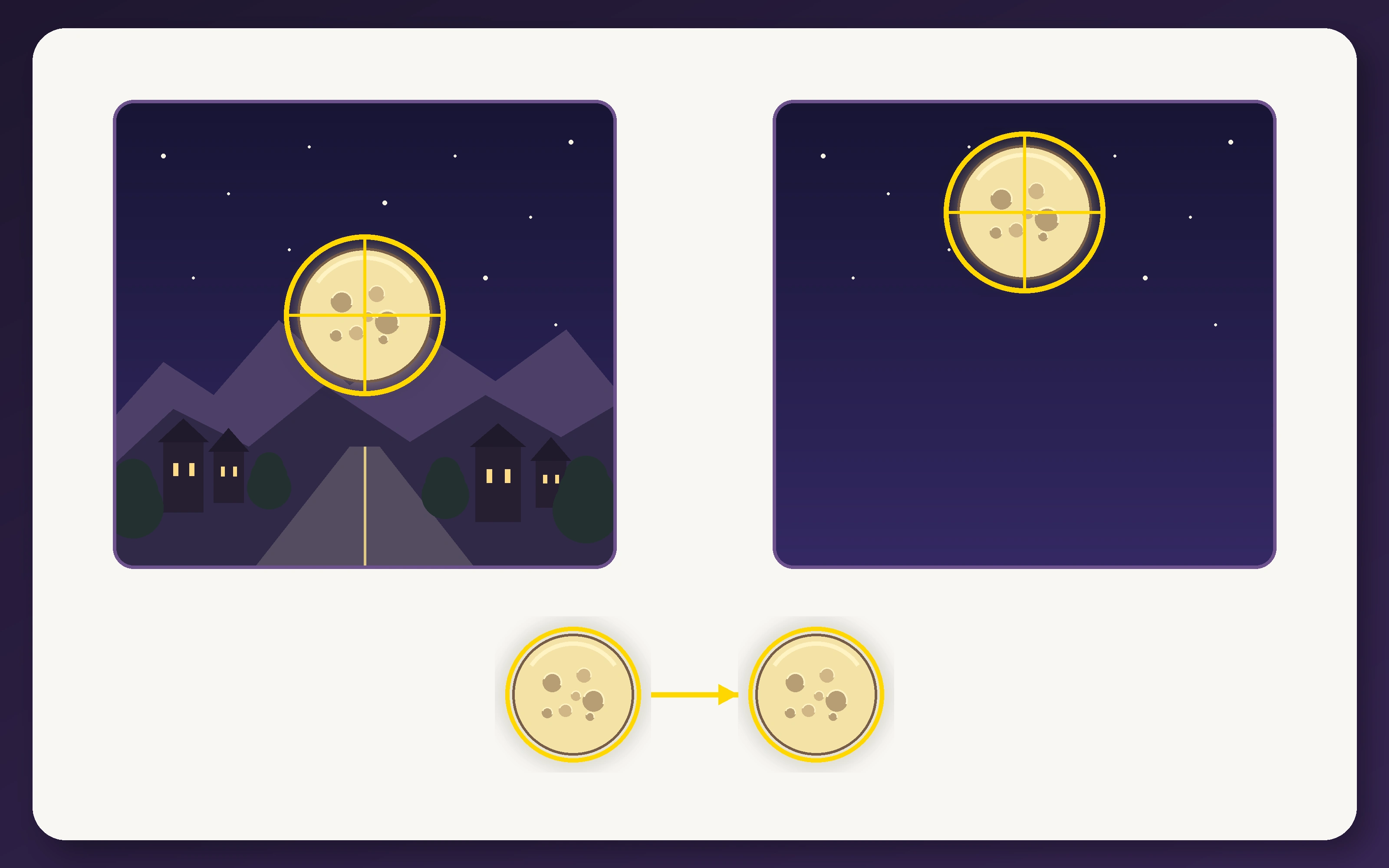
The horizontal and vertical guides cross the same points on both disks. The isolated copies below also fit inside equal circles.
Removing the landscape may reduce the apparent difference, but knowing the measurements does not always eliminate it when the full scenes return.
Is the Atmosphere Magnifying the Moon?
The atmosphere is not acting like a giant magnifying glass that makes the horizon Moon several times larger.
Light near the horizon passes through more atmosphere, which can alter color, reduce sharpness, and distort the Moon’s shape. Atmospheric refraction may flatten the disk vertically when it is very low.
Those optical effects do not explain the familiar impression of a greatly enlarged Moon.
The main source of that experience lies in how the visual system interprets size, distance, and surrounding space.
The Apparent-Distance Explanation
One influential explanation begins with size constancy.
An object produces a smaller retinal image as it moves farther away. The visual system normally combines retinal size with estimated distance so that a distant person is not perceived as physically tiny.
The horizon contains roads, buildings, trees, mountains, and textured ground extending into the distance. Those cues can make the horizon Moon appear to occupy a faraway part of a deep scene.
The overhead Moon lacks that visible chain of distance cues. It sits in an open expanse whose distance is difficult to judge.
If two objects produce similar retinal images but one is interpreted as farther away, the farther one may be perceived as physically larger.
This idea resembles the Ponzo Illusion, in which two equal lines appear different in length because converging perspective lines make one seem farther away.
What Terrain Experiments Found
Irvin Rock and Lloyd Kaufman tested the role of terrain using artificial moons and controlled viewing conditions.
In their 1962 Science study, the apparent size of a simulated Moon depended strongly on whether visible terrain supplied distance information.
A Moon presented near a detailed horizon appeared larger than a comparable Moon presented without the same terrain cues.
The result supported the idea that the horizon is not merely a nearby frame used for simple comparison. It creates an extended spatial layout that affects how far away the Moon seems and how large it is represented.
A later series of experiments by Lloyd Kaufman and James Kaufman again concluded that the horizon Moon is treated as though it occupies a much greater effective distance.
The Size-Distance Paradox
The apparent-distance explanation encounters an important complication.
When people are directly asked which Moon seems closer, many report that the large horizon Moon feels closer rather than farther away.
This is known as the size-distance paradox. The size judgment behaves as though the horizon Moon is farther away, while the conscious distance judgment may describe it as nearer.
Researchers have proposed that perceived size and reported distance may be based on different stages or forms of spatial processing.
Experiments measuring sensitivity to illusory size and distance differences found support for a relationship between the two, but the full pattern is not captured by one simple size-distance rule.
The Moon illusion remains a debated phenomenon rather than an effect with one universally accepted explanation.
Do Nearby Objects Make the Moon Look Bigger?
Relative size may also contribute in ordinary scenes.
Near the horizon, the Moon can appear beside houses, trees, mountain peaks, or other familiar objects. These provide a scale against which the lunar disk can be compared.
High in the sky, it has few nearby reference objects and may seem like a small isolated light surrounded by enormous empty space.
This resembles the Ebbinghaus Illusion, where identical circles appear different because they are surrounded by larger or smaller circles.
However, a simple relative-size explanation does not account for the full Moon illusion.
In a 2002 test of size-scaling and relative-size explanations, inverting a depicted ground plane so that it appeared to be a ceiling reversed the illusion. The results favored depth-based size scaling over a simple relative-size explanation, although nearby objects can still influence how the Moon is judged in ordinary scenes.
Why the Sky May Feel Flattened
People often experience the visible sky less like a perfect hemisphere and more like a flattened vault.
The zenith can feel relatively close, while the horizon seems to extend much farther away across the landscape.
If the Moon is perceived as lying on that vault, a disk with the same angular size appears to occupy a farther location near the horizon than overhead. Size constancy can then enlarge its apparent physical size.
The Ames Room Illusion and Shepard Tables Illusion demonstrate the same broader principle: inferred three-dimensional layout can override literal image measurements.
Try a Related Spatial Reasoning Test
The Moon illusion depends on how visual context changes judgments of distance, scale, and spatial layout.
Cognitive Train’s Spatial Reasoning Test measures mental rotation, cube-net folding, and mirror-image recognition in one assessment:
More tools involving distance, orientation, mental transformation, and spatial memory are available in the Spatial Reasoning hub.
Why Knowing the Truth Does Not Shrink It
You may know that the horizon Moon has not suddenly doubled in physical size. It can still look enormous while rising behind buildings or mountains.
That persistence shows that the illusion is not simply a mistaken belief about astronomy.
Size perception is constructed automatically from retinal size, apparent distance, surrounding scale, and the organization of the complete scene.
Conscious knowledge can correct your conclusion without completely replacing the visual experience.
What It All Comes Down To
The Moon illusion makes an approximately equal angular diameter look larger near the horizon than high in the sky.
Terrain and perspective cues can place the horizon Moon within an extended distant scene. Familiar objects may provide additional relative-size information, and the perceived shape of the sky may also influence the result.
No single theory explains every observation, but the dramatic enlargement comes primarily from visual interpretation rather than physical magnification by the atmosphere.
For more size distortions, impossible objects, apparent motion, and ambiguous figures, browse the full Optical Illusions guide. Cognitive Train’s brain tests explore perception, attention, speed, and reasoning, while its free brain training tools offer more ways to challenge visual thinking.