Just World Hypothesis — Meaning, Examples & How to Overcome It
Mind · Cognitive Biases · Social & Self-Perception family
Test yourself — can you spot the bias in each scenario? Take the Cognitive Bias Spotter Test. Jump to the test ↓
What Is the Just World Hypothesis? Simple Definition
The just world hypothesis is the belief that the world is fundamentally fair — that people generally get what they deserve and deserve what they get. Good behaviour is rewarded; bad behaviour is punished; misfortune reflects some failing in the person who suffered it. The universe maintains a moral balance, and outcomes are appropriate to the character and actions of those who experience them.
This belief is so deeply embedded that it operates largely outside conscious awareness, shaping how people interpret events, judge others, and respond to suffering. Its most visible and consequential consequence is victim blaming — the tendency to attribute responsibility for bad outcomes to the people who experienced them, rather than to situational factors, random chance, or the actions of others.
This page is part of the cognitive biases guide on our free cognitive testing and brain training platform, alongside interactive tools covering memory, attention, reaction time, and decision-making.
Just World Hypothesis Meaning & Psychology
The just world hypothesis was identified and named by social psychologist Melvin Lerner, who began studying it in the 1960s after repeatedly observing the tendency of people — including mental health professionals — to blame victims for their suffering. In his foundational research, Lerner demonstrated that observers who watched an innocent person receive electric shocks tended to derogate the victim — rating her less positively as a person — particularly when they were told they could do nothing to help her. The derogation served a psychological purpose: if the victim was somehow deserving of her fate, the world remained just, and the observer's own sense of security and predictability was maintained.
Lerner's decades of research, summarised in his 1980 monograph, documented how the belief in a just world is not merely a passive assumption but a motivated belief — one that people actively defend because its loss is psychologically threatening. A comprehensive review by Hafer & Bègue (2005) of the experimental research found consistent evidence for the core mechanism: when the belief in a just world is threatened by evidence of innocent suffering, people use several strategies to restore it — helping the victim, rationalising the suffering as deserved, or derogating the victim's character.
Why people need to believe in a just world
Lerner argued that the belief in a just world serves a fundamental psychological function: it makes the world predictable and controllable. If outcomes are connected to character and behaviour, then you can protect yourself from bad outcomes by being good, working hard, and making wise choices. If outcomes are random, this sense of control evaporates. The belief in a just world therefore supports the ability to plan, invest, and defer gratification — all of which require confidence that effort and virtue will be appropriately rewarded.
This is why the belief tends to be stronger among people who have more reason to feel in control of their outcomes — those with higher socioeconomic status, greater resources, and less experience of arbitrary misfortune. And it is why evidence of genuine injustice — innocent people suffering through no fault of their own — is so psychologically disturbing: it directly threatens the belief that the world is manageable and that good behaviour provides protection.
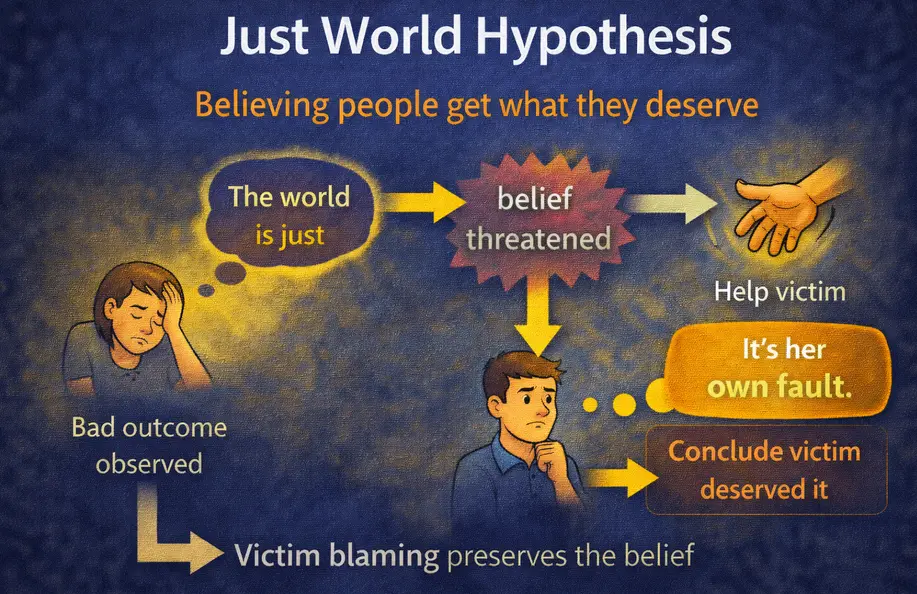
The just world hypothesis: a bad outcome threatens the belief that the world is just, triggering either helping the victim or concluding they deserved it — victim blaming preserves the belief.
Just World Hypothesis in Real Life — Examples
The just world hypothesis produces victim blaming across a wide range of contexts. When someone is robbed, observers wonder what they were doing in that area or why they were carrying valuables. When someone is assaulted, observers ask what they were wearing or whether they had been drinking. When someone loses their job, observers conclude they must not have been working hard enough. When someone becomes seriously ill, observers attribute it to their diet, their stress levels, or their failure to exercise. In each case, attributing the bad outcome to the victim's own behaviour restores the sense that the world is just and that the observer is protected by their own good behaviour.
The just world hypothesis also shapes reactions to poverty and economic inequality. People who strongly believe in a just world tend to attribute poverty to laziness, poor choices, or character failings, rather than to systemic factors, structural barriers, or circumstance. This attribution makes economic inequality feel appropriate rather than unjust — and reduces the perceived need for redistribution or structural change, since the poor are assumed to be receiving what they deserve.
Just World Hypothesis in Law and Justice
The legal system is significantly affected by just world thinking. Jurors who strongly believe in a just world are more likely to blame victims of crimes for their victimisation, and less likely to hold perpetrators fully responsible — because attributing responsibility to the victim preserves the sense of a predictable, controllable world in which innocent people do not suffer. This produces systematic biases in jury decisions about assault, rape, and other crimes where victim behaviour is open to interpretation.
Just world thinking also affects how defendants are perceived. A defendant whose life circumstances fit a narrative of deserved punishment — troubled background, bad choices, social disadvantage — may be judged more harshly precisely because their conviction fits the just world template. A defendant whose circumstances do not fit that template may benefit from the implicit assumption that innocent-looking people do not end up in criminal proceedings unless something about them warrants it.
Just World Hypothesis in Health and Illness
The just world hypothesis shapes how people respond to illness and disability. Patients who are seen to have contributed to their condition through lifestyle choices — smoking, diet, lack of exercise — are judged more harshly and receive less sympathy than patients whose illness has no behavioural component. This is consistent with just world reasoning: the illness is deserved because the behaviour was chosen. But it leads to systematic misattribution of complex health outcomes to simple moral failures, and to reduced compassion and support for people who need it.
The belief in a just world also affects how people with serious illness respond to their own situation. Some patients engage in a searching review of their past behaviour to find what they did to deserve their illness — a psychologically painful process that combines victim blaming with self-blame, and that often produces guilt and shame in addition to the suffering of the illness itself.
Just World Hypothesis and Self-Protection
The just world hypothesis is not only a judgment about others — it also functions as a form of psychological self-protection. Believing that victims deserve their suffering implies that if you behave well, you will be protected from similar outcomes. This is why just world beliefs tend to be stronger for outcomes that feel personally threatening: it is particularly important to believe that rape victims brought it on themselves, or that people who lose their savings were reckless, because these are outcomes that the believer most wants to feel protected against.
This self-protective function means that the just world hypothesis is hardest to surrender in exactly the circumstances where it is most harmful — when the suffering is most severe and the need to feel safe is strongest. The more threatening the outcome, the more motivated the observer is to find ways the victim deserved it.
How to Avoid and Overcome the Just World Hypothesis
Recognise the motivational basis of the belief
The most important step in countering just world thinking is recognising that the belief is not a neutral factual assessment but a motivated belief — one maintained because its loss is psychologically uncomfortable. When you notice yourself searching for ways in which a victim may have contributed to their outcome, ask whether this search is driven by genuine causal analysis or by the need to maintain the sense that the world is orderly and that you are protected. The feeling of discomfort when contemplating innocent suffering is the signal that just world motivation is active.
Separate moral desert from causal responsibility
Just world thinking conflates two distinct questions: what caused this outcome, and what does this outcome say about the person who experienced it? The causal question is answerable by evidence; the moral desert question is not answered by the fact that something bad happened to someone. Bad outcomes befall people who did nothing to cause them. Keeping these questions separate — asking "what caused this?" rather than "what did they do to deserve this?" — reduces the automatic just world attribution.
Develop tolerance for randomness
The just world hypothesis is most powerful when the alternative — that outcomes are substantially random and that good people can suffer through no fault of their own — is most threatening. Building genuine psychological tolerance for this reality, rather than defending against it through victim blaming, is both more accurate and more compassionate. The randomness of outcomes does not eliminate agency or the value of good choices; it means that good choices reduce risk without eliminating it, which is the accurate picture. This connects to the corrective for neglect of probability: accurate risk thinking acknowledges both the role of behaviour and the role of chance.
The Deeper Point
The just world hypothesis is a bias that serves a genuine psychological need — the need for a predictable and controllable world — but satisfies it at the cost of accurate social judgment and genuine compassion for those who suffer. It is one of the most socially consequential cognitive biases precisely because its effects fall most heavily on the most vulnerable: people who have already been harmed are judged as having deserved their harm, which adds social stigma, blame, and reduced support to the original injury.
Understanding the just world hypothesis does not require abandoning the belief that behaviour matters or that moral agency is real. It requires recognising that outcomes are not perfect proxies for desert — that the world is not, in fact, systematically just, and that treating it as though it is produces not justice but its opposite: the reassignment of responsibility from those who cause harm to those who suffer it.
Related biases that interact closely with this one: fundamental attribution error, which over-attributes behaviour to disposition and provides the raw material for just world attributions; self-serving bias, which similarly protects the self by attributing outcomes asymmetrically; and confirmation bias, which selectively attends to evidence that confirms the just world belief while discounting evidence of undeserved suffering.
The Cognitive Bias Spotter Test below puts that understanding to work — see if you can identify the just world hypothesis and the other nine biases when they appear in realistic scenarios.