Open Palms Body Language: Honesty, Trust & What the Gesture Actually Signals
Signal · Hands & Arms · Honesty / Openness family
Think you can read body language? We've included a Body Language Test at the bottom — see how well you read the full range of nonverbal cues. Jump to the test ↓
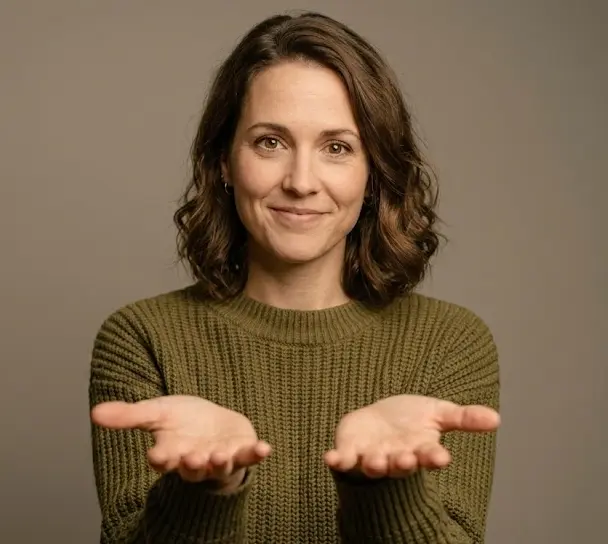
Open palms are one of the most ancient and universally recognized signals in human body language. The gesture — hands visible, palms turned outward or upward — communicates a single core message: I am not a threat, and I have nothing to hide. In a species that evolved with weapons in hand, showing empty palms became the primary way of broadcasting peaceful intent without words. It is one of the signals tested and explored across Cognitive Train.
The signal appears across every culture studied, in courtrooms, in religious ceremonies, in political speeches, and in the most ordinary moments of daily conversation. It is one of the few body language cues that operates the same way whether it is conscious or automatic.
What Do Open Palms Mean in Body Language?
The open palm display has a straightforward evolutionary origin: it proves that the hand holds no weapon. For most of human prehistory, an approaching stranger with concealed hands was a genuine threat. An approaching stranger with visible, open palms was demonstrating non-aggression in the clearest way available. That logic is still active in the human nervous system today, even when the stakes are a job interview rather than a territorial encounter.
When someone shows their palms — whether by gesturing with hands upturned, by holding their arms slightly away from the body with palms visible, or by placing open hands on a table during conversation — they are activating this ancient trust circuit. The observer's nervous system registers the absence of concealment before the conscious mind processes anything.
This is why the gesture functions differently from most verbal reassurances. Saying "I'm being honest with you" can be done while lying. Spontaneously showing open palms, especially when the person is unaware they are doing it, is much harder to fake convincingly when the rest of the body is not aligned.
The Psychology Behind It
Psychologist Allan Pease, who has researched palm gestures extensively, found that speakers who use upward-facing palm gestures during communication are consistently rated as more trustworthy and credible than those who use palm-down or concealed-hand gestures. The palm-up position signals openness and offering; the palm-down position signals authority and control; hidden hands signal guardedness or concealment.
Research on gesture and communication has confirmed that hand gestures carry independent information — listeners process and integrate what they see with what they hear, often without being aware they are doing it. Separately, body language researchers including Allan Pease have observed through speaker studies that audiences consistently rate palm-up gestures as more open and honest than palm-down or pointed gestures, and that speakers who use palm-up positions are perceived as more credible — even when the verbal content is identical.
There is also a vulnerability component. The inner wrist — exposed when the palm is turned upward — contains prominent veins and sensitive tissue. Displaying it is a low-level vulnerability signal, similar in logic to the head tilt that exposes the neck. Voluntarily showing a vulnerable area communicates trust in the other person: I do not need to protect myself from you.
What Open Palms Can Signal
Honesty and transparency — the primary and most universal reading. When someone is being direct and wants to be believed, open palm gestures tend to appear spontaneously. The body is confirming what the words are saying. This is why it appears naturally when people say "honestly," "look," or "I swear" — the hands rise and open as an automatic integrity signal.
Submission and appeasement — open palms raised at chest height or higher signal surrender and non-aggression. This is the raised-hands gesture of someone who wants to de-escalate a confrontation, the body's way of saying: I am not fighting you. Combined with collapsed posture, it communicates complete withdrawal from any power dynamic.
Offering and invitation — palms facing upward in a cupped or extended position signal offering. This is the gesture of giving, of presenting an idea for consideration, of inviting someone into a conversation or a space. Speakers who use this form during presentations are communicating that they are sharing rather than dictating.
Uncertainty and helplessness — a shrug with open palms facing upward is one of the most universal expressions of not knowing. The palms-up shrug appears across cultures with minimal variation and is recognized globally as "I don't know" or "it's out of my hands." The open palm in this context signals that the person has nothing to offer — not deception, but genuine absence of information or control.
Pleading and sincerity — outstretched arms with open palms facing the other person is a pleading posture. It is lower-status than the simple honest gesture, communicating need rather than neutral transparency. This is the gesture of someone asking for forgiveness, making an emotional appeal, or trying to convey that they mean what they are saying at a deep level.

Reading clusters is the core skill in body language. The Body Language Test below ↓ is built around exactly this — interpreting signals in context, not in isolation.
Open Palms in High-Stakes Contexts
The palm display is used deliberately in contexts where trust is essential. In courtrooms, witnesses raise their right hand with palm visible while taking an oath — an ancient ritual that uses the open palm as a physical declaration of honest intent. Religious leaders across traditions address their congregations with open, visible palms as a signal of openness and blessing. Politicians who want to appear genuine and accessible instinctively adopt open palm gestures when speaking; those who are perceived as closed or untrustworthy often keep their hands hidden, stiff, or in pointing positions.
The converse is equally informative. When people conceal their hands — keeping them in pockets, clasped behind the back, tucked under folded arms — observers register this as guardedness even without consciously identifying the specific cue. Hidden hands trigger a low-level wariness in the observer's social assessment system, often experienced simply as a vague sense that something is off.
The Difference Between Palm Up and Palm Down
Palm orientation carries two distinct meanings that operate almost as opposites. Palm up signals offering, openness, and submission. Palm down signals authority, control, and finality. A manager who gives instructions with a downward-facing palm gesture is unconsciously adopting a commanding frame; the same manager giving the same instructions with upward palms reads as collaborative and inviting of input.
Neither is inherently better — context determines which serves the goal. Palm down is appropriate when decisiveness and authority are needed. Palm up is appropriate when trust, transparency, or cooperation is the priority. The error is using palm down when trust-building is what the situation actually requires, or using palm up when clear authority needs to be communicated.
Crossed arms with concealed palms — the full inverse of the open palm display — reads as the most defensive and closed posture possible. The body is doing the maximum amount of self-concealment available without physically leaving. Compare this to expanded posture, which opens the body in the opposite direction, and the contrast makes the underlying logic of palm display clearer.
When Open Palms Can Be Misleading
The open palm gesture can be performed deliberately, and skilled deceivers know this. Practiced liars and professional persuaders consciously use palm-up gestures to project honesty while saying something false. However, the gesture rarely functions in isolation. When someone is genuinely being honest, the open palms typically appear alongside other aligned cues: relaxed facial muscles, steady eye contact, calm breathing, and a body that is neither too still nor too animated.
When the open palm gesture is being performed rather than expressed, incongruences appear. The palms may be up but the jaw is tight. The hands are open but the feet are turned away. The body is displaying transparency in the hands while closing off elsewhere. These inconsistencies are what the trained observer watches for — not any single signal, but whether the full cluster is coherent.
How to Read Open Palms Accurately
Timing is the first variable. Open palms that appear spontaneously at emotionally significant moments — when a person says something they feel strongly about, when they are making a personal disclosure, when they are asking for something they genuinely want — are more likely to reflect real internal states. Open palms maintained consistently throughout a performance-oriented presentation may be deliberate technique.
Watch the rest of the hands. Fingers that are stiffly extended, slightly curled, or tense undercut the openness of the palm itself. Genuinely relaxed open palms have soft, naturally curved fingers. The difference is subtle but readable once you know to look for it.
Consider what accompanies the gesture. Open palms paired with hands on hips signal something entirely different from open palms paired with a forward lean and direct eye contact. The palm orientation sets a base reading; everything surrounding it refines it. That cluster-reading skill is exactly what the Body Language Test below is designed to develop.
How Much Body Language Can You Read?
Open palms are one signal in a much larger system. How accurately can you read the rest? The test below covers expressions, gestures, and postures across multiple contexts — with detailed explanations after every answer so you learn as you go.