Unilateral Brow Raise Body Language: Meaning, Psychology & What It Really Signals
Face · Eyebrows · Skepticism / Dominance family
Think you can read body language? We've included a Body Language Test at the bottom — see how well you read the full range of nonverbal cues. Jump to the test ↓

Unilateral brow raise — one brow clearly lifted, the other neutral and lower. The asymmetry signals skepticism or evaluative doubt.
Most facial expressions involve both sides of the face working in rough symmetry. The unilateral brow raise is a notable exception. When one eyebrow lifts while the other stays level — or drops slightly — the asymmetry itself carries meaning. It is the face operating in two registers simultaneously: one part is engaged, the other is withholding judgment. The result is an expression that communicates something bilateral expressions cannot: a split between reception and doubt, between interest and reservation. This page is part of the body language resources available through our free cognitive tests and training and the Mind Training Hub.
Not everyone can produce a unilateral brow raise voluntarily. Research on deliberate versus spontaneous eyebrow movements — published in the Journal of Nonverbal Behavior — found that both smiles and eyebrow raises show meaningful differences between posed and genuine versions, with spontaneous raises being slower and smaller in amplitude than deliberately produced ones. This distinction matters when reading the signal: a slow, subtle unilateral brow raise that emerges naturally in response to something said is more likely to reflect a genuine internal state than a large, rapid one that appears performed or theatrical. The spontaneous version is the one that tells you something real about what the person is actually thinking.
What Does Unilateral Brow Raise Mean? The Psychology Behind It
The unilateral brow raise is fundamentally an expression of asymmetric appraisal — the face signaling that two things are happening at once. One part of the response is lifting toward engagement, curiosity, or challenge. The other is staying flat, held back, or withheld. This asymmetry is what gives the expression its characteristic flavor of skepticism: not outright rejection, not open acceptance, but a conditional and questioning stance toward whatever has just been said or presented.
The muscle responsible for brow elevation is the frontalis, which runs across the forehead and can, in some individuals, be contracted independently on each side. When only one side activates — whether spontaneously or through practiced voluntary control — it produces the distinctive asymmetric lift. Because bilateral frontalis contraction is the default for most emotional expressions, a unilateral lift stands out. The face is doing something asymmetric in a context where symmetry is the norm, and observers register this departure even without consciously analyzing it. The signal is read as "not fully convinced" in a way that a flat expression or a full bilateral raise simply does not produce.
The expression sits at the intersection of several distinct emotional states that share a common thread: none of them represent straightforward acceptance of what is being encountered. Skepticism, doubt, amusement, mild challenge, and even dominance all produce versions of the unilateral brow raise, distinguished from each other by what the rest of the face is doing at the same time. The raised brow alone sets the asymmetric register; the mouth, eyes, and overall expression fill in which version of that register is active.
What Does Unilateral Brow Raise Mean in Different Contexts?
Skepticism and doubt — the most widely recognized meaning of the unilateral brow raise is skepticism. When someone makes a claim, presents an argument, or offers an explanation that the listener is not fully accepting, the single raised brow is often the first visible signal of that internal resistance. It precedes any verbal pushback, appearing before the person has formulated their objection. The face is querying — "Is that so?" — while the verbal response is still being composed. In this context, the raised brow is one of the more useful early signals available in conversation: it indicates that something has not landed, that acceptance has not yet been granted, and that more explanation or evidence may be needed.
Mild challenge and intellectual engagement — not every unilateral brow raise signals disbelief. When it appears alongside genuine interest — a slight forward lean, sustained eye contact, an engaged rather than flat expression — it can indicate active intellectual engagement. The person is not dismissing what they're hearing; they are pushing on it, testing it, asking it to hold up under scrutiny. This version of the raise is common in people who process information critically as a habit, and in conversations where ideas are being genuinely examined rather than simply exchanged. The tone is more "prove it" than "I don't believe you."
Dominance and authority — the unilateral brow raise has a pronounced social dimension. In hierarchical interactions, a raised brow directed downward — from a person in a higher-status position toward someone making a request, presenting an idea, or explaining themselves — carries a quiet authority that the bilateral raise does not. It communicates evaluative distance: the person is assessing, not participating as an equal. This is the version of the raise most associated with authority figures, interviewers, and anyone whose role involves judging what another person says. The asymmetry signals that assessment is underway and that the verdict has not been decided.
Playfulness and irony — paired with a smile or a smirk, the unilateral brow raise shifts register entirely. The skepticism becomes teasing, the doubt becomes playful challenge, and the dominance softens into humor. This is the version most associated with wit and sarcasm — the raised brow that accompanies a dry remark or an arch observation, signaling that the speaker is aware of the absurdity of what they're saying and expects the listener to catch it. The asymmetry of the expression maps naturally onto the asymmetry of ironic communication, where what is said and what is meant are deliberately not the same thing.
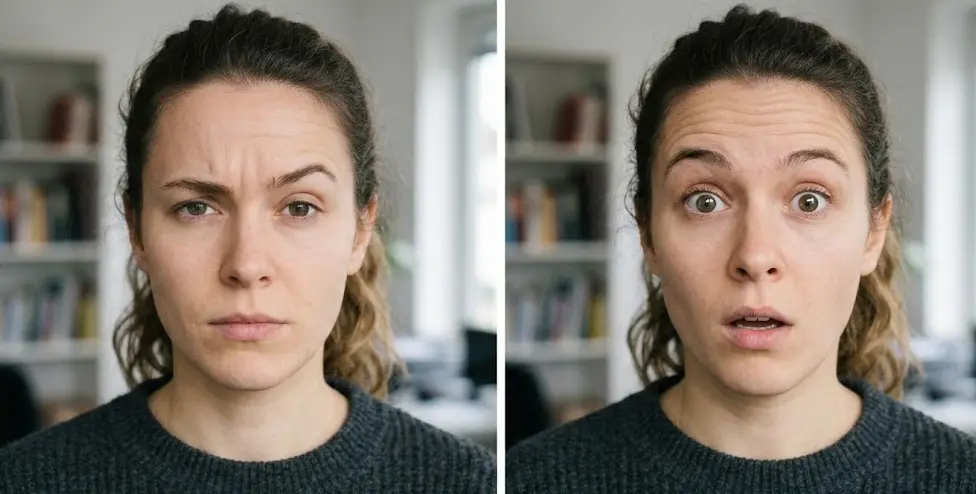
Left: brow furrow with asymmetry — inner brows pulled down, expression concerned and evaluative. Right: bilateral brow raise — both brows up, eyes wide, expression open and surprised.
One eyebrow tells a very specific story. The Body Language Test below ↓ trains you to read subtle facial signals like this alongside full-body cues and expressions.
Unilateral Brow Raise & Deception: What It Reveals About Doubt and Managed Responses
The unilateral brow raise is a particularly useful signal in contexts where genuine reactions need to be distinguished from managed ones, for one simple reason: not everyone can produce it voluntarily. Because independent control of the frontalis muscle on each side requires either natural asymmetric wiring or deliberate practice, many people cannot generate a convincing unilateral raise on demand. This means that when it appears spontaneously — emerging naturally in response to something said — it tends to reflect a genuine internal state rather than a performed reaction.
In practice, this makes the spontaneous unilateral brow raise one of the more reliable leak signals available during conversation. A person who is verbally agreeing while displaying a subtle, brief unilateral raise is showing two channels in conflict: the verbal channel saying yes, and the facial channel registering something that is not quite yes. The brow is not under the same level of conscious management as the words, and its appearance in response to a specific claim or statement reliably flags that the claim has not been fully accepted internally, regardless of what the mouth says next.
The timing is also informative. A unilateral raise that appears immediately upon hearing something — before any verbal processing has occurred — is more likely to represent an automatic appraisal response than one that appears mid-sentence as a person is formulating their reply. Fast, small, and involuntary is the version that most reliably signals genuine doubt. Large, slow, and sustained is more likely to be a deliberate social display — used to communicate skepticism rather than to involuntarily express it.
Unilateral Brow Raise vs Similar Signals
Unilateral brow raise vs bilateral brow raise — the bilateral brow raise involves both eyebrows lifting together, producing a symmetrical expression associated with surprise, concern, openness, or the social greeting flash. The key distinction is symmetry: bilateral raises are overwhelmingly associated with genuinely open emotional states — surprise, fear, interest, recognition — where the full face is responding to a single stimulus. The unilateral raise, with its asymmetry, introduces a divided quality that the bilateral raise lacks. It signals that two responses are active simultaneously — engagement and reservation — which is precisely why it reads as skepticism rather than surprise.
Unilateral brow raise vs brow furrow — the brow furrow involves the inner brows drawing together and downward, producing a contracted expression associated with negative appraisal, confusion, concern, or anger. Where the brow furrow signals active negative processing — something is wrong, difficult, or threatening — the unilateral raise signals conditional appraisal — something is being questioned or tested but has not yet been rejected. The furrow closes and contracts; the raise opens on one side while withholding on the other. In practice, they can appear together: a unilateral raise combined with a furrowed inner brow on the opposite side produces a particularly complex expression of simultaneous curiosity and skepticism.
Unilateral brow raise vs smirk — the smirk is another asymmetric facial expression, involving one side of the mouth lifting while the other remains neutral. Both the unilateral brow raise and the smirk share the asymmetric structure that signals a split internal state, and both are associated with irony, mild contempt, and knowing amusement. When they appear together — one brow up, one corner of the mouth up — the combined expression is one of the clearest signals of dry humor, condescension, or amused dismissal available in the facial repertoire. Each signal amplifies the other, and the resulting cluster is highly readable across most social contexts.
How to Spot Unilateral Brow Raise Accurately
The first challenge with this signal is simply noticing it. Because the unilateral brow raise is often subtle — a small lift, brief in duration, appearing and fading quickly — it is easily missed by observers who are focused on verbal content or more prominent facial cues. Training attention on the eyebrow region specifically, and developing the habit of monitoring it continuously rather than only when a strong expression appears, is the foundation of reading this signal accurately.
The second challenge is distinguishing spontaneous from deliberate versions. As noted above, the spontaneous unilateral raise tends to be smaller, slower in onset, and shorter in duration than the deliberately produced version. A large, theatrical, held raise is most likely a conscious social display. A small, fast, transient raise that appears in direct response to a specific statement is more likely to reflect a genuine appraisal. Calibrating to the size and timing of the raise — rather than just its presence — is what separates accurate reading from surface-level interpretation.
The third principle is reading the full cluster. The unilateral brow raise sets a skeptical or evaluative register; the rest of the face determines which version is active. A raised brow above narrowed, cool eyes and a flat mouth signals cold skepticism or contempt. The same raised brow above warm eyes and a slight smile signals playful challenge or amusement. A raised brow combined with a brow furrow on the opposite side signals genuine confusion or complex processing. Developing the ability to read the eyebrows alongside the full facial expression simultaneously — rather than isolating individual elements — is the core skill the test below builds through repeated practice.
How Much Body Language Can You Read?
The unilateral brow raise is one of the subtler signals in the facial repertoire. The test below covers the full range — from expressions like this to full-body posture and gesture — with detailed explanations after every answer to sharpen your read of people.