Freeze Response Body Language: Meaning, Psychology & What Sudden Stillness Really Signals
Whole-Body Signals · Threat Response · Autonomic / Involuntary
Think you can read body language? We've included a Body Language Test at the bottom — see how well you read the full range of nonverbal cues. Jump to the test ↓

The freeze response — body stopped mid-movement, arms held rigid, expression locked and tense, eyes wide and alert. The nervous system has halted action while the threat is assessed.
Most people are familiar with fight or flight. The freeze response — the third option in the threat-response sequence — gets less attention, but it is just as fundamental to human survival and just as readable in everyday social behavior. When the body perceives threat and neither fight nor flight is immediately viable, it can shift into a state of behavioral inhibition: movement suppresses, attention sharpens, the body becomes still. This is not the stillness of relaxation. It is a distinct physiological state, mediated by specific neural circuits, with a characteristic signature that is recognizable once you know what you are looking at. This page is part of the body language resources available through our free cognitive training tools and the Mind Training Hub.
The freeze response is not a failure to act — it is an action, chosen by the nervous system when stillness offers better survival odds than movement. Understanding it changes how you read people in high-stakes or stressful situations: sudden stillness, held breath, a body that stops mid-gesture is not passivity or indifference. It is the nervous system executing one of its oldest threat protocols.
What Does the Freeze Response Signal? The Psychology Behind It
The neurobiological basis of the freeze response is well established. A comprehensive review by Roelofs (2017), published in Philosophical Transactions of the Royal Society B, describes freezing as a state of attentive immobility activated at intermediate levels of threat — the point where the perceived threat is significant enough to demand a response but where movement would increase rather than reduce danger. The freeze state involves simultaneous activation of both the sympathetic and parasympathetic branches of the autonomic nervous system. Sympathetic activation primes the body for action — elevated muscle tone, increased arousal, heightened sensory processing. Parasympathetic activation simultaneously suppresses overt movement, producing the characteristic stillness and bradycardia (heart rate deceleration) associated with the freeze state. The result is a body that is internally activated but externally motionless — primed and ready, but not yet moving.
The defense cascade framework, described by Kozlowska et al. (2015) in the Harvard Review of Psychiatry, places freezing within a sequence of threat responses that scale with the perceived severity and proximity of danger. Arousal comes first — the initial alerting response. Freeze follows when the situation demands assessment before action. Fight or flight activates when the threat is imminent and a response is viable. Tonic immobility — the deepest freeze state, sometimes called "playing dead" — can occur as a last resort when all other options have failed. Recognizing where in this sequence a person's response sits is important: mild freeze looks very different from tonic immobility, and reading one as the other produces significant misinterpretation.
What Does the Freeze Response Look Like? Reading It in Context
Sudden cessation of movement — the most immediately recognizable feature of the freeze response is an abrupt halt in ongoing movement. A person who was gesturing, shifting posture, or moving through a space stops completely. This is not a gradual slowing — it is a sudden discontinuity. Freeze onset can be triggered by an unexpected loud sound, an abrupt threat cue, or a piece of information that the nervous system flags as dangerous before the conscious mind has fully processed it. The sudden stop is one of the clearest behavioral markers of threat detection at the automatic level.
Breath holding or shallow breathing — respiratory suppression is a consistent feature of the freeze state. The person either holds their breath entirely or shifts to very shallow, controlled breathing. This is an autonomic response — reduced respiration reduces movement and noise, both of which would increase detection risk in a genuine predator-threat context. In social settings, you can observe this as a visible change in chest movement, sometimes accompanied by a slight rise of the shoulders as the breath is held high in the chest rather than allowed to deepen.
Muscle tension and rigid posture — elevated muscle tone is part of the sympathetic activation that accompanies freezing. The body is primed for rapid movement even while movement is suppressed, creating a quality of tension or rigidity that distinguishes the freeze state from relaxed stillness. Joints may lock slightly, particularly at the knees and hips. The posture may have a braced quality — not collapsed, but coiled. This is the stillness of readiness, not of ease.
Facial lock — the face in a freeze state tends to lose its normal micro-movement and expressiveness. Micro-expressions, small postural adjustments, and the normal subtle animation of conversational engagement all reduce or disappear. The result is a face that looks fixed or mask-like — not actively communicating, but not relaxed either. Fixed stare frequently accompanies this — the gaze locks onto the threat source or goes slightly unfocused as attention turns inward. Blink rate drops markedly.
Pallor — blood is redirected away from the skin surface during the freeze-threat response, which can produce visible pallor, particularly around the mouth and nose. The skin may take on a slightly waxy quality. This reflects the peripheral vasoconstriction that is part of the sympathetic component of the freeze state — blood is being redistributed toward the large muscle groups rather than the skin surface.
Orienting toward the threat — unlike gaze aversion or postural withdrawal, the freeze response typically involves orientation toward the threat source rather than away from it. The head and gaze lock onto or toward the perceived danger. This reflects the perceptual enhancement function of the freeze state: the nervous system is not withdrawing from the threat but gathering information about it while keeping the body still. This threat-oriented stillness is one of the clearest distinguishing features between the freeze state and submission or shame responses, which involve orientation away.
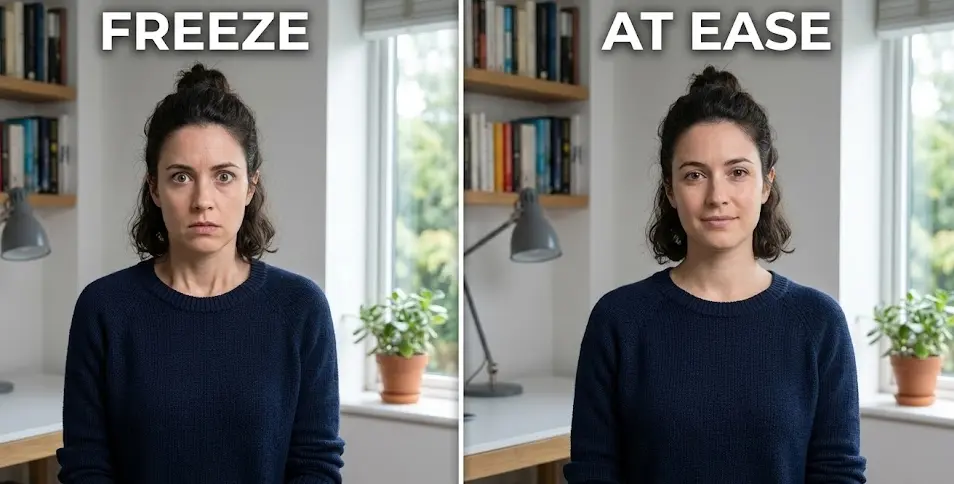
[CAPTION PLACEHOLDER — update after image approval]
The freeze response appears in everyday situations, not just extreme ones. The Body Language Test below ↓ trains you to read threat and stress signals alongside the full range of nonverbal cues.
Freeze vs Similar Signals
Freeze vs collapsed posture — freeze and collapsed posture both signal threat responses but reflect different positions in the defense cascade. Freeze is an intermediate state — body primed and tense, attention directed at the threat source. Collapsed posture reflects the deeper tonic immobility or defeat state — the body losing structural tone rather than coiling it. Freeze has a coiled, ready quality; collapse has a limp or defeated quality. Freeze is active inhibition; collapse is passive withdrawal. The postural tone is the clearest structural difference: high and rigid in freeze, low and slack in collapse.
Freeze vs startle response — the startle response and freeze are related but distinct. Startle is an explosive, brief, reflexive motor response to a sudden unexpected stimulus — a rapid flinch, blink, and sometimes vocalization that lasts under a second before the body returns to baseline. Freeze can follow startle — the initial explosive response gives way to the stillness of threat assessment — but freeze itself involves suppression of movement rather than an explosive burst of it. Startle is over almost instantly; freeze can be sustained for seconds or much longer depending on the perceived threat level.
Freeze vs gaze aversion — gaze aversion and freeze both involve reduced social engagement, but their orientation and function are opposite. Gaze aversion breaks contact and involves the gaze moving away from another person — it is a social withdrawal signal. Freeze typically involves the gaze locking onto the threat source rather than breaking from it. Gaze aversion communicates submission or disengagement; freeze communicates threat-detection and assessment. A person averting their gaze is managing a social interaction; a person in freeze is responding to a perceived danger.
Freeze vs forward lean — a subtle freeze can be mistaken for stillness during engagement, particularly if the person is leaning slightly forward as they process a difficult or threatening piece of information. The distinguishing features are postural tone and breath. Engaged stillness during a forward lean involves normal breathing, animated facial expression, and the absence of the rigid quality that characterizes freeze. Freeze stillness will show breath suppression, reduced facial movement, and the locked, tense quality of primed inhibition rather than the fluid quality of active engagement.
How to Read the Freeze Response Accurately
The freeze response is most likely to be misread as indifference, passivity, or lack of reaction. In reality, it is one of the highest-activation states the body can enter — internally intensely active while externally motionless. When someone goes suddenly still in response to information, a sound, or a perceived threat, the absence of visible reaction should be read as a response, not as an absence of one.
Cluster reading is essential. The freeze state should show multiple concurrent signals: sudden stillness onset, breath suppression, elevated postural tone, facial lock, and in many cases fixed stare or gaze locked toward the threat source. Any one of these in isolation is ambiguous — a person can be still without being frozen, and pallor has many causes. The combination, particularly if it onset suddenly in response to a specific stimulus, is diagnostic.
Context matters significantly. Freeze is most reliably present when the stillness onset is sudden and follows a specific triggering stimulus — a noise, a statement, a piece of news, or an unexpected social event. Freeze that onset gradually or without an apparent trigger is less diagnostic. And the duration matters: brief freeze (a few seconds of sudden stillness followed by resumption of normal movement) is a normal stress response that most people experience routinely. Sustained freeze, particularly when the person cannot easily be re-engaged, reflects a higher-intensity threat response and warrants a different level of attention.
How Much Body Language Can You Read?
The freeze response is one of the most misread signals in body language — stillness that looks like passivity but reflects peak threat-system activation. The test below covers the complete range of expressions, postures, and gestures with detailed explanations after every answer.