Arms Raised V-Shape Body Language: Meaning, Psychology & What It Really Signals
Posture · Arms · Victory / Elation family
Think you can read body language? We've included a Body Language Test at the bottom — see how well you read the full range of nonverbal cues. Jump to the test ↓

Arms raised in a V-shape — both arms lifted and spread wide, head up, chest open. One of the most universal signals of triumph and pride the human body produces.
When something goes right — when a goal is scored, a race is won, an obstacle is overcome — the body does something specific and immediate. The arms shoot upward and outward into a wide V-shape, the head tilts back, the chest expands, and the whole posture becomes larger, taller, and more open. This is not a gesture people decide to make. It happens before thought, before words, before the conscious mind has processed what has just occurred. The arms raised V-shape is one of the most instinctive signals in the entire human nonverbal repertoire — and the evidence for its biological origins is among the most compelling in body language research. This page is part of the body language resources available through our free cognitive tests and training and the Mind Training Hub.
The definitive evidence for the innate nature of this signal comes from a landmark study by Jessica Tracy and David Matsumoto, published in the Proceedings of the National Academy of Sciences. They photographed judo competitors from over 30 nations at the 2004 Olympic and Paralympic Games — including sighted athletes, blind athletes, and athletes who had been blind from birth and had therefore never seen another person perform this gesture. Every group, across every culture, produced the same response to victory: arms raised, head up, chest expanded. The congenitally blind athletes — who could not have learned this display from watching others — produced it just as reliably as those who could see. The V-shape is not a learned behavior. It is wired in.
What Does Arms Raised V-Shape Mean? The Psychology Behind It
The arms raised V-shape is the full-body expression of pride and triumph — the physical form that the internal experience of success takes when the body is allowed to express it freely. When a person wins, achieves, or succeeds at something that matters, the limbic system produces an immediate postural response: the body expands, lifts, and opens. The arms go up and out, maximizing the body's vertical and horizontal presence. The chest opens and expands. The head tilts back. Every element of the display makes the body larger, more visible, and more dominant in the space it occupies.
This expansion toward maximum size is not coincidental. Tracy and Matsumoto's research connects the human victory display directly to the dominance and status signaling observed across primate species — the chest-thumping inflation displays of dominant chimpanzees, the expanded postures of alpha gorillas. When the human body raises its arms in a V after success, it is drawing on the same ancient circuitry that communicates to others: I am powerful, I am in control, I have prevailed. The signal announces status before a word is spoken, and it does so in a form that observers across cultures and species recognize instinctively.
Further research by Matsumoto and Hwang, published in Evolution and Human Behavior, refined the distinction between triumph and pride as separate universal displays. Their analysis of Olympic and Paralympic judo matches found that the immediate post-victory display — arms raised above the shoulders, fists clenched, chest pushed out, head tilted back — is specifically a triumph signal, distinct from the quieter pride expression that follows after self-reflection. Triumph is faster, more explosive, and more aggressive in quality; it is the body's dominance signal firing before the rational mind has composed a more socially calibrated response. This distinction matters for reading the signal accurately: the full arms raised V-shape with clenched fists and an intense facial expression is triumph; the same raised arms with open hands and a small smile is pride. Both are positive, both involve expansion — but they reflect different internal states and appear at different points in time after success.
What makes the Tracy and Matsumoto finding particularly significant is what it eliminates as an explanation. Cultural learning cannot account for the display appearing in people who have never seen it performed. Imitation cannot explain it in individuals who have been blind since birth. The only remaining explanation — the one the data supports — is that the arms raised V-shape is a biologically programmed response to success, as hardwired as crying in response to pain or flinching in response to a sudden noise.
What Does Arms Raised V-Shape Mean in Different Contexts?
Immediate triumph and victory — the purest version of the arms raised V-shape appears in the seconds immediately following a clear, unambiguous win. The display is involuntary, fast, and total: the entire body participates simultaneously. This is the version Tracy and Matsumoto documented at the Olympic Games — the moment after a match is decided, before the athlete has had time to compose themselves or consider how they appear. It is one of the most authentic nonverbal signals available precisely because it is produced before self-monitoring kicks in.
Celebration and shared elation — outside of direct competition, the arms raised V-shape appears wherever groups of people experience shared success: crowds celebrating a goal, teams reacting to a game-winning play, friends hearing news they've been hoping for. In these contexts it functions not only as an expression of individual triumph but as a social amplifier — a visible, full-body signal that broadcasts the internal state to everyone nearby and invites collective participation in the emotion. The open, expansive quality of the display makes it inherently inclusive rather than private.
Deliberate performance and motivation — the arms raised V-shape can also be produced intentionally, and research on embodied cognition suggests this produces real psychological effects. Deliberately assuming the victory posture — arms up, chest open, body expanded — has been associated with increased feelings of confidence and power. The body is not only expressing the internal state; it is also feeding back into it. Athletes who consciously use the victory posture as part of pre-competition preparation report feeling more powerful and ready. The signal runs in both directions: emotion produces posture, and posture reinforces emotion.
Subtle everyday versions — the full arms raised V-shape is most visible in high-intensity situations where social inhibitions are temporarily overridden by the strength of the emotional response. In lower-stakes everyday contexts, the same underlying impulse often produces scaled-down versions: a brief arm raise after solving a problem, a small fist pump at good news, a slight expansion of the chest and lift of the chin when something goes well. These micro-versions carry the same signal as the full display, just compressed by the social context that makes full expansion inappropriate. Learning to recognize the compressed versions is one of the more practically useful skills in everyday body language reading.
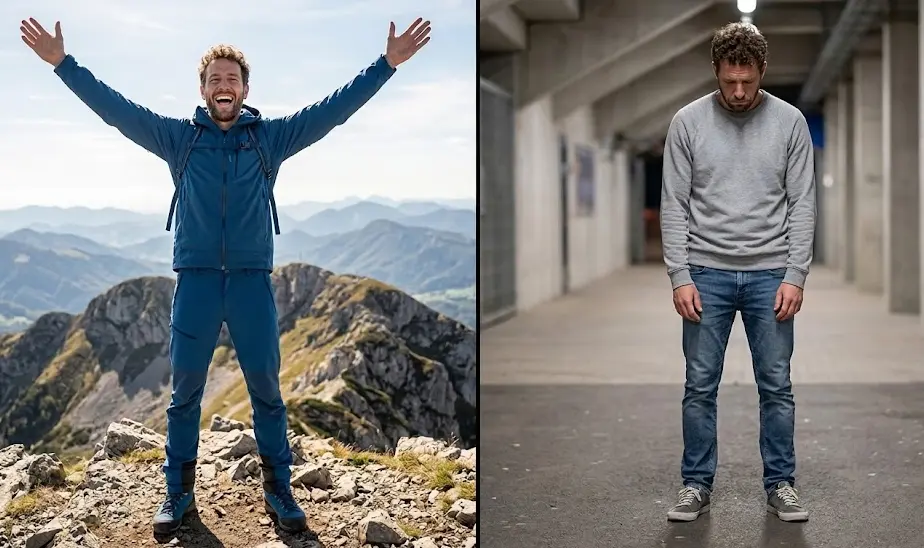
Left: arms raised V-shape — body fully expanded, expression triumphant, maximum physical presence. Right: contracted posture — head down, body closed, the physical expression of defeat.
The body speaks before the mind decides. The Body Language Test below ↓ trains you to read full-body signals like this alongside facial expressions and gestures.
Arms Raised V-Shape & Authenticity: What Blind Athletes Tell Us About This Signal
The Tracy and Matsumoto study is worth examining in more detail because its implications extend beyond the V-shape itself. The research photographed judo competitors immediately after each bout — a moment when the emotional response is at its peak and social composure has momentarily collapsed. By including athletes who were blind from birth, the study created a natural experiment that no laboratory could ethically replicate: it tested whether the display would appear in people who had genuinely never seen it modeled, in a situation where the emotional stakes were as high as they could be.
The congenitally blind athletes, representing nations from Algeria to North Korea to Ukraine, produced the pride display — arms raised, head up, chest expanded — at the same rate as their sighted counterparts. They had not seen the display. They had not been taught it. Their bodies simply produced it in response to winning, because winning activates the same ancient circuitry that has been producing this display in humans for as long as humans have competed with each other.
The same study documented the opposite signal with equal clarity: defeat produced slumped shoulders, a narrowed chest, and a lowered head — across all groups, across all cultures, in both sighted and blind athletes. Victory expands; defeat contracts. These two postural poles are not arbitrary conventions. They are the body's direct physical expression of the psychological states of dominance and submission, triumph and defeat — states that have shaped social hierarchies throughout human evolutionary history and that the body still communicates through posture before the rational mind has time to intervene.
Arms Raised V-Shape vs Similar Signals
Arms raised V-shape vs expanded posture — expanded posture involves the body making itself larger and taking up more space, communicating confidence and dominance. The arms raised V-shape is the most extreme version of expansion — the body going to its maximum size and height in a single explosive movement. Where expanded posture can be a sustained, resting state, the full V-shape is typically a brief, peak-intensity display. The V-shape includes expanded posture but adds the vertical arm raise and the temporal quality of an immediate, involuntary response to a specific trigger.
Arms raised V-shape vs open palms — open palms signal openness, honesty, and non-threat. The arms raised V-shape, while also open, carries a very different emotional charge — it is about power and triumph rather than deference and transparency. Both involve the vulnerable inner surfaces of the arms being exposed, which is a signal of confidence rather than fear. But open palms are typically directed toward another person as a social gesture; the V-shape is typically directed upward and outward, toward the environment, as a spontaneous expression of internal state.
Arms raised V-shape vs ventral fronting — ventral fronting involves orienting the open front of the body toward another person, signaling trust and engagement. The V-shape also exposes the ventral surface — the chest, abdomen, and inner arms — but in a context of triumph rather than social approach. The shared element is the exposure of the body's vulnerable front in a context of positive feeling, which in both cases signals the absence of threat and the presence of a strongly positive internal state.
How to Spot Arms Raised V-Shape Accurately
The full arms raised V-shape is among the easiest signals to read accurately precisely because it is so total and so involuntary in its peak form. The challenge is not identifying it when it appears fully — that is unmistakable — but recognizing its compressed, socially modulated versions in everyday contexts where full expression is inhibited.
The key is tracking the impulse toward expansion rather than waiting for the complete display. A sudden brief lift of both arms that is quickly suppressed, a slight widening of the chest, a momentary tilt of the chin upward — these are the everyday echoes of the same signal. They appear when something goes right and the body begins to produce its triumph response before social context cuts it short. Noticing these micro-expansions requires attention to what the body is doing across the whole interaction, not just during peak moments.
The contrast between the expansion and contraction displays is also practically useful. Just as the V-shape marks a moment of genuine triumph, its opposite — the sudden drop of the shoulders, the narrowing of the chest, the slight lowering of the head — marks the moment when something has gone wrong or when resistance has formed. Tracking the direction of postural change across the course of an interaction — expanding or contracting, opening or closing — gives a continuous, real-time read of how the person is experiencing what is happening. The test below develops exactly this skill, training attention on full-body signals across the complete range of emotional expression.
How Much Body Language Can You Read?
The arms raised V-shape is one of the body's most powerful signals — but reading body language accurately means tracking the full range from triumph to defeat, engagement to withdrawal. The test below covers it all, with detailed explanations after every answer.