Belief Perseverance — Meaning, Examples & How to Overcome It
Mind · Cognitive Biases · Belief & Motivated Reasoning family
Test yourself — can you spot the bias in each scenario? Take the Cognitive Bias Spotter Test. Jump to the test ↓
What Is Belief Perseverance? Simple Definition
Belief perseverance is the tendency to maintain a belief even after the evidence that originally supported it has been discredited, corrected, or shown to be false. Once a belief has formed — even on the basis of weak, misleading, or entirely fabricated information — it tends to persist independently of its original evidential foundation.
In plain terms: the belief outlives the evidence. You can tell someone that the information they based a conclusion on was wrong, and they will often continue to hold the conclusion anyway. This is not stubbornness in the ordinary sense — it happens automatically, driven by cognitive processes that operate below the level of conscious deliberation.
This page is part of the cognitive biases guide on our cognitive testing and brain training platform, alongside interactive tools covering memory, attention, reaction time, and decision-making.
Belief Perseverance Meaning & Psychology
The systematic study of belief perseverance was established by a series of experiments conducted at Stanford University in the 1970s and 1980s. In the foundational study by Ross, Lepper & Hubbard (1975), participants were given false feedback about their performance on a task — either that they had succeeded or that they had failed. They were then fully debriefed and explicitly told that the feedback had been predetermined and entirely false. Despite this complete debriefing, participants' self-assessments continued to reflect the original false feedback. Those who had been told they succeeded continued to rate their ability higher than those who had been told they failed — even though both groups now knew the feedback was meaningless.
A follow-up study by Anderson, Lepper & Ross (1980) extended this finding to social theories. Participants were given fabricated case studies suggesting either a positive or negative relationship between risk-taking and firefighting ability, then asked to explain why the relationship existed. When told the case studies were fictional, participants still held beliefs about the relationship — and the effect was stronger among those who had generated explanations. The act of explaining the (false) evidence had created a self-sustaining belief structure that survived the removal of the evidence itself.
Why belief perseverance happens
The key mechanism is explanation generation. When people receive information, they do not just store it passively — they actively build causal stories around it, connecting it to other things they know and believe. Once that explanatory structure is in place, removing the original data point does not dismantle it. The explanation remains, and the explanation itself supports the belief. This is why simply telling someone that a piece of evidence was false is rarely enough to fully reverse the beliefs it produced — the belief is now supported by an independent structure of reasoning, not just the original evidence.
Belief perseverance is closely related to confirmation bias, which drives selective attention to information consistent with existing beliefs. Together they create a self-reinforcing cycle: new information is filtered through existing beliefs, and existing beliefs survive the removal of the evidence that created them.
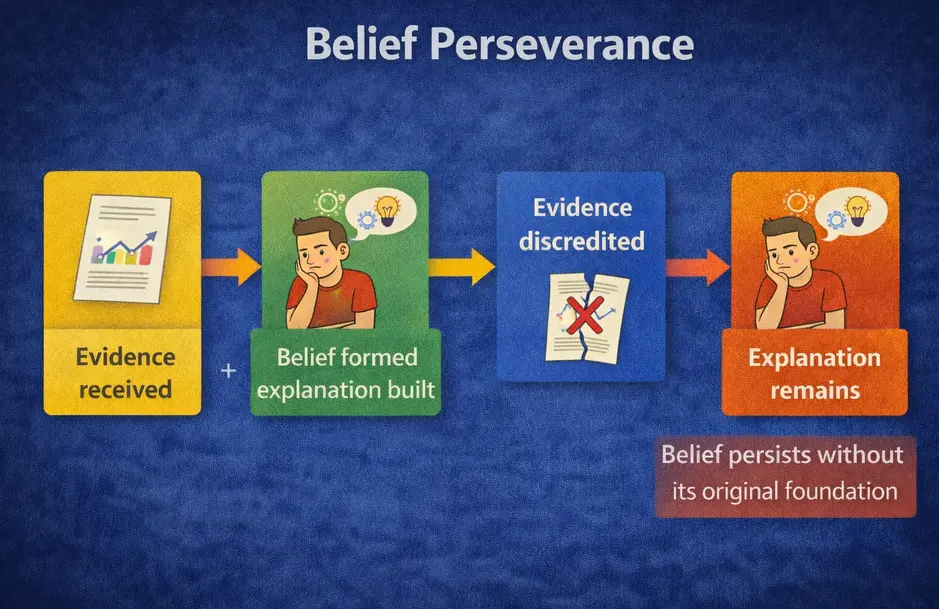
Belief perseverance: evidence is received and a belief forms with an explanation built around it — when the evidence is discredited, the explanation remains, and the belief persists without its original foundation.
Belief Perseverance in Real Life — Examples
Belief perseverance appears wherever first impressions are formed and then challenged. In job interviews, an early positive or negative impression of a candidate shapes how all subsequent information about them is interpreted — and corrections to that initial impression are absorbed less fully than the impression itself. A hiring manager who forms a positive view in the first two minutes will tend to interpret ambiguous answers charitably for the remainder of the interview, and vice versa.
In medical settings, a doctor who forms an early diagnostic hypothesis will tend to gather and weight evidence in light of that hypothesis. If the diagnosis is later shown to be incorrect, the mental model constructed around it does not simply evaporate — it continues to influence how the doctor thinks about the patient's presentation, sometimes persisting even after clear disconfirming evidence has been reviewed.
In everyday social life, first impressions of people are notoriously resistant to revision. Research and common experience both confirm that negative impressions formed early tend to persist even when the person behaves consistently contrary to them. The explanation built around the initial impression — "they are just trying to seem nicer than they are" — survives the accumulation of contradictory evidence by reinterpreting that evidence rather than revising the belief.
Belief Perseverance in the Workplace
Performance evaluations are a significant domain for belief perseverance effects. A manager who has categorised an employee as a high performer or a low performer early in their tenure will process subsequent evidence about that employee through that lens. Strong performance from a low-rated employee may be attributed to luck or exceptional circumstances; weak performance from a high-rated employee may be attributed to temporary factors. The original categorisation persists partly because the manager has built an explanatory model of the employee that can accommodate contradictory evidence without fundamentally revising the core belief.
In strategy and planning, teams that have committed to a particular direction build explanatory frameworks around that direction — why it is the right approach, why alternatives are inferior, why early difficulties are temporary. When the evidence shifts against the chosen strategy, these explanatory frameworks sustain the original commitment. This is closely related to the sunk cost fallacy, where prior investment distorts forward-looking decisions, but belief perseverance adds a specifically cognitive dimension: the belief that the strategy is correct persists independently of the investment.
Belief Perseverance in Politics and Media
Political beliefs are among the most resistant to revision because they are embedded in dense networks of explanation, identity, and social affiliation. A political belief is not just a factual claim — it is connected to a person's understanding of how the world works, who they trust, and which group they belong to. Disconfirming evidence, even when clearly presented, has to overcome not just the original belief but all of the explanatory structure that has accumulated around it.
Retractions and corrections in media coverage illustrate belief perseverance directly. Studies consistently show that initial reports — even when subsequently corrected — have a disproportionate effect on beliefs relative to the corrections. The correction is processed against an already-formed belief and explanatory structure, and it tends to update that structure only partially. The headline persists; the correction is a footnote.
Belief Perseverance in Science and Education
Belief perseverance is a well-recognised problem in science education. Students enter classrooms with prior theories about how the world works — about physics, biology, history, and human behaviour — and these naive theories persist even after formal instruction that contradicts them. Students may be able to reproduce the correct scientific explanation in an exam context while continuing to rely on the prior naive theory in everyday reasoning. The explanation built around the intuitive theory is independent of formal instruction and survives it.
In the history of science, the resistance of established paradigms to anomalous evidence is partly a manifestation of belief perseverance at the community level. Scientists who have built careers explaining phenomena within a particular theoretical framework do not abandon that framework when confronted with contradictory data — they extend and adapt the explanatory structure to accommodate the anomalies, a process that can continue long after the weight of evidence has shifted.
How to Avoid and Overcome Belief Perseverance
Consider the opposite explicitly
The most consistently effective debiasing technique for belief perseverance is to deliberately generate reasons why the opposite of your current belief might be true. Research on this "consider the opposite" strategy has found that it directly weakens the explanatory structure that sustains persevered beliefs. It works because belief perseverance is driven by one-sided explanation generation — you build a case for your current belief — and considering the opposite forces the construction of an alternative explanatory structure that competes with the first.
Separate the evidence from the belief
When evaluating any belief, it is worth explicitly asking: if I had never encountered the original evidence for this belief, would I still hold it? If the original basis for a belief has been discredited or significantly weakened, the appropriate response is to substantially revise the belief — not just note that the evidence was imperfect while leaving the belief unchanged. This requires conscious effort because the explanatory structure built around the belief feels like independent support for it, when in fact it derives from the same discredited foundation.
Slow down first impressions
Because belief perseverance operates from the moment a belief first forms, reducing the speed and confidence of initial belief formation reduces how much work is required to revise it later. Treating early impressions — of people, situations, and arguments — as provisional rather than tentatively confirmed creates less explanatory scaffolding that needs to be dismantled when contradictory evidence arrives. The anchoring bias operates similarly: the first number or impression anchors all subsequent processing, and the remedy in both cases is to treat initial information as one data point rather than a foundation to build on.
Seek disconfirming information actively
Belief perseverance and confirmation bias reinforce each other: confirmation bias leads you to seek evidence that supports existing beliefs, and belief perseverance ensures those beliefs are resistant to the contradictory evidence you do encounter. Breaking this cycle requires actively seeking out the strongest case against your current belief — not the weakest version of the opposing view, but the most credible and well-supported challenges to what you currently think.
The Deeper Point
Belief perseverance reveals something important about how beliefs function in the mind. They are not just stored conclusions waiting to be updated when the evidence changes — they are active frameworks that organise how incoming information is interpreted. Removing the original evidence for a belief does not remove the belief because the belief is no longer primarily supported by that evidence; it is now supported by the explanatory structure built around it, by related beliefs, and by the ways it has shaped how subsequent information has been perceived and remembered.
This means that correction — of misinformation, of misconceptions, of false first impressions — is genuinely hard. It requires not just presenting contradictory evidence but actively dismantling or replacing the explanatory structure that the original belief generated. Simply stating that a piece of evidence was false is not enough. What is needed is an alternative explanation that accounts for the same phenomena the original belief explained — something that gives the mind a place to go rather than just taking something away.
Related biases that interact closely with this one: confirmation bias, which builds and maintains the explanatory structure that belief perseverance relies on; the backfire effect, which describes the most extreme form of resistance to correction; and hindsight bias, where known outcomes are retrospectively woven into existing belief structures as if they were always expected.
The Cognitive Bias Spotter Test below puts that understanding to work — see if you can identify belief perseverance and the other nine biases when they appear in realistic scenarios.