Hermann Grid Illusion
Why gray dots appear in the intersections you are not looking at, then disappear the moment you turn toward them.
Look at the grid below without scanning from square to square. Dark gray smudges should begin appearing at some of the white intersections around the point where you are looking. Try to catch one directly, however, and it vanishes. Another one immediately seems to appear somewhere else.
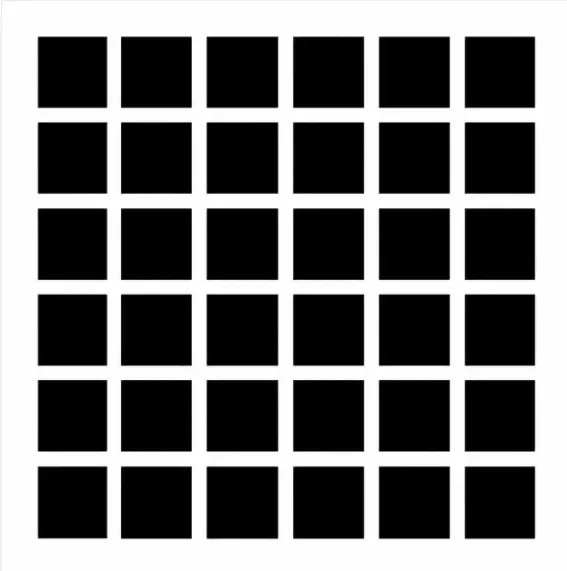
Nothing is flashing. No gray circles have been added to the image. The apparent dots are created by your visual system, and their refusal to stay still is the most revealing part of the illusion.
The Hermann Grid belongs to the larger family of optical illusions that expose how strongly perception depends on context. Your brain does not measure the brightness of every point in isolation. It compares nearby areas, emphasizes boundaries, and changes how a patch appears according to what surrounds it.
What You Are Supposed to See
The classic Hermann Grid consists of black squares separated by narrow white streets. When you look generally across the grid, faint gray or charcoal spots appear where the streets cross. The effect is usually strongest at intersections away from the exact point of fixation.
As soon as you look directly at one of those intersections, it appears clean and white. The other intersections remain in your peripheral vision, where new gray spots may emerge.
This creates the peculiar feeling that the illusion is dodging your gaze. It is not moving ahead of your eyes. The visual processing applied to the intersection changes when that intersection moves from peripheral vision into the center of your visual field.
Where the Hermann Grid Came From
The illusion is named after German physiologist Ludimar Hermann, who described it in 1870. It later became a standard demonstration in psychology, neuroscience, and vision textbooks because it seemed to offer a beautifully simple view of how neighboring visual signals influence one another.
The usual explanation became almost as famous as the illusion itself: gray spots were said to result from lateral inhibition in the retina. That account remains useful, but modern experiments have shown that the full story is not nearly so tidy.
The Classic Lateral Inhibition Explanation
Cells in the early visual system do not simply report how much light falls on one microscopic location. Many respond through a center-surround arrangement: stimulation in one region increases the cell's response, while stimulation in the surrounding region suppresses it.
This contrast-enhancing system helps the brain detect edges. A gradual difference in brightness becomes a sharper perceptual boundary, making objects easier to separate from their backgrounds.
In the classic explanation of the Hermann Grid, a receptive field centered along one white street receives light from the street itself but darkness from the black squares beside it. At an intersection, more of the surrounding region is exposed to white. That produces greater inhibition, making the intersection appear slightly darker than the straight section of street.
The account also offers a reason the spots disappear under direct inspection. Receptive fields near the center of vision are smaller. A smaller field can fit more precisely within the white intersection, so the supposed difference between an intersection and an ordinary street segment is reduced.
A major review by Lothar Spillmann found strong support for lateral interactions while also recognizing that orientation-sensitive cortical processing probably contributes. Even before later challenges, the illusion was not thought to depend on one retinal mechanism alone.
Why the Textbook Explanation Is Incomplete
The classic model predicts that the amount of white entering a receptive field should be the crucial factor. But subtle changes to the shape and direction of the grid can dramatically weaken the illusion even when the amount of light and the basic arrangement remain similar.
An experiment on grid orientation found that an oblique grid produced only about one-third of the effect generated by an ordinary horizontal-and-vertical grid. A simple circular receptive-field explanation would not naturally predict such a large dependence on orientation.
An even stranger result came from grids with slightly distorted streets. Instead of perfectly straight boundaries, researchers used gently curved or wavy edges. The gray spots weakened sharply or disappeared.
In a systematic study of these distortions, János Geier and colleagues concluded that the straightness of the grid edges was the main factor behind the illusion. Their explanation emphasized how the visual system combines orientation signals along long, uninterrupted contours.
A later summary of the evidence described the familiar lateral-inhibition account as incomplete. The Hermann Grid almost certainly involves contrast processing, but later stages of visual analysis, including sensitivity to orientation and contour organization, also appear to matter.
Why the Spots Disappear When You Look at Them
Central and peripheral vision are built for different jobs. The center of your visual field provides fine detail and precise spatial resolution. Peripheral vision covers a much larger area, but it combines information more broadly and is less exact about small features.
The Hermann Grid exploits that difference. An intersection outside your direct gaze is processed using coarser spatial information, stronger contextual pooling, and surrounding contour signals. When you look directly at it, the intersection is represented with much finer detail. The phantom dark patch no longer survives that closer inspection.
This is why adding real gray dots to the intersections would ruin the trick. Real dots would remain visible when inspected. The Hermann Grid dots exist only under the particular processing conditions created by peripheral viewing.
You can explore that central-versus-peripheral difference more directly with Cognitive Train's free peripheral-awareness exercise:
What Makes the Illusion Stronger or Weaker?
The effect is not equally strong in every version of the grid. Display size, viewing distance, street width, contrast, orientation, and the number of intersections can all change how obvious the spots appear.
Peripheral viewing strengthens it. Looking toward the center while paying attention to intersections farther away usually produces clearer spots than studying one crossing directly.
High contrast helps. Black squares and bright white streets generally create a stronger effect than a low-contrast grid. Contrast is also why screen brightness and surrounding light can change what you notice.
Straight edges matter. Even modest bending or waviness can weaken the effect, despite preserving the intersections and overall brightness pattern.
Horizontal and vertical grids tend to work best. Rotating the whole pattern diagonally can reduce the strength of the apparent dots.
The effect may also vary from person to person and from screen to screen. Not seeing a dramatic field of dots does not mean the image is broken. For some viewers, the spots are faint, brief, or easiest to detect only after changing viewing distance.
Hermann Grid vs. Scintillating Grid
The Hermann Grid is often confused with the scintillating grid. They are related, but they are not the same illusion.
In the Hermann Grid, the phantom spots appear at empty white intersections between dark squares. They usually look like soft gray smudges and disappear under direct fixation.
The scintillating grid adds real bright disks to the intersections. When the eyes move around the image, dark points seem to flash rapidly inside those disks. The effect is sharper, more active, and more dependent on eye movements.
The distinction matters because the two illusions do not respond identically to changes in geometry. A pattern that weakens the Hermann effect may still produce scintillation, suggesting that partly different visual mechanisms are involved.
What the Grid Reveals About Brightness
The Hermann Grid demonstrates that brightness is relational. A white patch does not have one fixed perceptual appearance determined only by the light it sends to the eye. Surrounding contrast, edges, orientation, visual-field position, and nearby structure all influence how bright that patch seems.
The same principle appears in the Checker Shadow Illusion, where two physically identical gray squares appear radically different because the brain interprets one as lying in shadow. The illusions look unrelated, but both show that visual perception is trying to interpret a scene rather than report raw pixel values.
Cognitive Train's Contrast Sensitivity Test approaches the subject from another direction by measuring how faint a large letter can become before it blends into its background.
A Common Myth: The Retina Completely Explains It
Descriptions of the Hermann Grid often present the original receptive-field account as a finished explanation. It is not. Lateral inhibition is a real and important process, and it likely contributes to the effect. But it does not readily explain why rotating the grid changes the illusion so much or why slight curvature can demolish it.
The evidence now points to a combination of processes rather than one small retinal circuit. Early contrast enhancement, receptive-field size, orientation-sensitive neurons, contour integration, peripheral pooling, and attention may all contribute at different stages.
That does not make the illusion less useful. It makes it more useful. A demonstration once treated as a simple diagram of the retina turned out to expose interactions across several levels of visual processing.
Why You Cannot Catch the Gray Dot
The Hermann Grid feels playful because it sets up an impossible chase. You notice something at the edge of awareness, direct your sharpest vision toward it, and erase the very conditions that made it visible.
The dot is not an object waiting at a location. It is an effect of how that location is being processed while you look somewhere else. Moving your eyes changes the computation, so the evidence disappears at the same moment you try to inspect it.
This differs from an ambiguous figure such as Rubin's Vase, where the same edges support two competing objects. The Hermann Grid does not switch between two meaningful interpretations. Instead, contrast and contour processing add a feature that is not physically present at all.
What It All Comes Down To
The Hermann Grid is memorable because the illusion knows exactly where your vision is weakest. Gray spots appear outside direct gaze, migrate when your eyes move, and vanish whenever you attempt to verify them.
The old lateral-inhibition explanation captures part of what is happening, but the pattern's dependence on straightness and orientation shows that the brain is doing more than comparing local patches of light. It is also organizing edges and contours across the grid.
For more demonstrations of how the visual system edits what reaches awareness, browse the full Optical Illusions guide. You can also explore Cognitive Train's broader brain tests or its collection of free cognitive training tools.