Status Quo Bias — Meaning, Examples & How to Overcome It
Mind · Cognitive Biases · Judgment & Decision-Making family
Test yourself — can you spot the bias in each scenario? Take the Cognitive Bias Spotter Test. Jump to the test ↓
What Is Status Quo Bias? Simple Definition
Status quo bias is the tendency to prefer the current state of affairs and to resist change — not because the current state is demonstrably better, but simply because it is familiar and already in place. When faced with a choice between maintaining what exists and switching to something different, people disproportionately favour inaction and continuation, even when the expected value of switching is higher. The default wins, not on its merits, but because it is the default.
The bias goes beyond mere habit or convenience. It operates even in high-stakes decisions — financial planning, healthcare choices, career decisions — where the costs of sticking with a suboptimal status quo are substantial and well-understood. The preference for what already exists is not a considered judgment that the current state is best; it is a systematic cognitive tendency to weight the current state more favourably than an objective evaluation would warrant.
This page is part of the cognitive biases guide on our free cognitive testing and brain training tools, alongside interactive tools covering memory, attention, reaction time, and decision-making.
Status Quo Bias Meaning & Psychology
The status quo bias was named and formally investigated by Samuelson & Zeckhauser (1988), who demonstrated in a series of experiments that individuals disproportionately stick with the status quo when making choices, and that this preference increases as the number of alternatives grows. Their real-world data on health plan and retirement programme choices by university faculty showed the same pattern: existing employees were significantly more likely to remain in their current plan than new employees were to choose the same plan from scratch — a gap that could not be explained by rational preference stability, since the plans themselves had not changed.
The mechanisms underlying status quo bias were examined by Kahneman, Knetsch & Thaler (1991), who connected it to loss aversion and the endowment effect. Loss aversion — the well-established asymmetry in which losses weigh approximately twice as heavily as equivalent gains — means that the potential downsides of switching from the status quo loom larger than the potential upsides of an equal magnitude. The status quo serves as the reference point against which alternatives are evaluated, and any departure from it is coded as a potential loss, triggering the heightened aversion that loss framing produces. The result is a systematic bias toward inaction, because action risks loss and inaction preserves the reference point.
Multiple reinforcing mechanisms
Status quo bias is not driven by a single mechanism but by several that frequently operate simultaneously. Loss aversion provides the primary asymmetry in how gains and losses from the status quo are weighted. The endowment effect increases the perceived value of what one already has relative to what one might acquire. Regret aversion makes inaction feel safer than action, because errors of omission — failing to change when changing would have been better — are typically experienced as less painful than errors of commission — changing and having it go wrong. Transition costs — the effort, time, and uncertainty involved in switching — provide rational grounds for inertia that are often amplified well beyond their actual magnitude by the cognitive tendency to weight costs more heavily than benefits.
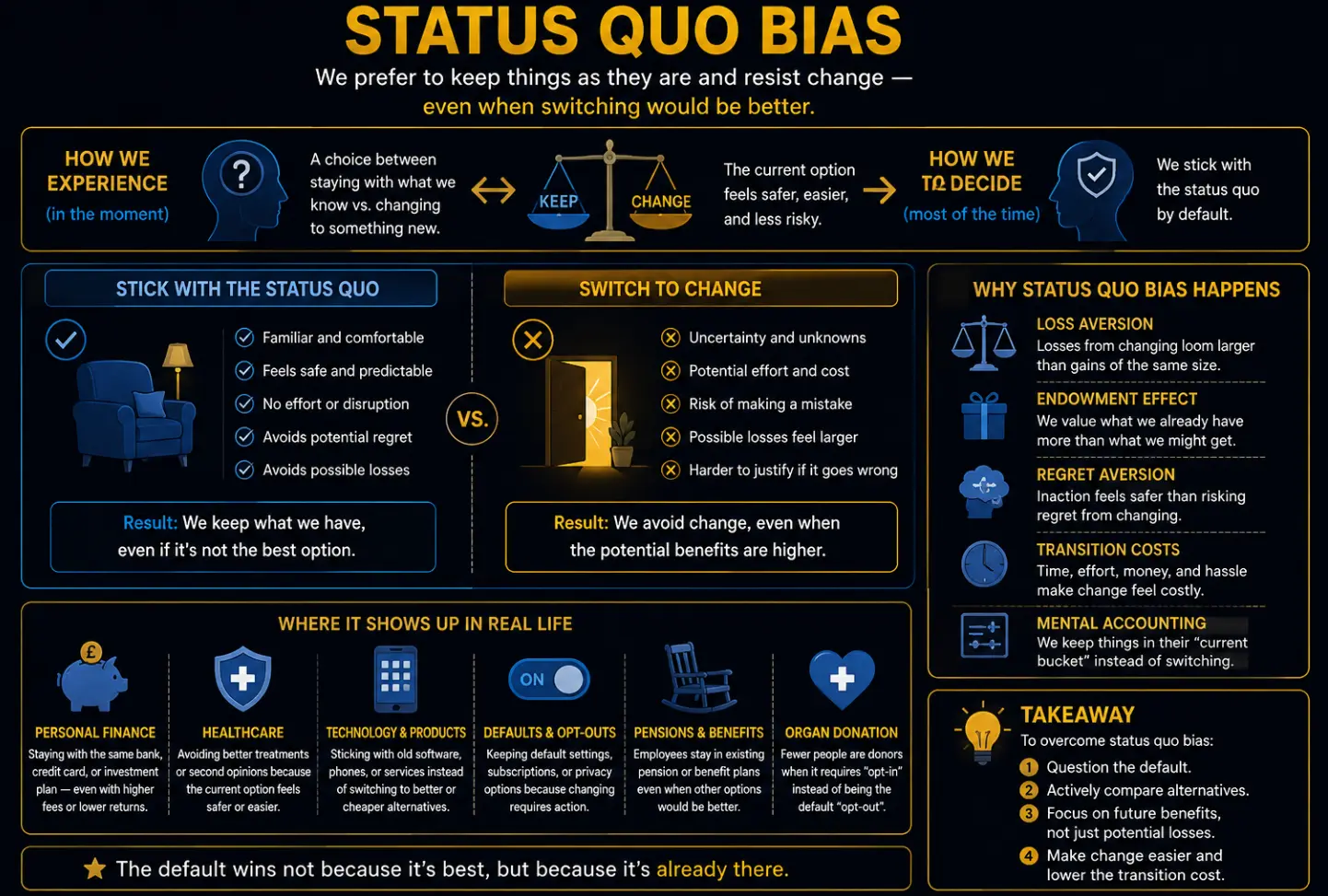
Status quo bias: the default wins not because it is best, but because it is already there — driven by loss aversion, regret aversion, the endowment effect, and the perceived cost of transition.
Status Quo Bias in Real Life — Examples
In personal finance, status quo bias is one of the most significant drivers of suboptimal outcomes. People stay in savings accounts with poor interest rates because switching feels effortful, even when the financial gain from switching is clear and substantial. Investors hold underperforming assets longer than is rational because selling would crystallise a loss and require committing to a new position — both of which trigger loss aversion. Pension savers frequently remain in the default investment fund chosen at enrolment, regardless of whether it remains the most suitable option for their current circumstances.
In healthcare, status quo bias causes patients to continue with treatments that are no longer optimal, to remain with healthcare providers they have grown dissatisfied with, and to avoid seeking second opinions on diagnoses they have accepted. The existing treatment plan, the existing diagnosis, and the existing provider relationship all carry the psychological weight of the status quo — departing from them requires overcoming a bias toward continuation that has nothing to do with the clinical merits of the alternatives.
In technology and product adoption, status quo bias explains a significant portion of the gap between awareness of superior alternatives and actual switching behaviour. Users remain on outdated software, older devices, and inferior platforms not because the alternatives are unknown or inaccessible, but because the friction and perceived risk of switching outweighs the objectively assessed benefit — particularly when loss aversion amplifies the perceived downside of a transition that does not go smoothly.
Status Quo Bias and Default Options
One of the most practically significant applications of status quo bias is in the design of default options. Because people systematically favour whatever option is already in place, the choice of default has enormous influence on outcomes — far greater than rational choice theory would predict. Opt-out organ donation systems produce substantially higher donor registration rates than opt-in systems, with no change in the information available to people or the effort required to change the outcome. Default enrolment in workplace pension schemes produces higher participation rates than voluntary enrolment, with the same level of employee choice available in both cases.
This is the basis of the nudge architecture developed by Thaler and Sunstein: because status quo bias makes defaults sticky, setting the right default can effectively guide the majority of people toward better outcomes without restricting their freedom to choose otherwise. The default does not just reflect where people start — it shapes where they end up, because most people never move from it.
Status Quo Bias vs. Rational Inertia
It is important to distinguish status quo bias from rational reasons to prefer the current state. Genuine switching costs — the time, money, and effort required to change — are real and should influence decisions. Uncertainty about alternatives is a legitimate reason for caution. Familiarity with the current option reduces error rates and transition friction. These are not biases; they are reasonable inputs to a decision. Status quo bias refers to the preference for the current state that persists even after these legitimate factors have been accounted for — the residual tendency to favour inaction that cannot be explained by the rational merits of the status quo. Separating the rational and the biased components of inertia is the practical challenge in any situation where staying put feels like the obvious choice. This distinction also applies to sunk cost fallacy, where past investment in the status quo adds another irrational weight to the pull toward continuation.
How to Overcome Status Quo Bias
Treat the status quo as just another option
The most direct counter to status quo bias is to explicitly remove the special status the current situation enjoys in the evaluation. Rather than asking "is there a good enough reason to change?", ask "if I were starting from scratch with no current position, which option would I choose?" This reframe eliminates the asymmetry between the status quo and the alternatives, placing all options on equal footing and requiring the current state to justify itself on its merits rather than its incumbency.
Identify what you are actually losing by not changing
Status quo bias operates through loss aversion — the potential losses from switching loom larger than the potential gains. A deliberate corrective is to enumerate what you are losing by not switching: the interest rate differential, the treatment improvement, the career opportunity foregone, the time spent on an inferior product. Making the costs of inaction as vivid as the costs of action counteracts the asymmetry that drives the bias. The framing effect is directly relevant here — restating the status quo in loss-frame terms ("staying costs me X per year") rather than gain-frame terms ("switching would gain me X") can shift the perceived balance of the decision.
Set a time limit for reviewing the status quo
One practical mechanism for reducing status quo bias in ongoing decisions — financial, professional, personal — is to establish a regular review schedule that requires the current arrangement to be actively reaffirmed rather than passively continued. Rather than remaining in a plan until a reason to leave arises, the plan must justify itself at each review. This shifts the default from continuation to active choice, reducing the power of inertia to maintain suboptimal arrangements indefinitely without scrutiny.
The Deeper Point
Status quo bias reveals that what people choose is not simply a function of what they prefer — it is also a function of where they start. The current state is not just one option among equals; it is the reference point that shapes how all alternatives are perceived, the anchor against which gains and losses are measured, and the beneficiary of the asymmetric aversion to loss that makes departures feel riskier than they actually are. Defaults are not neutral; they are powerful determinants of outcomes, and their power flows directly from status quo bias.
Understanding status quo bias does not mean treating all inertia as irrational. It means developing the habit of asking whether the current state is genuinely preferred on its merits or merely benefiting from its incumbency — and being willing to make the comparison on equal terms when the answer matters.
Related biases worth exploring alongside this one: sunk cost fallacy, which adds the weight of past investment to the pull toward the status quo; framing effect, whose loss-frame power is the primary mechanism driving status quo bias; and anchoring bias, which similarly uses the current state as a reference point that distorts the evaluation of alternatives.
The Cognitive Bias Spotter Test below puts that understanding to work — see if you can identify status quo bias and the other nine biases when they appear in realistic scenarios.