Peak-End Rule — Meaning, Examples & How to Overcome It
Mind · Cognitive Biases · Memory & Judgment family
Test yourself — can you spot the bias in each scenario? Take the Cognitive Bias Spotter Test. Jump to the test ↓
What Is the Peak-End Rule? Simple Definition
The peak-end rule is the tendency to judge an experience not by the average of how it felt throughout, nor by its total duration, but almost entirely by two moments: the most emotionally intense point — the peak — and how it felt at the end. Everything in between is largely discarded from the retrospective evaluation. A long, mostly pleasant experience that ends badly is remembered as worse than a short unpleasant one that ended on a slightly less bad note. The memory does not faithfully represent the experience — it compresses it into two snapshots and treats those snapshots as the whole.
This page is part of the cognitive biases guide on our free brain training and cognitive assessment tools, alongside interactive tools covering memory, attention, reaction time, and decision-making.
Peak-End Rule Meaning & Psychology
The peak-end rule was identified and named by Daniel Kahneman and Barbara Fredrickson, who developed the snapshot model of remembered utility — the idea that when people evaluate a past experience, they do not mentally replay every moment but instead draw on a small number of emotionally representative snapshots, particularly the peak and the end. Fredrickson & Kahneman (1993) demonstrated duration neglect in two experiments in which participants watched aversive and pleasant film clips of varying lengths. When asked to evaluate the clips retrospectively, participants' ratings were determined almost entirely by the intensity of the peak moment and the feeling at the end — the duration of the clip had virtually no independent effect on overall evaluation.
The most striking demonstration of the rule came from the cold water experiment reported by Kahneman, Fredrickson, Schreiber & Redelmeier (1993). Participants were exposed to two trials. In the short trial, they held one hand in 14°C water for 60 seconds — consistently painful throughout. In the long trial, they held the other hand in 14°C water for 60 seconds, and then kept it submerged for a further 30 seconds as the water temperature was gradually raised to 15°C — still uncomfortable but slightly less so than before. When asked which trial they would prefer to repeat, a significant majority chose the long trial, despite its longer total exposure to pain. The slightly less painful ending of the long trial outweighed its greater total duration of discomfort. The memory of the long trial was better because it ended better — not because it was less painful overall, which it was not.
Duration neglect
The companion phenomenon to the peak-end rule is duration neglect: the finding that the length of an experience has little independent influence on how it is retrospectively evaluated. A painful procedure lasting ten minutes and one lasting thirty minutes are not evaluated as three times as bad; if their peaks and endings are similar, they are evaluated as roughly equivalent. This is a fundamental violation of the intuitive assumption that experience accumulates — that more time in a positive state is better and more time in a negative state is worse. Duration neglect means that this accumulation is largely absent from retrospective evaluation, even when it is present in the moment-to-moment experience itself.
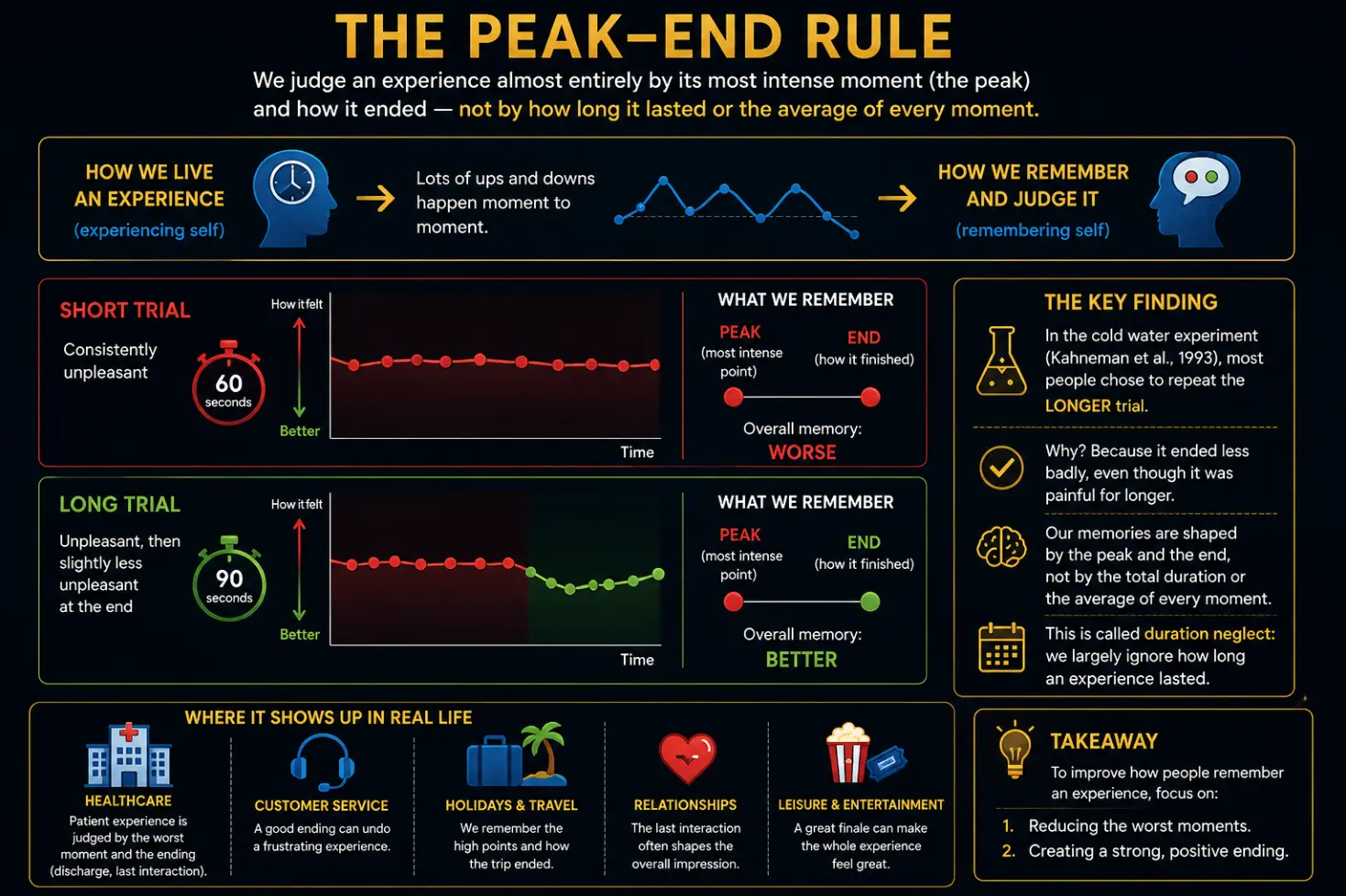
The peak-end rule: we judge experiences by their most intense moment and how they ended — not by duration or the average of every moment. The cold water experiment showed that most people preferred to repeat the longer trial because it ended less badly, despite involving more total pain.
Peak-End Rule in Real Life — Examples
In healthcare, the peak-end rule has direct implications for patient experience and treatment compliance. A medical procedure that involves a very painful moment followed by a period of reduced discomfort at the end will be remembered more favourably than one in which the highest pain level occurs at the end — even if the total amount of pain experienced is greater in the former. This is not a trivial observation: it suggests that small modifications to the sequencing of painful procedures — allowing a brief period of reduced discomfort at the end rather than stopping at the peak — can substantially improve patients' retrospective evaluations and their willingness to return for follow-up care. Redelmeier and Kahneman's subsequent research on colonoscopy patients confirmed the peak-end effect in a real clinical setting.
In customer service and consumer experience, the peak-end rule predicts that how an interaction ends matters disproportionately to how it is remembered. A customer service call that resolves a problem efficiently but ends abruptly will be remembered less favourably than one that takes slightly longer but ends with a warm, confirming close. Hotel and restaurant experiences are similarly shaped by the quality of the checkout and departure moments — a final poor experience can suppress the memory of a largely positive stay, and a final positive moment can rescue the memory of an otherwise mediocre one.
In personal relationships and social interactions, the peak-end rule means that the emotional tenor of a conversation's ending has disproportionate weight in how the conversation is remembered and how the relationship is subsequently experienced. An argument that ends with a gesture of reconciliation is remembered differently from one that ends with unresolved tension, even if the overall content of both arguments was similar. This is why the skill of managing endings — conversations, visits, projects — is genuinely important to the quality of remembered experience, and not merely a social nicety.
Peak-End Rule in Holidays and Leisure
The peak-end rule produces the well-documented phenomenon in which a holiday that ends with a problem — a delayed flight, a difficult final evening, a lost bag — is remembered as substantially worse than one that ended smoothly, even when the problematic ending occupied only a small fraction of the total holiday. Conversely, a holiday with a spectacular final experience — a memorable last dinner, an unexpected encounter, a beautiful final day — benefits disproportionately from that ending in retrospective evaluation.
This has practical implications for how leisure experiences are designed and how individuals manage their own experience. Planning the best moment of a holiday for near the end rather than the middle maximises the remembered value of the experience as a whole — not because the actual experience changes, but because the memory is shaped by the peak-end rule rather than by a faithful average of all moments.
The Experiencing Self vs. The Remembering Self
Kahneman distinguished between what he called the experiencing self — the self that lives through each moment — and the remembering self — the self that evaluates experiences retrospectively and uses those evaluations to make decisions. The peak-end rule is a property of the remembering self. The experiencing self does accumulate experience over time; it does feel the difference between ten and thirty minutes of pain. But the remembering self discards most of this information, retaining only the peak and the end.
This distinction matters because most decisions about whether to repeat or avoid experiences are made by the remembering self on the basis of memory, not by the experiencing self on the basis of current feeling. When you decide whether to return to a restaurant, book the same holiday again, or agree to a medical procedure, you are consulting your memory — and your memory has been constructed according to the peak-end rule rather than by accurate averaging of your actual experience. The remembering self, not the experiencing self, governs choice. This connects directly to how availability heuristic operates: the most emotionally vivid moments — the peaks and endings — are also the most available in memory, compounding their influence on subsequent decisions.
How to Overcome the Peak-End Rule
Actively recall the full duration of an experience before evaluating it
When forming a retrospective judgment about an experience — whether to repeat it, how good it was, how to describe it — deliberately try to recall the middle as well as the peak and end. Ask: what was most of the experience like? What fraction of the total time was spent at the peak intensity, and what fraction was spent at more moderate levels? This exercise does not override the peak-end rule automatically, but it introduces information about duration and overall pattern that would otherwise be absent from the evaluation.
Separate the question of how it felt from how it ended
For important decisions driven by memory — whether to pursue a medical treatment again, whether to return to a relationship, whether to accept a job in a particular type of role — it is worth explicitly asking: am I evaluating this experience as a whole, or am I mainly evaluating how it ended? If the ending was atypically good or bad relative to the overall experience, adjusting for that atypicality produces a more accurate evaluation and better decisions.
Design endings deliberately when you have the ability to do so
In contexts where you can influence how an experience ends — a meeting, a service interaction, a project delivery, a difficult conversation — investing in a positive ending produces disproportionate returns in how the experience is remembered. This is not manipulation; it is an accurate understanding of how memory works and using that understanding to improve the quality of remembered experience for all parties involved. This is also relevant to how recency bias operates — the most recent information carries disproportionate weight, and the end of an experience is both recent and emotionally salient.
The Deeper Point
The peak-end rule reveals a fundamental discontinuity between living an experience and remembering it. The two are not the same process, they do not produce the same output, and decisions made on the basis of memory are decisions made on the basis of a systematically distorted representation of what the experience actually contained. Duration is discarded; most of the middle is discarded; only two moments are retained and averaged to produce the remembered utility that drives future choices.
This is not a flaw that can be corrected by trying harder to remember accurately. It is a feature of how memory encodes experience — a compression that trades completeness for speed and manageability. Understanding it makes possible more deliberate evaluation of past experiences and more thoughtful design of future ones.
Related biases worth exploring alongside this one: availability heuristic, which similarly gives disproportionate weight to vivid, emotionally intense memories; recency bias, which over-weights recent information and interacts with the peak-end rule's emphasis on endings; and negativity bias, which amplifies the peak-end effect when the peak is negative — a negative peak dominates retrospective evaluation even more strongly than the rule alone would predict.
The Cognitive Bias Spotter Test below puts that understanding to work — see if you can identify the peak-end rule and the other nine biases when they appear in realistic scenarios.