Negativity Bias — Meaning, Examples & How to Overcome It
Mind · Cognitive Biases · Judgment & Decision-Making family
Test yourself — can you spot the bias in each scenario? Take the Cognitive Bias Spotter Test. Jump to the test ↓
What Is Negativity Bias? Simple Definition
Negativity bias is the tendency for negative events, information, emotions, and experiences to have a disproportionately greater impact on psychological state and behaviour than positive ones of equivalent magnitude. Bad is stronger than good — not occasionally and not in extreme circumstances, but consistently, across a wide range of domains, and by a substantial margin. A single criticism weighs more heavily than several compliments. A single bad day lingers longer than a good one. A financial loss of £100 is more painful than a gain of £100 is pleasurable. The asymmetry is not modest; it is pervasive and deeply embedded in human cognition.
This page is part of the cognitive biases guide on our free cognitive tests and brain training platform, alongside interactive tools covering memory, attention, reaction time, and decision-making.
Negativity Bias Meaning & Psychology
The systematic nature of negativity bias was documented comprehensively by Rozin & Royzman (2001), who identified four distinct components of the phenomenon. Negative potency refers to the fact that negative entities are simply stronger than equivalent positive ones — a bad smell is more aversive than a good smell is pleasant at the same intensity. Steeper negative gradients refers to the finding that the negative impact of bad events increases more rapidly as they approach in time or space than the positive impact of good events does. Negativity dominance describes the tendency for mixtures of negative and positive elements to be evaluated more negatively than a simple averaging of their individual values would predict — one bad apple spoils the barrel. Negative differentiation refers to the greater variety and conceptual complexity of negative categories relative to positive ones: humans have more words for negative emotions, negative personality traits, and negative outcomes than for their positive counterparts.
A landmark review by Baumeister, Bratslavsky, Finkenauer & Vohs (2001) surveyed the evidence across multiple domains — everyday events, major life events, trauma, close relationships, learning, and information processing — and concluded that the asymmetry between negative and positive is one of the most general and consistent findings in psychological research. Bad emotions have more impact than good ones. Bad feedback is more influential than good feedback. Bad information is processed more thoroughly and retained more accurately than good information. Bad impressions of people form more quickly and are more resistant to revision than good ones.
The evolutionary basis of negativity bias
The most widely accepted explanation for negativity bias is evolutionary. In environments where survival depended on detecting and responding to threats — predators, hostile competitors, toxic food — failing to respond to a genuine danger was far more costly than failing to respond to a genuine opportunity. Missing a meal is bad; being eaten is worse. This asymmetry in the costs of false negatives (missing a threat) versus false positives (responding to a non-threat) created selection pressure for a system that errs strongly on the side of threat sensitivity — a system that, in modern environments where most threats are social rather than mortal, produces systematic over-weighting of negative information relative to its actual significance.
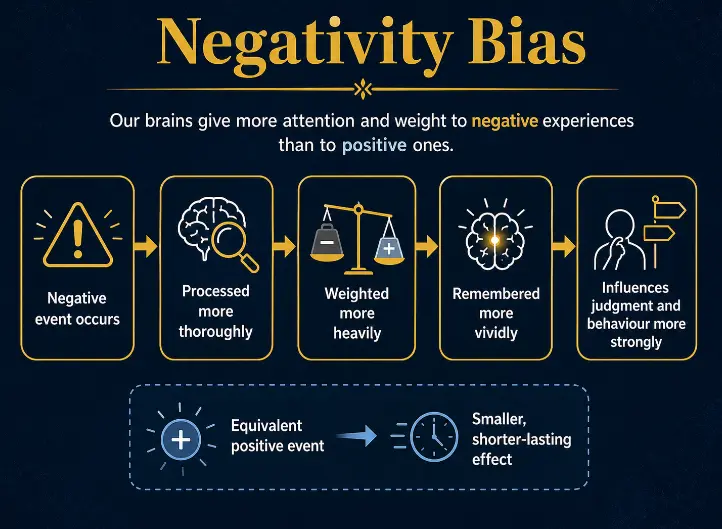
Negativity bias: negative events are processed more thoroughly, weighted more heavily, and remembered more vividly than equivalent positive ones — which produce a smaller, shorter-lasting effect on judgment and behaviour.
Negativity Bias in Real Life — Examples
In personal relationships, negativity bias means that negative interactions carry substantially more weight than positive ones in determining overall relationship satisfaction. Research on couples consistently finds that the ratio of positive to negative interactions required to maintain a stable, satisfying relationship is considerably higher than one-to-one — one critical remark requires multiple positive exchanges to counterbalance its effect. A single argument, a single harsh word, or a single act of perceived betrayal can overshadow a large accumulated store of positive shared experience. This is not irrationality on the part of the relationship partners — it is negativity bias operating exactly as it was designed to operate, treating social threats as more urgent than social rewards.
In professional settings, negative feedback from a manager or colleague tends to be remembered more accurately, dwelt upon more extensively, and given more weight in self-assessment than equivalent positive feedback. A performance review that contains one significant criticism alongside multiple genuine compliments is typically remembered primarily as negative, with the compliments fading faster than the criticism. This produces a systematic distortion in self-perception and motivation — people who receive predominantly positive evaluations with isolated criticisms often leave the experience feeling evaluated negatively overall.
In consumer and reputational contexts, negativity bias drives the well-documented asymmetry between the impact of negative and positive reviews. A single strongly negative review suppresses purchase intent more than a single strongly positive review boosts it. A single well-publicised product failure or corporate scandal damages brand reputation more than a comparable success enhances it. Reputational damage is systematically harder to repair than it was to build — a direct consequence of the greater weight, persistence, and resistance-to-revision of negative impressions.
Negativity Bias and News Consumption
News media operate in an environment that is shaped by negativity bias on both the supply and demand side. Audiences attend more readily to threatening, alarming, and negative content — a product of evolved threat-detection systems that scan for danger. Media outlets that optimise for audience engagement therefore tend to select and frame stories in negative terms, reinforcing the cognitive availability of negative events and creating a feedback loop in which the world appears more dangerous, more conflicted, and more dysfunctional than a balanced accounting of events would suggest.
This connects closely to the availability heuristic: negative events that are heavily covered in media become highly available in memory, leading to systematic overestimation of their frequency and probability. Plane crashes are more cognitively available than car crashes, despite being far rarer; violent crime dominates news coverage relative to its actual statistical prevalence. The combination of negativity bias and availability heuristic produces a persistent and significant distortion in perceived risk.
Negativity Bias in Decision-Making
In decision-making, negativity bias manifests most directly as loss aversion — the tendency for losses to feel approximately twice as painful as equivalent gains feel pleasurable. This is the mechanism behind the framing effect: the same information presented as a potential loss produces more risk-seeking behaviour than the same information presented as a potential gain, because the loss frame activates the stronger negative valence system. It is also behind the status quo bias — the tendency to prefer inaction to action when action risks a loss, even when the expected value of acting is positive.
In organisational decision-making, negativity bias contributes to excessive risk aversion, the over-weighting of potential downsides relative to potential upsides, and a systematic tendency to weight negative information in assessments more heavily than positive information of equivalent quality. Negative evidence about a candidate, a strategy, or a proposal is often treated as more diagnostic — more revealing of the true underlying state — than positive evidence of the same strength.
How to Overcome Negativity Bias
Deliberately counterweight negative information with positive
Because negative information is over-weighted automatically, a conscious corrective involves deliberately seeking out and attending to positive information that would otherwise be given insufficient weight. This is not the same as wishful thinking or motivated reasoning — it is a calibration exercise that adjusts for a known systematic error. In performance evaluation, it means actively cataloguing positive evidence before allowing negative evidence to dominate. In risk assessment, it means explicitly enumerating the potential upsides of a decision rather than allowing the potential downsides to monopolise attention.
Apply a proportionality check to negative reactions
When a negative event, criticism, or piece of information produces a strong reaction, ask: is the intensity of this reaction proportionate to the actual significance of the event? Negativity bias produces reactions that are calibrated to a threat-sensitivity system that over-responds to social and informational threats because it was designed to over-respond to physical ones. The question is not whether the negative thing is real — it is whether the size of the response is appropriate to the size of the thing. This proportionality check interrupts the automatic amplification that negativity bias produces.
Track positive events explicitly
Because positive events are processed less thoroughly and remembered less vividly, they can be systematically under-represented in the running record of experience that informs mood, self-assessment, and judgment. Keeping an explicit record of positive events — gratitude journaling, deliberate reflection on what went well — is not a platitude; it is a calibration strategy that compensates for the asymmetric processing that otherwise causes positive experience to leave a smaller memory trace than negative experience of equivalent significance. This is also relevant to the recency bias interaction: recent negative events tend to dominate the record even more than older ones, further compressing the perceived proportion of positive experience.
The Deeper Point
Negativity bias is not a cognitive error in the way that many other biases are. It is a feature of a system that was well-adapted to environments where threat detection was the primary survival challenge. In modern environments, where the most significant decisions involve social relationships, professional performance, financial planning, and personal wellbeing rather than physical survival, the same feature produces systematic distortions: over-weighting of criticism, excessive risk aversion, distorted perception of prevalence and danger, and a persistent pull toward negative evaluation of self, others, and circumstances.
Understanding negativity bias does not neutralise it — the asymmetry is deeply embedded and operates largely automatically. But it makes possible the deliberate compensatory practices that can reduce its distorting influence on the domains where calibrated, evidence-based judgment matters most.
Related biases that are directly driven or amplified by negativity bias: availability heuristic, which combines with negativity bias to produce systematic overestimation of risk; framing effect, whose loss-frame power derives from the underlying negativity asymmetry; and horn effect, which reflects negativity bias operating in person perception — one negative trait suppresses the evaluation of everything else.
The Cognitive Bias Spotter Test below puts that understanding to work — see if you can identify negativity bias and the other nine biases when they appear in realistic scenarios.