Framing Effect — Meaning, Examples & How to Overcome It
Mind · Cognitive Biases · Judgment & Decision-Making family
Test yourself — can you spot the bias in each scenario? Take the Cognitive Bias Spotter Test. Jump to the test ↓
What Is the Framing Effect? Simple Definition
The framing effect is the tendency for people to make different decisions depending on how the same information is presented — whether it is framed in terms of gains or losses, positive or negative outcomes, percentages or absolute numbers — even when the underlying facts are logically identical. The frame does not change the reality being described; it changes how that reality is perceived, and those perceptual differences produce measurable differences in judgment and choice.
A simple example: people respond more favourably to a medical treatment described as having a 90% survival rate than to the same treatment described as having a 10% mortality rate. The two statements are mathematically equivalent — they describe the same outcome — but the gain frame (survival) produces more positive evaluations and greater willingness to proceed than the loss frame (mortality). The content is the same; the frame is different; the decision changes.
This page is part of the cognitive biases guide on our free cognitive assessment and brain training platform, alongside interactive tools covering memory, attention, reaction time, and decision-making.
Framing Effect Meaning & Psychology
The framing effect was identified and formalised by Amos Tversky and Daniel Kahneman in a landmark study that remains one of the most cited experiments in behavioural science. In their classic Asian Disease Problem, Tversky & Kahneman (1981) presented participants with a scenario in which an unusual disease was expected to kill 600 people, and two programmes had been proposed to address it. One group of participants received the options framed in terms of lives saved (gain frame): Programme A would save 200 people; Programme B had a one-third probability of saving all 600 and a two-thirds probability of saving none. A second group received the same options framed in terms of lives lost (loss frame): Programme A would result in 400 deaths; Programme B had a one-third probability of no deaths and a two-thirds probability of 600 deaths. The outcomes described were mathematically identical across both conditions. Yet 72% of participants in the gain frame chose Programme A — the safe, certain option — while only 22% of participants in the loss frame chose it. The framing alone reversed the majority preference.
Prospect theory and loss aversion
Tversky and Kahneman explained the framing effect through prospect theory, which they had developed in earlier work. Prospect theory holds that people evaluate outcomes relative to a reference point — typically the status quo — and that losses are felt more acutely than equivalent gains. Losing £100 is psychologically more painful than gaining £100 is pleasurable, by roughly a factor of two. This asymmetry means that loss-framed presentations of information trigger stronger emotional responses and greater risk-seeking behaviour than gain-framed presentations of the same information — people are willing to take risks to avoid losses that they would not take to achieve equivalent gains.
Three types of framing
Subsequent research expanded the framing effect beyond risky choice. Levin, Schneider & Gaeth (1998) developed an influential typology identifying three distinct varieties. Risky choice framing — as in the Asian Disease Problem — affects willingness to take risks when options are described as gains versus losses. Attribute framing affects evaluation of objects or events: ground beef labelled "80% lean" is rated more favourably than the same beef labelled "20% fat." Goal framing affects the persuasiveness of communications: a health message emphasising the negative consequences of not performing a behaviour (loss frame) tends to be more effective at prompting action than one emphasising the positive consequences of performing it (gain frame). Each type operates through the same underlying sensitivity to valence but in different decision contexts.
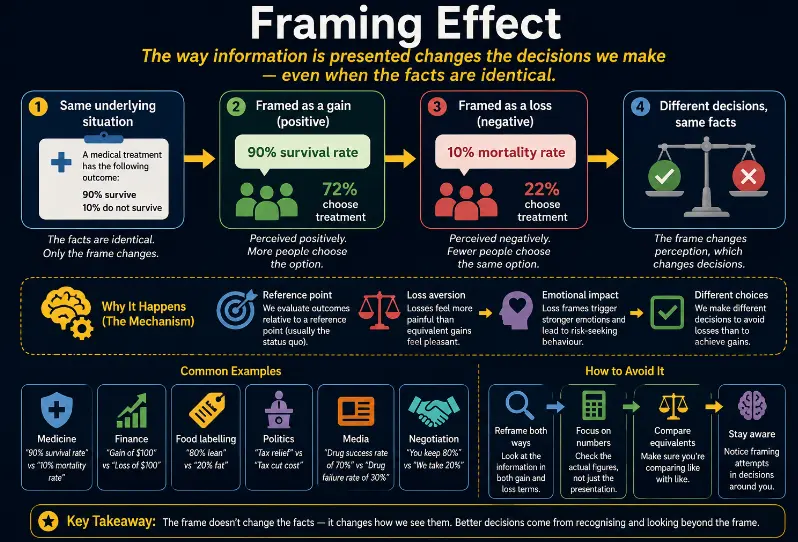
The framing effect: identical facts presented as a gain (90% survival rate) or a loss (10% mortality rate) produce dramatically different decisions — the frame changes perception, not the underlying reality.
Framing Effect in Real Life — Examples
In medicine, framing effects are among the most consequential and best-documented influences on patient and clinician decision-making. Survival statistics and mortality statistics are mathematically equivalent but produce systematically different responses. Patients and doctors alike show greater willingness to pursue a treatment when outcomes are described in terms of survival rates, and greater hesitancy when the same outcomes are described in terms of mortality rates. This is not a trivial difference in presentation preference — it produces measurable differences in treatment uptake and clinical decisions, with real consequences for patient outcomes.
In personal finance and investment, the framing effect shapes how people respond to risk. A fund described as delivering positive returns in 7 out of 10 years is judged more favourably than one described as delivering negative returns in 3 out of 10 years, even though the two descriptions are equivalent. Fees described as "a small monthly charge" feel less significant than the same fee described as an annual total. Prices described as discounts from a higher reference point feel more attractive than the same prices presented without a reference point — which is why retailers so consistently display original prices alongside sale prices.
In food labelling, "95% fat free" and "5% fat" describe the same product, but the former produces more favourable evaluations and higher purchase intent. The gain frame — what the product has more of — reduces the salience of the undesirable attribute. Similarly, "contains real fruit juice" on a product that is predominantly sugar and water draws attention to a positive attribute while the overall nutritional profile recedes into the background.
Framing Effect in Politics and Media
Political communication is saturated with deliberate framing. The same policy can be described as a "tax relief" or a "tax cut for the wealthy"; as "investment in public services" or "government spending"; as "border security" or "immigration restriction." Each framing activates different associations, different emotional responses, and different evaluative frameworks. The underlying policy content is identical, but the frame shapes how it is received and whether it is supported.
News media framing operates similarly. An economic statistic can be reported as "unemployment falls to 4%" or "one in twenty-five workers without a job." A crime statistic can be framed as a rate per hundred thousand or as a raw number. Public health risks can be framed as individual lifestyle failures or as systemic public health problems. Each framing is factually accurate, but each activates different mental models and produces different policy preferences among audiences. Understanding this is relevant to availability heuristic as well — the framing that is most emotionally vivid tends also to be the most available, compounding its influence on judgment.
Framing Effect in Negotiation
In negotiation, the framing effect is a well-established influence on outcomes. Presenting a concession as "what you gain" rather than "what you give up" produces different evaluations of the same concession. Anchoring the negotiation with a high initial offer creates a gain-frame reference point against which subsequent concessions feel like improvements, even when the final agreement is no better than one reached without the anchor. The anchoring bias and the framing effect work closely together in negotiation — the anchor sets the reference point, and the frame determines whether movement from that anchor is perceived as gain or loss.
How to Avoid and Overcome the Framing Effect
Reframe information deliberately in multiple ways
The most direct counter to the framing effect is to actively restate the same information in alternative frames before making a decision. If you are presented with a survival rate, convert it to a mortality rate and consider both. If you are presented with a discount, calculate the actual price and consider whether you would pay it without the reference to the original price. The goal is to ensure that the frame in which information was first presented does not monopolise your evaluation — that you are assessing the underlying facts rather than their packaging.
Identify the reference point being used
Framing effects operate through reference points — the baseline against which gains and losses are measured. Identifying the reference point explicitly reveals the frame: "This is being presented as a gain relative to X — what would it look like relative to a different reference point?" Changing the reference point changes the frame and often changes the emotional valence of the information. Salespeople, negotiators, and advertisers invest heavily in setting reference points precisely because the reference point determines the frame.
Apply consistent decision criteria across frames
A more systematic defence against framing is to develop explicit decision criteria before encountering framed information — criteria that apply regardless of how options are presented. If your criterion for a medical decision is expected value and risk tolerance, apply those criteria to the underlying numbers, not to the framed presentation. If your criterion for a purchase is value for money at the actual price, apply that criterion rather than responding to the discount frame. Criteria set in advance are more resistant to framing than evaluations made in response to presented options. This connects to the corrective for anchoring bias — establishing your own reference point before being exposed to someone else's.
The Deeper Point
The framing effect is one of the most robust and consequential findings in cognitive psychology. Unlike some biases that operate only in specific conditions or with weak effects, framing has been replicated across cultures, age groups, levels of education, and domains of decision-making. It affects experts and novices alike — doctors, judges, financial professionals, and ordinary decision-makers all show measurable framing effects under appropriate conditions.
The implication is not that all framings are equal or that language is arbitrary. It is that the psychological response to information is not determined solely by the information's content, but also by its presentation — and that this sensitivity to presentation is systematic, predictable, and exploitable. Recognising the framing effect is the first step toward ensuring that important decisions are made on the basis of the underlying facts rather than on the basis of the frame through which those facts were delivered.
Related biases that interact closely with this one: anchoring bias, which similarly operates through reference point manipulation; loss aversion, which is the underlying asymmetry that makes gain and loss frames produce different responses; and availability heuristic, which interacts with vivid loss frames to amplify risk perception beyond what the underlying probabilities warrant.
The Cognitive Bias Spotter Test below puts that understanding to work — see if you can identify the framing effect and the other nine biases when they appear in realistic scenarios.