Moral Licensing — Meaning, Examples & How to Overcome It
Mind · Cognitive Biases · Self-Regulation family
Test yourself — can you spot the bias in each scenario? Take the Cognitive Bias Spotter Test. Jump to the test ↓
What Is Moral Licensing? Simple Definition
Moral licensing is the tendency for people who have recently done something virtuous, ethical, or praiseworthy to subsequently behave in ways that are less moral, less ethical, or more self-indulgent — as though the earlier good deed has earned them a kind of credit that makes the later lapse permissible. Doing something good appears to license doing something bad. The moral balance sheet goes up, and then the person draws it back down.
The effect is counterintuitive because it runs against the expectation that virtuous behaviour builds virtuous habits and that people who care about acting well will be consistently motivated to do so. Instead, the psychological record of past good behaviour appears to reduce the motivation to continue behaving well — at least temporarily — as though the self-image of being a good person has been sufficiently established and no longer needs reinforcement.
This page is part of the cognitive biases guide on our free cognitive tests and brain training tools, alongside interactive tools covering memory, attention, reaction time, and decision-making.
Moral Licensing Meaning & Psychology
The psychological framework for moral licensing was systematised by Merritt, Effron & Monin (2010), who reviewed the research on what they called moral self-licensing — the phenomenon in which past good deeds liberate individuals to engage in behaviours that are immoral, unethical, or otherwise problematic, behaviours they would otherwise avoid for fear of feeling or appearing immoral. Their review identified two distinct mechanisms by which prior good behaviour produces subsequent moral laxity.
The first mechanism is moral credits: the idea that good deeds accumulate as a positive balance in a moral ledger, which can then be drawn down by subsequent less-virtuous behaviour. The ledger metaphor implies that morality is a balance to be maintained at some acceptable level rather than a standard to be consistently upheld — good deeds provide headroom for bad ones. The second mechanism is moral credentials: prior good behaviour establishes evidence that one is a moral person, and this evidence then licenses behaviour that would otherwise signal immorality, because the established credentials reframe the behaviour as inconsistent with prejudice, selfishness, or wrongdoing. The person can engage in behaviour that looks problematic because their track record demonstrates that they are not, in fact, the kind of person who acts badly.
Two pathways to the same outcome
Both mechanisms produce the same observable outcome — prior virtue leads to subsequent lapse — but through different psychological routes. Credits work through a feeling of earned indulgence: "I've been good enough that I can afford this." Credentials work through a reframing of identity: "My past behaviour proves I'm not a bad person, so this action doesn't mean what it would mean coming from someone else." In practice both can operate simultaneously, and distinguishing them is less important for everyday purposes than recognising that both are real.
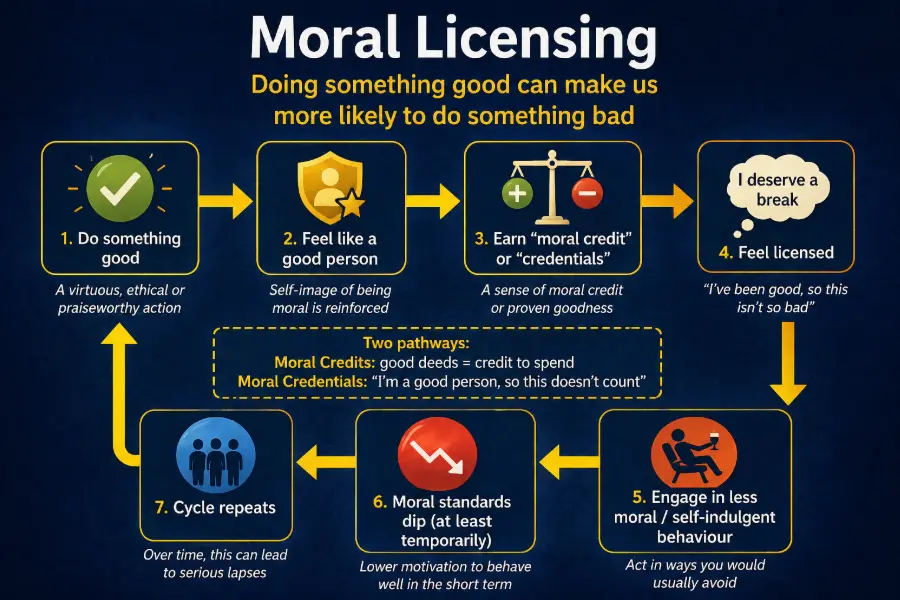
Moral licensing: a good deed earns moral credits or credentials, which produce a sense of licence — leading to less virtuous behaviour and a temporary dip in moral standards before the cycle repeats.
Moral Licensing in Real Life — Examples
The most frequently cited everyday example of moral licensing is in health behaviour. A person who exercises in the morning feels licensed to eat a larger or less healthy meal later in the day — the exercise has earned the indulgence. A person who orders a salad feels licensed to add a dessert. The virtuous first choice reduces the motivation to make a virtuous second choice, even though the two choices are separate and the logic of the licence is faulty: eating a large dessert after a salad produces the same caloric outcome regardless of whether the first choice was virtuous.
In environmental behaviour, moral licensing appears as the tendency of people who engage in one environmentally virtuous act — recycling, buying organic food, taking public transport — to subsequently feel less obligated to take other environmental steps. The prior virtuous act establishes green credentials that then reduce the felt urgency to act further. This is a practical problem for environmental campaigns that focus on single-behaviour changes: the change may license reduced commitment to broader environmental behaviour rather than initiating a virtuous cycle.
In charitable and prosocial behaviour, people who have recently donated to a cause, volunteered their time, or helped someone in need show reduced willingness to do so again in the immediate period after the act. The prior act of generosity licenses reduced generosity subsequently, even when the need it was addressing is ongoing.
Moral Licensing in Organisations and Leadership
Moral licensing is particularly consequential in organisational and leadership contexts. A manager with a track record of fair and inclusive hiring decisions may, on the strength of those credentials, make a subsequent decision that disadvantages a minority candidate — and feel justified in doing so because the prior record demonstrates that the decision is not discriminatory. The credentials provide cover for behaviour that, absent those credentials, would be recognised as problematic.
Leaders who have publicly committed to ethical standards, transparent governance, or social responsibility may feel that these commitments provide latitude for subsequent decisions that compromise those standards, precisely because the public commitment has established their moral credentials. The stronger and more visible the prior commitment, the more powerful the licensing effect it can generate.
Moral Licensing and Identity
Moral licensing is fundamentally about identity maintenance rather than morality per se. People are not primarily motivated to act morally in each individual situation; they are motivated to maintain a self-image as a moral person at some acceptable level. Once that self-image has been adequately reinforced by a prior virtuous act, the motivational pressure to continue acting morally is reduced. The identity goal has been satisfied for the time being.
This framing connects moral licensing to broader patterns of self-regulation. The same logic appears in many non-moral domains: a dieter who has been disciplined all week feels licensed to indulge on the weekend; a student who has worked hard all term feels licensed to coast in the final weeks. In each case, the prior virtuous behaviour satisfies the identity goal — "I am disciplined," "I am hardworking" — and that satisfaction reduces the felt need to continue earning the identity through consistent behaviour. This connects to the pattern described in self-serving bias, where the self-image is protected by attributing positive outcomes to stable character rather than to specific behaviours that require ongoing maintenance.
How to Avoid and Overcome Moral Licensing
Treat moral behaviour as a standard, not a balance
The most direct counter to moral licensing is to reframe moral behaviour as a standard to be consistently upheld rather than a balance to be maintained at an acceptable level. This means evaluating each decision on its own merits — "Is this the right thing to do?" — rather than in relation to a moral ledger — "Have I earned this?" Each action is independent of prior actions in terms of its ethical content, even if prior actions have established a record. The record does not change whether the current action is right or wrong.
Recognise the licensing feeling as a signal to pause
The subjective experience of moral licensing — the feeling that a prior good deed has earned you some latitude — is itself a recognisable cognitive state. Learning to notice that feeling and treat it as a signal to pause and evaluate, rather than as a justification to proceed, interrupts the automatic translation of prior virtue into present laxity. The feeling of having earned something is not the same as having actually earned it, and recognising the difference requires noticing the feeling in the moment.
Focus on behavioural commitments rather than identity credentials
Moral credentials work by establishing identity — "I am a good person" — which then licenses behaviour inconsistent with that identity because the identity is already secured. A more robust approach is to focus commitments on specific behaviours rather than on identity claims: "I will do X" rather than "I am the kind of person who does X." Behavioural commitments are evaluated against specific actions and are not discharged by prior demonstrations. Identity commitments are evaluated against a self-image that can be satisfied by accumulated evidence and then drawn upon. This distinction also reduces the interaction with confirmation bias, which selectively attends to evidence that confirms the established moral self-image while discounting evidence that challenges it.
The Deeper Point
Moral licensing reveals that moral motivation is more fragile and more tactical than the idea of character as a stable disposition suggests. People do not simply have or lack moral character that expresses itself consistently across situations; they manage a moral self-image in response to prior behaviour, social context, and identity goals, and this management produces systematic patterns — including the pattern in which virtue enables vice.
Understanding moral licensing is not a counsel of cynicism about human goodness. It is a more accurate picture of how moral motivation actually operates — one that makes it possible to design behaviour and commitments in ways that are less susceptible to the licensing effect. The practical implication is straightforward: do not treat good deeds as credit. Treat them as the baseline from which the next decision is made independently.
Related biases worth exploring alongside this one: self-serving bias, which similarly protects the moral self-image by attributing good outcomes to character and bad ones to circumstance; overconfidence effect, which inflates assessment of one's own moral consistency and resistance to temptation; and sunk cost fallacy, which similarly treats past investment — in this case, past moral behaviour — as a resource that should influence present decisions in ways that the actual merits of those decisions do not warrant.
The Cognitive Bias Spotter Test below puts that understanding to work — see if you can identify moral licensing and the other nine biases when they appear in realistic scenarios.