Fundamental Attribution Error — Meaning, Examples & How to Overcome It
Mind · Cognitive Biases · Social & Self-Perception family
Test yourself — can you spot the bias in each scenario? Take the Cognitive Bias Spotter Test. Jump to the test ↓
What Is the Fundamental Attribution Error? Simple Definition
The fundamental attribution error is the tendency to over-attribute other people's behaviour to their personal character, personality, or disposition — while underweighting the situational, contextual, and external factors that may be driving their behaviour. When someone cuts you off in traffic, you conclude they are an aggressive or selfish person, rather than considering that they may be rushing to a hospital. When a colleague misses a deadline, you conclude they are disorganised or uncommitted, rather than considering the pressures and obstacles they may be facing.
In plain terms: we judge others by what they do; we judge ourselves by the circumstances we are in. The same behaviour that you would explain situationally in your own case is explained dispositionally when you observe it in someone else.
This page is part of the cognitive biases guide on our free cognitive tests and brain training platform, alongside interactive tools covering memory, attention, reaction time, and decision-making.
Fundamental Attribution Error Meaning & Psychology
The foundational study demonstrating the fundamental attribution error was conducted by Jones & Harris (1967). Participants read essays written by college students either supporting or opposing Fidel Castro. In one condition, participants were told the writers had freely chosen their positions; in another, they were told the writers had been assigned their positions by coin toss. When writers had chosen freely, participants attributed the essay's position to the writer's genuine beliefs — which is reasonable. The striking finding was that even when participants knew the writers had been randomly assigned to write a pro- or anti-Castro essay, they still inferred that the essay reflected the writer's actual attitudes. The situational constraint — being told what to write — was insufficient to prevent dispositional attribution. The behaviour was attributed to the person even when the situational cause was known and explicit.
The term "fundamental attribution error" was coined by social psychologist Lee Ross in 1977, who argued that this tendency to over-attribute behaviour to disposition forms the conceptual bedrock of social psychology. The bias is also called the correspondence bias — the tendency to see behaviour as corresponding to the actor's underlying traits, even when situational factors are the more plausible explanation.
Why the brain does this
The fundamental attribution error arises partly from a perceptual asymmetry: when observing someone else's behaviour, the person is what you see. They are the figure; the situation is the background. The situation — the pressures, constraints, incentives, and context shaping the behaviour — is less visually salient and less cognitively available. The person is what captures attention, and so the person becomes the default explanation for the behaviour.
A second mechanism is that you have privileged access to your own situational context. When you are late, you know you were delayed by unexpected traffic; when someone else is late, you do not have access to that information and so the person themselves — their reliability, their values — fills the explanatory gap. This asymmetry in information access produces a consistent asymmetry in attribution: self-attribution is more situational, other-attribution is more dispositional.
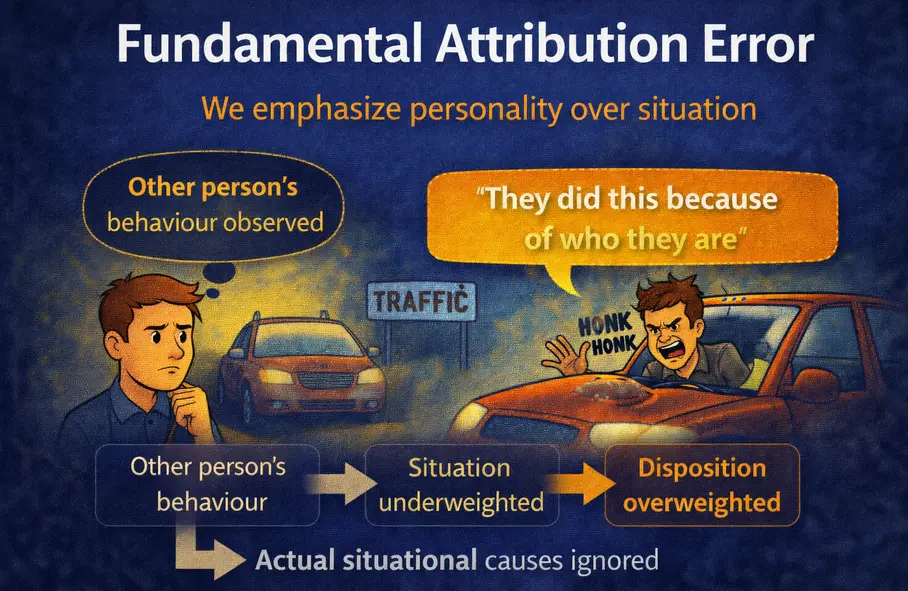
The fundamental attribution error: when we observe someone's behaviour, we underweight the situation and overweight their disposition — concluding "they did this because of who they are" while ignoring the actual situational causes.
Fundamental Attribution Error in Real Life — Examples
The fundamental attribution error shapes everyday social judgment continuously. A person who is short or cold in a conversation is assumed to be unfriendly or rude, rather than stressed, tired, or distracted by a problem. A student who performs poorly on a test is assumed to be less intelligent or less diligent, rather than having been ill, sleep-deprived, or dealing with a personal crisis. A driver who is going slowly is assumed to be incompetent, rather than unfamiliar with the road or cautious in difficult conditions.
The error is particularly consequential in its asymmetry. When the same person who just assumed someone else's rudeness was dispositional then behaves rudely themselves, they do not conclude that they are a rude person — they have full access to the situational explanation for their own behaviour. The result is a social world in which others' failings are seen as character flaws while your own are explained by circumstances — a pattern that generates conflict, blame, and persistent misunderstanding.
Fundamental Attribution Error in the Workplace
In professional settings, the fundamental attribution error shapes how performance, failure, and conflict are understood. When an employee performs poorly, managers tend to attribute the failure to the employee's ability, effort, or motivation — dispositional explanations — rather than to the systems, processes, incentives, or support structures that may have contributed. This leads to personnel decisions — dismissal, demotion, negative performance reviews — that would be better addressed through systems changes.
Conversely, when performance is strong, managers tend to attribute success to the individual's talent and effort rather than to favourable conditions, good systems, or supportive colleagues. This creates a distorted picture of what actually drives organisational performance — one that overweights individuals and underweights the environments in which they work.
The fundamental attribution error also shapes how workplace conflict is interpreted. When two colleagues disagree, each is likely to attribute the other's position to stubbornness, bad faith, or self-interest — dispositional explanations — rather than to a genuine difference in the information or priorities they are working from. This makes conflict harder to resolve because it is framed as a problem with the person rather than a difference in circumstances or perspective. This connects to the bias blind spot: each party sees the other's bias clearly while attributing their own position to clear-sighted objectivity.
Fundamental Attribution Error in Law and Justice
The legal system is profoundly affected by the fundamental attribution error, because legal judgments frequently require determining whether behaviour was caused by character or circumstance — exactly the attribution the bias distorts. Jurors who observe a defendant's behaviour in court tend to attribute that behaviour to character: calmness is read as cold-bloodedness, emotional distress is read as instability. The situational context — the extreme stress of a trial, the unfamiliarity of the courtroom, the effects of legal coaching — is underweighted relative to the dispositional inferences drawn from observed behaviour.
The just-world hypothesis — the belief that people get what they deserve — is closely related to the fundamental attribution error and similarly distorts legal judgment. When something bad happens to someone, the fundamental attribution error promotes the inference that the person's character must have contributed to their outcome, rather than situational factors outside their control. This underlies a tendency to blame victims and to underweight the role of circumstance in producing harmful outcomes.
Fundamental Attribution Error and Culture
Research has found consistent cultural differences in the fundamental attribution error. People from individualistic cultures — most Western countries — show the bias more strongly than people from collectivistic cultures such as China, Japan, and India. In collectivistic cultures, where the relationship between individual and social context is more prominently represented in everyday thinking, situational explanations for behaviour are weighted more heavily relative to dispositional ones. This cultural variation suggests that the bias is not simply a feature of human cognition but is shaped by the conceptual frameworks that culture provides for understanding behaviour.
How to Avoid and Overcome the Fundamental Attribution Error
Ask what situational factors might explain the behaviour
The most direct corrective is to actively consider situational explanations before settling on dispositional ones. When someone behaves in a way that triggers a negative judgment — rudeness, lateness, poor performance — deliberately ask what circumstances might be producing that behaviour. This does not mean dismissing dispositional explanations; it means giving situational factors the weight they deserve before concluding that the behaviour reflects character.
Apply the same standard you use for yourself
A practical corrective is to ask: if I were behaving this way, what would I say was causing it? The situational explanation you would readily accept for your own behaviour is typically the same kind of explanation that should be considered for others'. Applying the same explanatory standard to others that you apply to yourself directly counters the asymmetry that drives the fundamental attribution error.
Seek information about the other person's context
The fundamental attribution error is strongest when situational information is absent — when you only observe the behaviour without knowing the context. Actively seeking context — asking what is going on in someone's life, what pressures they are under, what constraints they are working within — provides the information that allows situational explanations to compete with dispositional ones. This is why managers who know their team members well make more accurate attributions about performance than those who only observe outputs.
The Deeper Point
The fundamental attribution error is called fundamental not because it is the most important bias in this series, but because Lee Ross argued it underlies so much of social psychology and everyday social interaction. The tendency to see behaviour as flowing from character — to treat people as the primary cause of their actions and situation as secondary — shapes how we form impressions, make judgments, resolve conflicts, administer justice, and structure organisations.
Understanding the error does not mean abandoning dispositional explanations — character does matter, and some behaviour does genuinely reflect stable traits. It means recognising that the default balance between dispositional and situational attribution is systematically skewed toward disposition for other people's behaviour, and correcting for that skew rather than simply accepting the first explanation that comes to mind. The person is what you see; the situation is what shapes them.
Related biases that interact closely with this one: self-serving bias, which mirrors the fundamental attribution error in the self-direction — attributing own successes to disposition and own failures to situation; halo effect, which extends dispositional attribution from one domain to overall character; and in-group bias, which modulates the strength of the error depending on whether the person being judged is seen as an in-group or out-group member.
The Cognitive Bias Spotter Test below puts that understanding to work — see if you can identify the fundamental attribution error and the other nine biases when they appear in realistic scenarios.