Illusion of Control — Meaning, Examples & How to Overcome It
Mind · Cognitive Biases · Risk & Decision family
Test yourself — can you spot the bias in each scenario? Take the Cognitive Bias Spotter Test. Jump to the test ↓
What Is the Illusion of Control? Simple Definition
The illusion of control is the tendency to believe you have more influence over outcomes than you actually do — particularly over outcomes that are determined by chance. People behave as though their personal involvement, choices, and actions can affect the results of random events, when in fact those results are entirely independent of what they do.
In plain terms: you throw the dice harder when you need a high number, press the lift button repeatedly to make it arrive faster, choose your own lottery ticket because it feels luckier than a randomly assigned one, and develop elaborate pre-game rituals that you believe influence outcomes. None of these actions affect the outcome — but they feel as though they should, and that feeling is the illusion of control.
This page is part of the cognitive biases guide on our free brain training and cognitive assessment tools, alongside interactive apps covering memory, attention, reaction time, and decision-making.
Illusion of Control Meaning & Psychology
The illusion of control was named and systematically studied by psychologist Ellen Langer in a landmark series of six experiments. Langer (1975) defined it as an expectancy of personal success probability inappropriately higher than the objective probability would warrant — in other words, believing you are more likely to succeed at a chance task than the actual odds justify, because you feel involved in the outcome.
In one of her most influential experiments, Langer gave participants in an office a chance to buy a lottery ticket for one dollar. Some participants were given a ticket randomly assigned to them; others were allowed to choose their own ticket. When a confederate later approached asking to buy their ticket — because the confederate needed it for a lottery where the odds were better — participants who had chosen their own ticket asked for significantly more money than participants with randomly assigned tickets. Objectively, both tickets had identical odds. But the act of choosing produced a sense of ownership and control that inflated the perceived value of the ticket and made participants less willing to part with it.
Skill cues in chance situations
Langer identified specific features of situations that trigger the illusion of control by importing the psychological experience of skill into contexts that are actually determined by chance. These skill cues include: the presence of competition (playing against an opponent feels more like a skill game), choice (selecting your own numbers or cards), familiarity (being familiar with the symbols or materials involved), and active involvement (pressing a button, throwing the dice yourself rather than having someone else throw). When these features are present in a chance situation, the illusion of control strengthens — people behave as though the skill they feel they are exercising is actually affecting the random outcome.
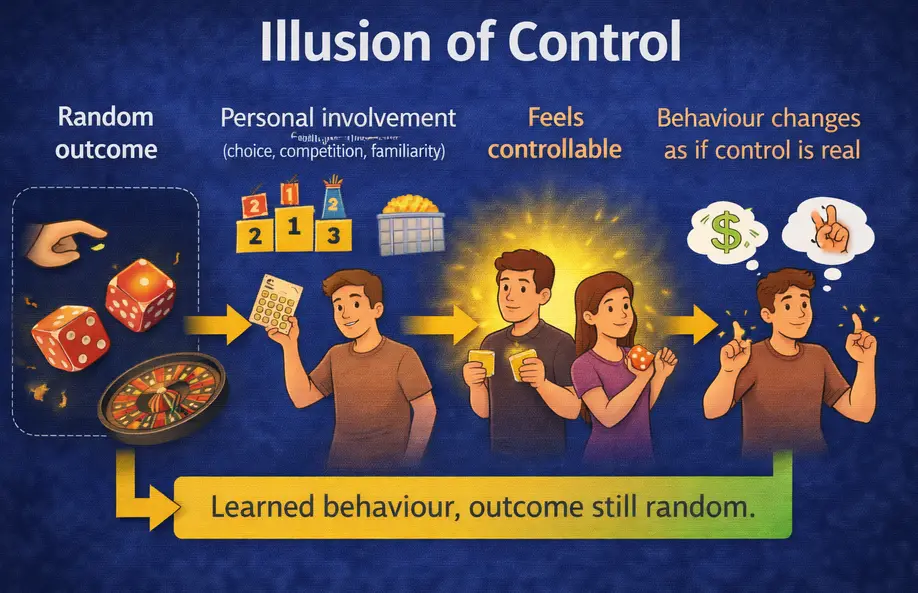
The illusion of control: personal involvement makes a random outcome feel controllable and changes behaviour — but the outcome remains random regardless.
Illusion of Control in Real Life — Examples
The illusion of control is everywhere in everyday behaviour. Gamblers in casinos throw dice gently when they need low numbers and firmly when they need high ones — the force of the throw has no effect on a fair die, but the felt sense of influence is compelling. People who choose their own lottery numbers believe they have a better chance of winning than those who accept randomly generated numbers, despite identical odds. Drivers overestimate their safety when they are behind the wheel compared to when they are passengers, even when the other driver is equally skilled — because driving involves active control, while being a passenger does not.
The illusion also manifests in superstitious behaviour. Lucky charms, rituals before sporting events, pressing a pedestrian crossing button multiple times, clicking a computer mouse harder when a program is slow — all of these reflect the same underlying tendency to believe that personal action is influencing an outcome that is actually independent of it. The behaviour is not random: it arises specifically in situations where there is an outcome the person cares about and some surface resemblance to skill situations.
Illusion of Control in Gambling
Gambling is the domain where the illusion of control has been most extensively studied and has the most consequential effects. The design of casino games deliberately incorporates skill cues — the ability to choose cards, the physical act of rolling dice or pulling a lever, the illusion of strategy in games that are fundamentally random — precisely because these features make gamblers feel more in control and therefore more willing to bet and to continue betting after losses.
Problem gambling is substantially maintained by illusions of control. Gamblers develop elaborate systems, strategies, and rituals that they believe give them an edge in games of pure chance. When these systems appear to work — because random sequences contain streaks — the illusion is reinforced. When they fail, the failure is attributed to the system being applied incorrectly rather than to the system being ineffective. This connects directly to the clustering illusion, which causes gamblers to see meaningful patterns in random sequences, and to gambler's fallacy, which generates false expectations about when random streaks will end.
Illusion of Control in Investing and Finance
Financial markets are a significant domain for the illusion of control, because investment involves active decision-making and produces outcomes that are partly determined by factors entirely outside the investor's influence. Investors who actively manage their portfolios — buying and selling, implementing strategies, monitoring positions — tend to believe they are exercising meaningful control over returns, when research consistently shows that most active management does not consistently outperform passive index strategies.
The illusion of control in investing is amplified by the self-serving bias: when active decisions produce good outcomes, they are attributed to skill; when they produce bad outcomes, they are attributed to market conditions beyond the investor's control. This pattern prevents accurate learning about what the investor is actually controlling and what they are not — and sustains the belief in a level of control that the overall track record does not support.
Illusion of Control in the Workplace
In organisational settings, the illusion of control shapes how managers and leaders relate to uncertainty. Leaders who feel actively involved in a project — making decisions, directing resources, attending meetings — tend to feel more in control of the outcome than the objective evidence warrants. This felt control can reduce anxiety and increase confidence, which has functional benefits, but it can also prevent accurate assessment of genuine uncertainty and produce overconfident commitments to strategies that are more contingent on luck than the decision-makers recognise.
The illusion of control also affects how organisations respond to unpredictable events. After a random bad outcome — a market shock, an unexpected competitor move, an environmental disruption — organisations often introduce new procedures and oversight mechanisms that produce the feeling of control without meaningfully reducing the probability of future random disruptions. The procedures are real; the control they provide over genuinely random future events is illusory.
Illusion of Control in Health and Everyday Decisions
The illusion of control shapes health decisions in ways that can cut both positively and negatively. People who believe they have significant personal control over their health outcomes — through diet, exercise, stress management, and positive thinking — are often more motivated to take health-promoting actions. When the sense of control is accurate, this is beneficial. When it extends to believing that personal effort and attitude can control outcomes that are substantially determined by genetics, environment, or random biological events, it can produce both unrealistic expectations and misplaced blame when illness occurs despite the person's best efforts.
In daily life, the illusion of control explains a wide range of small but persistent behaviours: closing your eyes during a close sporting match as if this affects the outcome, picking a lane in traffic as if your choice produces better results, or developing superstitions about particular seats, routes, or sequences of actions that feel connected to outcomes they cannot actually influence.
How to Avoid and Overcome the Illusion of Control
Distinguish skill situations from chance situations
The most fundamental corrective is to accurately categorise which situations involve genuine skill and which are substantially determined by chance. In skill situations, effort, preparation, and strategy genuinely affect outcomes and the sense of control is appropriate. In chance situations, personal involvement does not affect the outcome — only the probability distribution does. Explicitly asking "what is the actual causal mechanism by which my action affects this outcome?" breaks the automatic sense of control that skill cues produce in chance contexts.
Track outcomes relative to a chance baseline
The illusion of control is sustained partly because random sequences contain streaks that feel like evidence of control. The corrective is to track outcomes over a large enough sample to compare them to what would be expected by chance. If your trading strategy, gambling system, or other controlled activity produces results that are not statistically distinguishable from random outcomes over a meaningful number of trials, the felt sense of control is not producing actual control.
Be especially sceptical of active involvement
The illusion of control is strongest precisely when you are most actively involved — choosing, competing, pressing buttons, throwing dice. This means that the felt sense of control is least reliable exactly when it feels most real. Treat high involvement as a signal to examine your assumptions about causation more carefully, not as evidence that causation is present.
The Deeper Point
The illusion of control reflects a fundamental feature of how the human mind models causation. We are built to find causal connections between our actions and outcomes — this capacity is enormously valuable in the vast majority of situations where genuine causal connections exist. The problem arises in situations where no causal connection exists, but where the surface features of the situation trigger the same causal-reasoning machinery. The mind cannot easily turn off its tendency to find causal structure, so it finds it even where the outcome is random.
There is a genuine functional value in mild illusions of control: the sense of agency and influence supports motivation, reduces anxiety, and sustains effort in situations of genuine uncertainty. The cost is that it produces systematic overconfidence about personal influence in chance situations, distorts decision-making in gambling and finance, and sustains behaviours that have no causal connection to the outcomes they are meant to influence.
Related biases that interact closely with this one: the clustering illusion, which provides apparent evidence of control by generating streaks in random data; the gambler's fallacy, which similarly misapplies skill-based reasoning to chance outcomes; and optimism bias, which inflates expected success probabilities in ways that feed the sense of personal influence over outcomes.
The Cognitive Bias Spotter Test below puts that understanding to work — see if you can identify the illusion of control and the other nine biases when they appear in realistic scenarios.