Optimism Bias — Meaning, Examples & How to Overcome It
Mind · Cognitive Biases · Self-Perception family
Test yourself — can you spot the bias in each scenario? Take the Cognitive Bias Spotter Test. Jump to the test ↓
What Is Optimism Bias? Simple Definition
Optimism bias is the tendency to overestimate the likelihood of positive events happening to you and to underestimate the likelihood of negative events — relative to what is actually probable and relative to the risks facing other people. You believe you are more likely than average to succeed, live long, stay healthy, and avoid misfortune, and less likely than average to experience divorce, accident, illness, or failure.
Also called unrealistic optimism, the bias does not mean that optimists are always wrong — many positive outcomes do occur. It means that people's predictions about their own futures are systematically skewed in the positive direction in a way that cannot be statistically true for the majority simultaneously. If most people believe their marriage is less likely to end in divorce than average, most of them must be wrong.
This page is part of the cognitive biases guide on our free brain training and cognitive tests platform, alongside interactive tools covering memory, attention, reaction time, and decision-making.
Optimism Bias Meaning & Psychology
The systematic study of optimism bias was established by Weinstein (1980) in two studies examining how people estimate their chances of experiencing positive and negative life events relative to their peers. Across 42 events — including divorce, cancer, job loss, and owning a home — participants consistently rated their own chances of positive outcomes as above average and their chances of negative outcomes as below average. This pattern was both statistically impossible (not everyone can be above average) and remarkably robust: it persisted regardless of participants' age, sex, education, or how serious they judged the events to be.
Subsequent research has replicated the effect in hundreds of studies across dozens of countries and domains — health risks, financial outcomes, relationship success, career prospects, and athletic performance. The bias appears to be one of the most pervasive and consistent findings in social psychology, present across cultures, though somewhat more pronounced in individualistic Western cultures than in collectivist East Asian ones.
Why the brain does this
Several cognitive and motivational mechanisms contribute to optimism bias. The primary cognitive driver is egocentrism in risk assessment: when comparing their own risk to that of others, people focus on factors that reduce their personal risk — their healthy diet, their careful driving, their good genes — while paying less attention to factors that increase it or to the base rates that apply to everyone. This selective focus systematically underestimates personal risk relative to others.
Motivationally, optimism is genuinely adaptive in many respects. People who believe positive outcomes are likely for them tend to be more persistent, more resilient to setbacks, and better at maintaining effort over time. There is an evolutionary argument that a degree of optimistic bias is functional — beings who accurately calculated all risks might be too cautious to take the actions that produce reward. The problem is not optimism per se but unrealistic optimism that causes systematically poor decisions, particularly around preparation for negative outcomes.
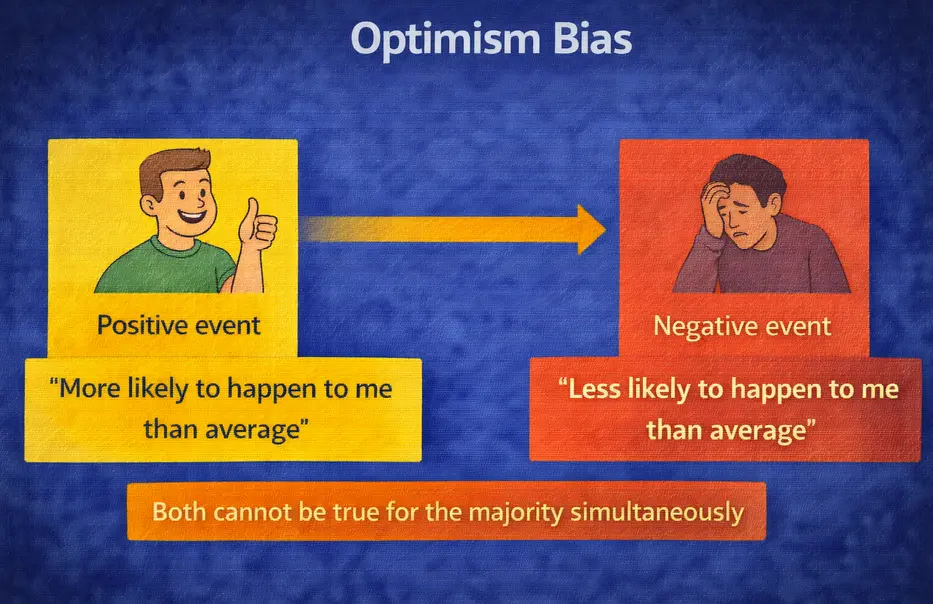
Optimism bias: positive events feel more likely to happen to us than average, and negative events feel less likely — but both cannot be true for the majority simultaneously.
Optimism Bias in Real Life — Examples
Optimism bias operates continuously across the full range of life decisions. Smokers consistently underestimate their personal risk of lung cancer relative to other smokers, even when they accurately know the base rate for the group. People who have just been diagnosed with a serious illness tend to believe their prognosis is better than the statistics for their condition would predict. New business owners entering competitive markets consistently overestimate their probability of survival relative to the well-documented base rates for business failure in their industry.
The planning fallacy — the tendency to underestimate how long projects will take and how much they will cost — is a direct expression of optimism bias applied to project forecasting. People focus on the most optimistic scenario for their own project while failing to adequately weight the base rate of how long and how much similar projects by other people have actually taken and cost. Kahneman and Tversky documented this in the context of construction projects, software development, and policy implementation, where actual costs and timelines routinely exceed even pessimistic estimates.
Optimism Bias in Health Decisions
Health-related optimism bias has direct consequences for preventive behaviour. People who believe they are personally less susceptible to a disease than average are less likely to seek screening, take precautions, or comply with preventive health recommendations. Smokers who underestimate their personal cancer risk smoke more. People who underestimate their personal risk of cardiovascular disease are less likely to modify their diet, exercise, or take prescribed medications.
Paradoxically, optimism bias in health contexts can be self-reinforcing: people who believe they are healthy are more likely to behave in ways that make them feel healthy, which then confirms the positive self-assessment, even when objective markers of risk are deteriorating. The subjective sense of health and resilience persists against incoming evidence because the optimism bias filters how that evidence is interpreted and weighted.
Optimism Bias in Investing and Finance
Financial decisions are systematically distorted by optimism bias. People starting businesses overestimate survival rates and revenue projections. Investors overestimate the performance of their own portfolios relative to the market. Homebuyers overestimate the appreciation of their property. Credit card users underestimate how much they will spend and how long it will take to pay off their balances.
The planning fallacy in financial contexts produces cost overruns in projects, inadequate emergency savings relative to actual risk exposure, and retirement savings plans built on unrealistically optimistic assumptions about investment returns and personal health. Optimism bias is one reason why people systematically undersave — the future looks rosier than the statistics justify, so the precautionary savings that the statistics would recommend feel unnecessary.
This interacts with the Dunning-Kruger effect: people who are least knowledgeable about investment tend to be most optimistic about their returns, while experienced investors have better-calibrated expectations. The combination of optimism bias and low financial literacy produces the worst investment decisions.
Optimism Bias in the Workplace
Project planning and organisational decision-making are pervasive contexts for optimism bias. Teams consistently underestimate project timelines, underestimate costs, and overestimate the probability that everything will go according to plan. The combination of individual optimism bias and the social dynamics of teams — where pessimistic voices may be suppressed and optimistic leaders set the tone — produces institutional optimism bias that compounds individual-level effects.
New ventures and product launches are particularly vulnerable: the teams closest to the project are the most optimistically biased about its prospects. The solution used by experienced project managers — reference class forecasting, which anchors predictions to the base rate of outcomes for similar projects — directly counters the optimism bias by replacing inside-view optimism with outside-view statistics.
Optimism Bias vs Normalcy Bias
Optimism bias and normalcy bias are related but distinct. Normalcy bias leads people to underestimate the likelihood that a disaster will occur at all — it is about the prediction of disruption. Optimism bias leads people to believe that even if a negative event occurs, it is less likely to happen to them personally than to others. The two biases often operate together: normalcy bias suppresses the overall probability of a disaster, while optimism bias suppresses the personal probability even further. Together they produce a compounded underestimation of personal risk that is particularly difficult to counteract.
How to Avoid and Overcome Optimism Bias
Use reference class forecasting
The most effective and empirically supported countermeasure to optimism bias in planning and forecasting is reference class forecasting: anchoring your predictions to the actual base rate of outcomes for a relevant class of similar projects, ventures, or decisions, rather than to your inside-view assessment of your own case. If 60% of businesses in your category fail within five years, that base rate should be the starting point for your survival estimate — and departures from it should be justified by specific factors, not by a general sense that your case is different. This directly counters the egocentrism that drives optimism bias.
Seek out the outside view
Related to reference class forecasting, deliberately seeking the perspective of people who have no personal investment in your project or decision produces more calibrated estimates. Advisers, mentors, or colleagues who can assess your plan against the base rates for similar plans, without the insider optimism that the people closest to the project bring, consistently produce better-calibrated forecasts. The value of outside perspectives is precisely that they are not subject to the same optimism bias that affects the insiders.
Pre-mortem analysis
Before committing to a plan, conducting a pre-mortem — imagining that the plan has failed and working backwards to identify what caused the failure — generates specific failure scenarios that optimism bias would otherwise suppress. This exercise disrupts the default assumption of success and surfaces concrete risks that the optimistic inside view overlooks. It is more effective than simply asking "what could go wrong?" because it treats failure as a fact to be explained rather than as a possibility to be acknowledged.
Track your predictions over time
Keeping a record of your predictions and comparing them to outcomes over time provides the calibration data that corrects optimism bias empirically. People who track their predictions consistently find that they are more optimistic than their outcomes justify — and this concrete track record is more persuasive than abstract arguments about the bias. The same practice recommended for hindsight bias and choice-supportive bias serves here too: an objective record of your predictions replaces distorted retrospective memory with actual data.
The Deeper Point
Optimism bias is unusual among cognitive biases in that it has a genuine positive dimension. The ability to maintain positive expectations about the future is associated with better mental health, greater persistence, stronger social relationships, and higher achievement in many domains. The bias is not simply an error — it is a feature of the human mind that serves genuine psychological and motivational functions.
The problem is not optimism itself but the specific ways in which optimism bias produces systematic miscalibration in domains where accurate risk assessment matters: health, finance, safety, planning, and any context where inadequate preparation for negative outcomes has real costs. The goal is not to become pessimistic — it is to be appropriately calibrated: accurate enough in risk assessment to prepare adequately, while maintaining the motivational benefits of a generally positive outlook. This requires treating personal risk estimates with the same statistical scepticism that you would apply to anyone else's.
Related biases that interact closely with this one: Dunning-Kruger effect, where limited self-knowledge amplifies overconfidence; normalcy bias, which compounds optimism bias in disaster and risk contexts; and confirmation bias, which selectively attends to evidence that confirms the optimistic self-assessment.
The Cognitive Bias Spotter Test below puts that understanding to work — see if you can identify optimism bias and the other nine biases when they appear in realistic scenarios.