Choice-Supportive Bias — Meaning, Examples & How to Overcome It
Mind · Cognitive Biases · Memory & Judgment family
Test yourself — can you spot the bias in each scenario? Take the Cognitive Bias Spotter Test. Jump to the test ↓
What Is Choice-Supportive Bias? Simple Definition
Choice-supportive bias is the tendency to remember your past choices more positively than they actually were — attributing more positive features to the option you chose and more negative features to the options you rejected, even when this does not match what actually happened.
In plain terms: once you have made a decision, your memory of the alternatives shifts to make your choice look better. The chosen option is remembered as having been clearly superior; the rejected options are remembered as having had more flaws. This distortion happens in memory, not just in attitude — the actual features of the options are misremembered, not merely re-evaluated.
This page is part of the cognitive biases guide on our free cognitive tests and brain training tools, alongside interactive apps covering memory, attention, reaction time, and decision-making.
Choice-Supportive Bias Meaning & Psychology
The foundational research on choice-supportive bias was conducted by Mather, Shafir & Johnson (2000) in a series of experiments examining how people remember the features of options after making a choice between them. Participants were given descriptions of two options — such as two job candidates or two potential dating partners — each with a mix of positive and negative characteristics. After making a choice, participants were asked to recall which features had belonged to which option. The results showed a consistent pattern: participants were more likely to correctly recall positive features of the option they had chosen, and more likely to incorrectly attribute negative features to the option they had rejected. The choice itself had reshaped their memory of the evidence on which it was based.
This effect is specifically a memory distortion, not just a post-hoc attitude change. It is driven by what researchers call source monitoring — the process by which the mind attributes remembered information to its correct origin. When recalling a past choice, people use the fact that they chose an option as a cue for what features that option must have had. The mind expects the chosen option to have been the better one, and this expectation shapes which features are attributed to it — both correctly and incorrectly.
Why the brain does this
Choice-supportive bias serves a psychological function: it reduces post-decision regret and supports cognitive consistency. Making a decision involves committing to one option and foreclosing others. If the decision was wrong, or even merely imperfect, that creates cognitive dissonance — a tension between the belief that you make reasonable choices and the evidence that this particular choice was not optimal. Misremembering the options as having been more clearly differentiated than they were reduces this tension. The chosen option is remembered as having been obviously better, which means the decision was obviously correct, which means there is nothing to regret.
This is closely related to confirmation bias, which filters incoming information to favour existing beliefs. Choice-supportive bias does the same thing retrospectively, filtering remembered information to favour a decision already made.
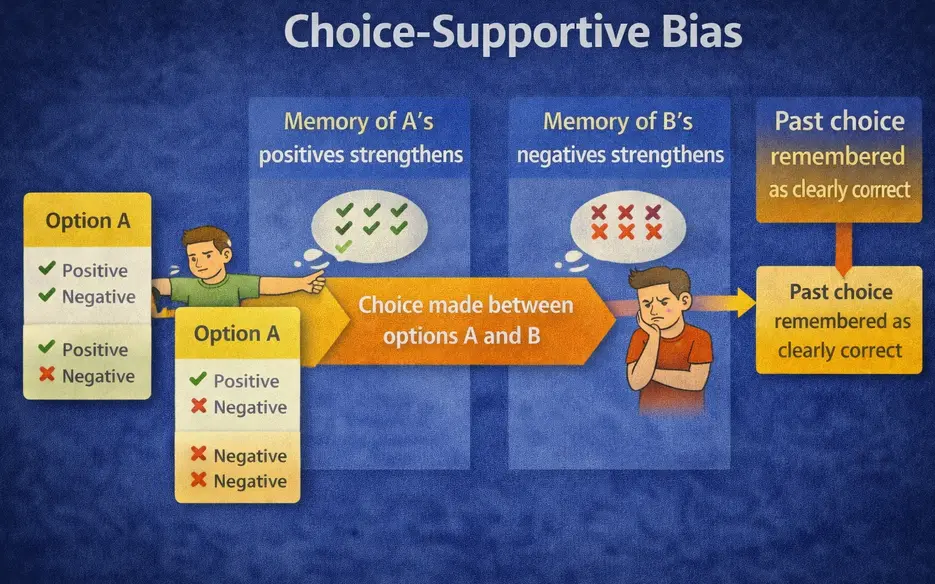
Choice-supportive bias: after choosing option A over B, memory of A's positives strengthens and memory of B's negatives strengthens — causing the past choice to be remembered as more clearly correct than it actually was.
Choice-Supportive Bias in Real Life — Examples
Choice-supportive bias operates across the full range of everyday decisions. After buying a car, people remember the test drive as having been more impressive than it was, and remember the cars they did not buy as having had more obvious drawbacks. After choosing a restaurant, the meal is remembered as better than it tasted at the time. After accepting a job offer, the rejected offer is remembered as having had more clearly visible downsides — longer commute, less interesting work, fewer growth opportunities — even if those features were genuinely ambiguous at the time of decision.
The bias is particularly visible in relationship decisions. People who choose one romantic partner over another tend to remember the unchosen option as having been less attractive, less compatible, or less suitable than their memory of them at the time of the choice would suggest. This is not deliberate — the distortion is in memory itself, not in conscious re-evaluation.
Choice-Supportive Bias in Consumer Behaviour
Consumer psychology has extensively documented choice-supportive bias under the related label of post-purchase rationalisation. After buying a product — a phone, a laptop, a piece of furniture — buyers tend to remember the competing products they considered as having had more visible flaws and the purchased product as having had more obvious strengths. This is one reason why customer satisfaction surveys administered shortly after purchase tend to show higher satisfaction than surveys administered after extended use: the immediate post-purchase period is when choice-supportive memory distortion is strongest.
Brands and marketers benefit from this bias whether they intend to or not. Once a customer has committed to a brand, choice-supportive bias makes them more likely to remember their experiences with it positively, more likely to discount negative experiences as exceptions, and more likely to remember the alternatives they considered as having had more obvious shortcomings. This is part of why brand loyalty, once established, tends to be robust even in the face of objective performance differences.
Choice-Supportive Bias in Investing and Finance
In financial decision-making, choice-supportive bias creates a specific problem: it distorts the feedback loop that should allow investors to learn from their decisions. After buying a stock or fund, investors tend to remember the reasoning for the purchase as having been clearer and more compelling than it actually was, and to remember the concerns they had about it as having been less significant than they were at the time. When the investment performs well, this reinforces the distorted memory. When it performs poorly, the bias creates resistance to recognising that the original reasoning was flawed — because the memory of that reasoning has been edited to make it look sounder than it was.
This interacts with the sunk cost fallacy: choice-supportive bias makes the original investment decision seem better in retrospect, which makes it harder to cut losses and move on, because doing so would implicitly acknowledge that the original decision was a mistake.
Choice-Supportive Bias in the Workplace
Hiring decisions are a significant arena for choice-supportive bias. After selecting a candidate, hiring managers tend to remember the interview as having more clearly demonstrated the chosen candidate's strengths and the rejected candidates' weaknesses than was actually the case. This makes it harder to identify what went wrong when a hire does not work out — the memory of the hiring process has been edited to make the choice look clearly correct, which obscures whatever genuine warning signs existed.
Similarly, strategic decisions made by leadership teams tend to be remembered more favourably over time. The concerns raised before the decision was made are forgotten or minimised; the considerations that supported the decision are remembered more vividly. This is part of why post-mortems on failed strategies are difficult to conduct honestly — the memory of the decision-making process has already been revised by choice-supportive bias.
How to Avoid and Overcome Choice-Supportive Bias
Record your reasoning before the decision
The most direct counter to choice-supportive bias is to create a record of your actual assessment of each option before making a choice. Writing down the genuine pros and cons of each option — including your reservations about the option you ultimately choose — creates an objective reference point that resists retrospective distortion. When reviewing past decisions, comparing your actual pre-decision reasoning against your current memory of it reveals the extent to which choice-supportive bias has operated. This is the same practice recommended for countering hindsight bias, and for similar reasons: both biases distort memory of past reasoning to make outcomes look more predictable and choices look more clearly correct than they were.
Evaluate options by fixed criteria before choosing
Assigning explicit scores or ratings to each option on defined criteria before making a final choice reduces the scope for choice-supportive memory distortion because the assessment is locked in before the choice is made. It also makes post-decision review more honest: you can compare the actual scores against your post-decision memory of how the options compared.
Seek honest post-decision review
When reviewing past decisions — whether in investing, hiring, strategy, or personal life — actively look for the genuine weaknesses of the option you chose and the genuine strengths of the options you did not. This is cognitively effortful because it runs directly against the grain of choice-supportive memory, but it is essential for learning from decisions rather than simply reinforcing them.
The Deeper Point
Choice-supportive bias is costly not because it makes you feel bad about your decisions — it does the opposite — but because it degrades the quality of the information you have available when making future decisions. If you cannot accurately remember the actual features of past options, the actual quality of your past reasoning, and the actual trade-offs you faced, you cannot learn effectively from experience. Every decision becomes self-validating in memory, which means the feedback loop that should improve judgment over time is systematically corrupted.
There is also a subtler cost: choice-supportive bias makes it harder to change course when you should. If the option you chose is remembered as having been clearly better, then evidence that it was not the best choice — that it is underperforming, that an alternative would have been superior — is processed against a memory that has already been edited to support the original decision. The bias does not just distort the past; it shapes the present by making it harder to update decisions in light of new evidence.
Related biases that interact closely with this one: confirmation bias, which selectively processes new information to support existing beliefs and decisions; belief perseverance, which maintains the belief that a decision was correct even after evidence to the contrary; and sunk cost fallacy, which compounds the tendency to continue with a chosen course of action beyond the point where it is rational to do so.
The Cognitive Bias Spotter Test below puts that understanding to work — see if you can identify choice-supportive bias and the other nine biases when they appear in realistic scenarios.