Hindsight Bias — Meaning, Examples & How to Overcome It
Mind · Cognitive Biases · Memory & Judgment family
Test yourself — can you spot the bias in each scenario? Take the Cognitive Bias Spotter Test. Jump to the test ↓
What Is Hindsight Bias? Simple Definition
Hindsight bias is the tendency to believe, after an event has occurred, that you had predicted or expected it all along — even when you did not. Once you know how something turned out, the outcome feels obvious and inevitable in a way it never did beforehand.
It is commonly known as the "I knew it all along" effect. The outcome, once known, rewrites the memory of what you expected, making the past feel more predictable than it actually was. This is not deliberate dishonesty — the distortion happens automatically, at the level of memory itself.
This page is part of the cognitive biases guide on our free brain training and testing platform, alongside interactive tools covering memory, attention, reaction time, and decision-making.
Hindsight Bias Meaning & Psychology
The systematic study of hindsight bias was pioneered by psychologist Baruch Fischhoff in the 1970s. In his foundational research, Fischhoff gave participants information about a historical event and its outcome, then asked them to estimate the probability they would have assigned to that outcome beforehand. Participants consistently rated the outcome as more predictable than it had actually been — and crucially, they were largely unaware that their judgment had been distorted by knowing the result. Fischhoff (1975) described this as "creeping determinism" — the tendency for known outcomes to seem like they were always going to happen.
Subsequent research by Hawkins and Hastie (1990) identified three distinct components of hindsight bias: memory distortion (misremembering your prior prediction as closer to the actual outcome), inevitability (believing the outcome was bound to happen), and foreseeability (believing you could have predicted it). All three tend to operate together, reinforcing each other to produce a robust and consistent bias.
Why the brain does this
Once an outcome is known, the mind automatically integrates it into its existing understanding of events. The new information is absorbed so completely that it becomes difficult to mentally reconstruct a state of not knowing it — a phenomenon sometimes called the curse of knowledge. The brain is also strongly motivated to see the world as coherent and predictable: believing that outcomes were foreseeable supports a sense of control and understanding. This same motivation underlies confirmation bias, where the mind selectively attends to information that supports what it already believes.
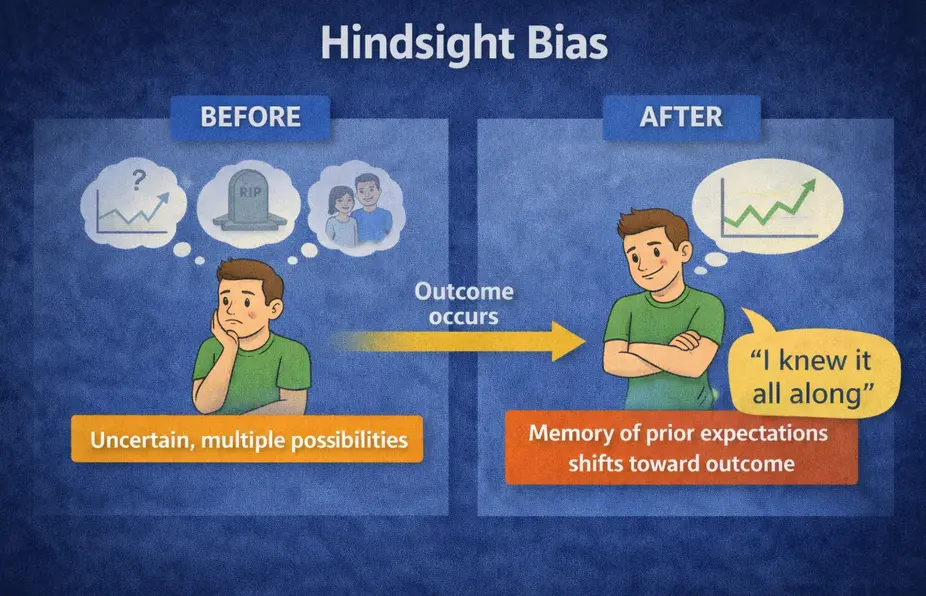
Hindsight bias in action: before the outcome, multiple possibilities exist; once the outcome occurs, memory of prior expectations shifts toward it — producing the "I knew it all along" effect.
Hindsight Bias in Real Life — Examples
Hindsight bias is one of the most pervasive cognitive biases in everyday life because it activates every time an uncertain event resolves. After a sports match, fans who predicted the losing team confidently claim they "had a feeling" the winner would prevail. After a medical diagnosis, patients and families often feel they should have recognised the symptoms earlier — even when the symptoms were genuinely ambiguous at the time. After a relationship ends, the warning signs that were not acted on feel retrospectively obvious, despite having been unclear when they occurred.
The bias is especially powerful for dramatic or surprising events. Research on reactions to unexpected political outcomes has shown that people rapidly revise their memories of how surprised they were, and within days or weeks of an unexpected result, many people report having expected it. The more significant the event, the stronger the hindsight bias tends to be.
Hindsight Bias in Investing and Finance
Financial markets are a fertile environment for hindsight bias. After every major market crash or bubble, hindsight bias produces a flood of commentary explaining why the crash was inevitable and obvious — despite the fact that the overwhelming majority of professional analysts failed to predict it before it happened. The housing market collapse, the dot-com bust, and every other significant financial disruption look self-evidently predictable in retrospect. In the moment, they did not.
For individual investors, hindsight bias creates two specific problems. First, it inflates confidence: because past market moves seem predictable in hindsight, investors overestimate their ability to predict future moves. Second, it distorts the evaluation of investment decisions. A decision that was sound given the information available at the time may look foolish after a bad outcome — and hindsight bias makes it difficult to fairly evaluate whether the original reasoning was actually flawed or simply unlucky. This is sometimes called outcome bias — judging the quality of a decision by its result rather than by the quality of the reasoning that produced it.
Hindsight Bias in Medicine and Legal Judgments
Hindsight bias has well-documented consequences in medicine. When doctors review cases where a patient suffered a bad outcome, they tend to judge the treating physician more harshly than when reviewing identical cases with a good outcome — even when the decisions made were identical. This has been studied extensively in the context of medical malpractice and clinical review, where the known outcome systematically colours the evaluation of whether the clinician "should have known" what to do differently.
The same effect operates in legal settings. Jurors and judges asked to evaluate whether a defendant should have foreseen the consequences of their actions are strongly influenced by knowing what the consequences actually were. The foreseeability of harm — a central concept in negligence law — is significantly harder to assess objectively once the harm is known.
Hindsight Bias in History and Politics
Historical narratives are almost always written with the benefit of hindsight, which makes past events appear more inevitable than they were. Wars, political upheavals, and technological revolutions are presented as the logical outcomes of forces that were building — because the writer knows how they ended. The genuine contingency of these events, the fact that small changes could have produced radically different outcomes, is systematically obscured by the narrative coherence that hindsight provides.
In politics, leaders and policymakers are routinely judged against what was known only after the fact. Crisis responses are evaluated with information that was unavailable when decisions had to be made. This is a direct application of hindsight bias at the institutional level, and it makes fair accountability genuinely difficult — both too easy (condemning decisions that were reasonable given available information) and too hard (excusing decisions that were negligent but happened to turn out well).
How to Avoid and Overcome Hindsight Bias
Keep a decision journal
The most effective countermeasure for hindsight bias is to record your predictions and reasoning before outcomes are known. Writing down what you expect to happen, and why, creates an objective record that resists the retrospective distortion that hindsight bias produces. When you review past decisions, you can compare what you actually thought at the time against what you now remember thinking — and the difference is often striking. This practice is used by serious investors, forecasters, and anyone who needs to evaluate the quality of their judgment over time rather than just its outcomes.
Separate decision quality from outcome quality
A good decision can produce a bad outcome through bad luck. A bad decision can produce a good outcome through good luck. Hindsight bias makes these two things difficult to distinguish because the outcome is vivid and the decision process is not. Deliberately evaluating decisions based on the information and reasoning available at the time — rather than the result — is both fairer and more instructive for improving future judgment.
Consider alternative outcomes explicitly
When reviewing any event, actively reconstruct the ways it could have gone differently. This counter-factual thinking weakens the sense of inevitability that hindsight bias produces. Researchers have found that generating explicit alternative scenarios reduces hindsight bias by making the genuine uncertainty that existed before the outcome more cognitively accessible. The availability heuristic makes the actual outcome feel representative precisely because it is the only outcome you can now easily picture — generating alternatives directly counteracts this.
Be sceptical of "it was obvious" narratives
Whenever you hear a confident post-hoc explanation of why an outcome was inevitable — in markets, in politics, in science — treat it with scepticism. Ask what the same commentators were saying before the event, and whether the explanation being offered now was being offered then. The persuasiveness of a retrospective explanation is not evidence that the outcome was foreseeable; it is often evidence of hindsight bias operating at scale.
The Deeper Point
Hindsight bias is costly because it degrades the feedback loop that learning depends on. If every outcome feels like it was predictable, then poor decisions that happened to turn out well are never identified as poor, and good decisions that happened to turn out badly are condemned as errors. The only way to improve judgment over time is to evaluate the quality of reasoning independently of the quality of outcomes — and hindsight bias systematically prevents this.
There is also a deeper consequence. A world seen through hindsight bias appears more predictable, more controllable, and more just than it actually is. Outcomes that were genuinely uncertain look inevitable. Decisions that were genuinely difficult look obvious in retrospect. This produces a distorted model of how the world works — one that breeds overconfidence in prediction, unfair judgment of others' decisions, and a reduced appreciation of the role that chance plays in outcomes.
Related biases that interact closely with this one: confirmation bias, which selectively reinforces the sense that what happened was always going to happen; the availability heuristic, which makes the known outcome feel representative; and anchoring bias, where the known result anchors all subsequent reasoning about what was foreseeable.
The Cognitive Bias Spotter Test below puts that awareness into practice — see whether you can catch hindsight bias and the other nine biases as they appear in realistic scenarios.