The Halo Effect — Meaning, Examples & How to Overcome It
Mind · Cognitive Biases · Social Judgment family
Test yourself — can you spot the bias in each scenario? Take the Cognitive Bias Spotter Test. Jump to the test ↓
What Is the Halo Effect? Simple Definition
The halo effect is the tendency to let one positive impression of a person, brand, or thing influence your overall judgment of them — including qualities you have no actual evidence about.
In simple terms: if someone makes a great first impression, you are likely to assume they are also intelligent, trustworthy, competent, and kind — even before you have seen evidence of any of those things. One positive trait casts a "halo" over everything else, making the whole person seem better than your actual information warrants.
This page is part of the cognitive biases guide on our free cognitive assessment platform, alongside interactive tests and tools covering memory, attention, and decision-making.
Halo Effect Meaning & Psychology
The term was coined by psychologist Edward Thorndike in 1920, who noticed that military officers rating soldiers on different qualities — intelligence, physique, leadership, character — produced ratings that were almost perfectly correlated. A soldier judged to have a good physique was rated highly on intelligence, leadership, and character too, regardless of whether those qualities had been independently observed. The ratings were not measuring different traits; they were measuring one global impression, dressed up as separate assessments.
Thorndike called this the halo effect — one outstanding characteristic creating a halo of positive evaluation around everything else. The original finding has since been replicated across hiring decisions, political elections, product evaluations, criminal sentencing, teacher assessments of students, and virtually every other domain where humans make evaluative judgments about other humans or entities.
Why the brain does this
The halo effect emerges from the brain's need for cognitive consistency. Holding conflicting impressions simultaneously — this person is attractive but dishonest, competent but cold — is uncomfortable and effortful. The brain resolves this tension by aligning all impressions around the most salient initial one. If the first impression is positive, subsequent information is interpreted through that positive frame: ambiguous behaviour is read charitably, negative evidence is minimised or explained away, and unobserved qualities are assumed to match the overall positive picture. This is closely related to confirmation bias — once the halo is established, the brain preferentially notices evidence that confirms it.
The horn effect
The halo effect has a direct counterpart: the horn effect (sometimes called the devil effect), where one negative trait contaminates overall judgment in the opposite direction. A candidate who stumbles over their words in the first minute of an interview may be perceived as less intelligent and less competent than they actually are, because the initial negative impression spreads across all subsequent evaluation. The horn effect is the same cognitive mechanism as the halo effect, running in reverse.
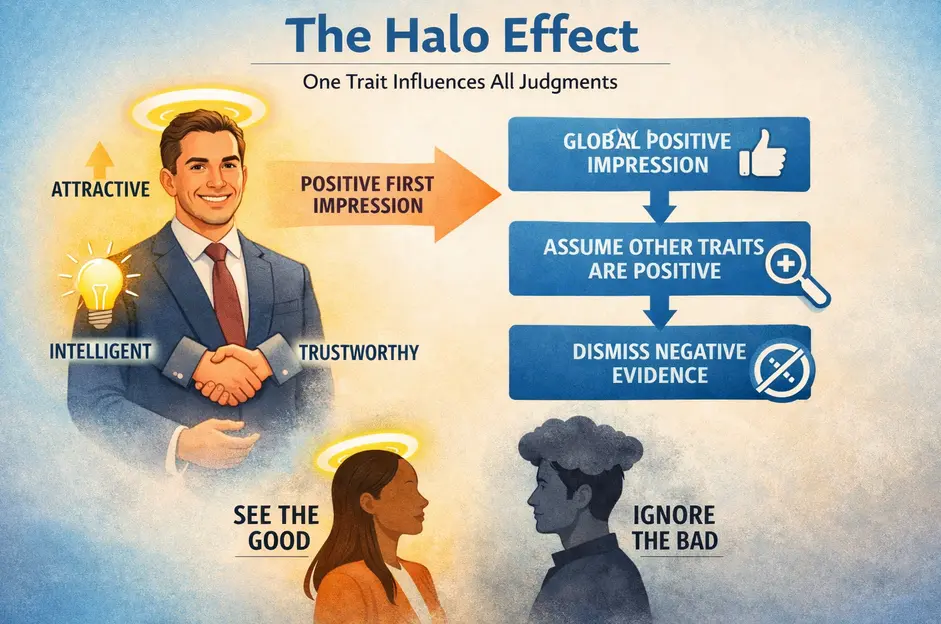
The halo effect — one positive trait generates a global impression that causes other traits to be assumed positive and contradictory evidence to be dismissed.
Halo Effect in Real Life — Examples
The halo effect is one of the most pervasive biases in everyday social judgment. When a well-dressed, articulate stranger asks for directions, most people automatically assume they are trustworthy and helpful — without any actual evidence. When a celebrity endorses a product outside their area of expertise, consumers rate that product more favourably than when an unknown person gives the same endorsement, because the celebrity's fame and appeal create a halo around the product itself.
Physical attractiveness is one of the most well-documented triggers of the halo effect. Attractive people are consistently rated as more intelligent, more honest, more competent, and more socially skilled than less attractive people — a pattern so robust it has been called the "what is beautiful is good" stereotype, documented formally by Dion, Berscheid, and Walster (1972). In studies where identical essays were submitted under names associated with physical attractiveness, the essays received higher grades. In mock trials, attractive defendants received lighter sentences for identical offences.
Halo Effect in the Workplace
The halo effect is particularly consequential in professional settings, where evaluations have direct impact on careers, compensation, and organisational outcomes.
In performance reviews, a manager who views an employee favourably after one impressive project tends to rate that employee highly across all dimensions — creativity, reliability, communication, teamwork — even when independent evidence for each dimension is limited. The reverse applies equally: an employee who makes a visible mistake early in their tenure may carry a negative halo that depresses all subsequent evaluations, even after demonstrably strong performance. Research on performance ratings consistently shows that halo effects are pervasive and resistant to rater training, suggesting the bias operates largely outside conscious awareness.
In hiring, the halo effect typically activates within the first few minutes of an interview. Research consistently shows that interviewers form an overall impression very early — often before substantive questioning has begun — and then spend the remainder of the interview unconsciously gathering evidence to confirm it. A candidate who is well-presented, confident, and articulate in their opening responses will be evaluated more favourably on subsequent technical questions than an equally capable candidate who started less smoothly. Structured interviews with pre-defined scoring criteria for each question significantly reduce this effect by forcing evaluators to assess each dimension independently before forming a global rating.
The halo effect also shapes how leadership is perceived. Managers who are tall, physically imposing, or verbally fluent are consistently rated as more effective leaders — independent of their actual performance outcomes. This is partly why leadership development programmes that focus exclusively on skills, without addressing impression management, have limited impact: the halo effect means that how a leader is initially perceived shapes how their subsequent actions are interpreted, often regardless of their content.
Halo Effect in Marketing and Branding
Marketing strategy is built substantially on the deliberate exploitation of the halo effect. When Apple introduced the iPod in 2001, its success created a powerful halo around the entire Apple brand — consumers who had never considered buying an Apple computer began purchasing Macs, because the iPod's design and user experience cast a halo over the company's other products. The strategy became a deliberate driver of their product launch approach: lead with a product that creates a strong positive impression, and let the halo do the rest.
Celebrity endorsements, premium packaging, and high-quality flagship stores all operate through the same mechanism. A brand that positions its most expensive, highest-quality product at the entrance to its retail space creates a halo that elevates consumer perception of its entire product range — including products that are objectively unremarkable. The flagship product is not necessarily the most profitable; it is the halo generator.
Country-of-origin effects are a well-documented variant of the halo effect in consumer behaviour. Products from countries associated with high quality in a particular category — German engineering, Swiss watchmaking, French cuisine — benefit from a halo that elevates perceived quality independent of the actual product. This halo persists even when consumers have no direct experience of the specific brand, and even when objective quality assessments find no meaningful difference from competitors.
Halo Effect in Psychology — Research and Evidence
Beyond Thorndike's original study, the halo effect has been extensively documented in controlled research. Nisbett and Wilson (1977) demonstrated it in a striking experiment: participants who watched a warm, likeable professor gave higher ratings to his accent, appearance, and mannerisms than participants who watched the same professor behave in a cold, distant manner — even though the accent and appearance were identical in both conditions. The overall impression changed how specific neutral attributes were evaluated.
The halo effect has also been documented in educational settings, where teachers' early impressions of students — formed partly on the basis of appearance, name, and family background — influence grades awarded throughout the school year in ways that are not fully explained by academic performance. This connects to the broader research on expectancy effects: when a teacher expects a student to do well, they interact with that student differently, creating a self-fulfilling cycle that the halo effect initiates and sustains.
Test yourself — can you spot the bias in each scenario? Take the Cognitive Bias Spotter Test ↓.
Halo Effect vs Horn Effect
The halo effect and the horn effect are two sides of the same cognitive coin. The halo effect occurs when one positive trait elevates overall judgment; the horn effect occurs when one negative trait depresses it. Both involve the same underlying mechanism — a global impression overriding independent evaluation of specific attributes — and both are equally resistant to correction through awareness alone.
In practice, the two effects interact. A candidate who triggers the halo effect in an interviewer will have their weaknesses overlooked or reframed as strengths; a candidate who triggers the horn effect will have their strengths overlooked or reframed as flukes. The same piece of evidence — an unconventional career move, a gap in employment, an unusual answer to a standard question — will be interpreted positively under a halo and negatively under a horn, even by the same evaluator on different days with different first impressions.
How to Avoid and Overcome the Halo Effect
Evaluate dimensions independently
The most effective structural countermeasure is to assess each relevant dimension — intelligence, reliability, creativity, communication — separately and in sequence, rather than forming a global impression and then rating each dimension against it. In hiring, this means scoring each interview question immediately after it is answered, before moving to the next. In performance reviews, it means rating each competency against documented evidence before arriving at an overall rating. Forcing independent evaluation prevents the global impression from contaminating each specific judgment.
Seek disconfirming evidence deliberately
Once a strong positive impression has formed, actively look for evidence that contradicts it. What has this person done poorly? What are the weaknesses of this product? What does this brand do badly? This is uncomfortable, because the halo effect makes contradictory evidence feel unfair or irrelevant — but it is precisely that discomfort that signals the halo is operating. This connects to the countermeasures for confirmation bias, which reinforces the halo by filtering out disconfirming information.
Use blind evaluation where possible
In domains where it is feasible, removing identifying information from the evaluation process eliminates many of the triggers that activate the halo effect. Blind CV screening, anonymised essay grading, and structured auditions — where the evaluator cannot see the performer — have all been shown to reduce halo-driven distortions and produce more equitable outcomes. The barrier to implementing blind evaluation is usually organisational rather than practical.
Slow down the first impression
The halo effect is particularly powerful when first impressions are formed quickly and under conditions of limited information. Deliberately deferring global judgment — committing to withhold an overall assessment until a defined amount of evidence has been gathered — reduces the influence of the initial impression. In interviews, this might mean completing all questions before reviewing any notes or scores. In product evaluation, it might mean using a product for a defined period before rating it.
The Deeper Point
The halo effect is not a failure of intelligence or character — it is a structural feature of how human social judgment works. The brain needs to form rapid overall impressions of people and entities in order to function; evaluating every attribute independently from scratch, every time, would be cognitively prohibitive. The halo effect is the shortcut that makes fast social judgment possible. The cost is that it systematically overweights salient initial impressions and underweights subsequent evidence.
Understanding it changes how you structure evaluations, how much weight you give to first impressions, and how you interpret your own strong positive or negative reactions to people and products. The goal is not to eliminate first impressions — they contain real information — but to prevent them from doing all the evaluative work that should be distributed across a fuller body of evidence.
Related biases that interact closely with this one: confirmation bias, which sustains the halo by filtering evidence to match it; the anchoring bias, where the first impression functions as an anchor from which all subsequent judgment insufficiently adjusts; and fundamental attribution error, which shapes how behaviour is explained once a halo or horn impression has been formed.
The Cognitive Bias Spotter Test below puts that understanding to work — see if you can catch the halo effect and the other nine biases when they appear in realistic scenarios.