Ponzo Illusion Explained: Why Converging Lines Trick Your Brain Into Seeing Wrong Sizes
Geometric & Size Illusion · Depth Perception · Discovered 1911

The Ponzo illusion — two identical yellow bars placed on converging railroad tracks. The upper bar appears significantly larger, even though both bars are exactly the same length. Your brain interprets the converging lines as depth and "corrects" the size accordingly.
Place two identical bars between a pair of converging lines and something immediate happens: the bar closer to the point of convergence looks larger. Not subtly larger — obviously, unmistakably larger. You can measure them, confirm they are the same, look again, and the illusion persists. Your visual system overrides what you know to be true, because the processing that produces the size distortion happens before conscious reasoning has any say in the matter. The Ponzo illusion, first described by Italian psychologist Mario Ponzo in 1911, is one of the clearest demonstrations that human vision is not a camera — it is a construction. This page is part of the Optical Illusions resources available through Cognitive Train and the Mind Training Hub.
The reason the illusion works — and the reason it refuses to stop working even after you understand it — reveals something fundamental about how the brain processes depth, distance, and size. The same neural machinery that lets you judge whether an oncoming car is far away or dangerously close is what makes those two bars look different. The Ponzo illusion is not a bug in your visual system. It is a side effect of one of its most essential features.
What Is the Ponzo Illusion?
The Ponzo illusion occurs when two objects of identical size are placed between converging lines — typically lines that suggest linear perspective, like railroad tracks, a road disappearing into the distance, or simple diagonal lines meeting at a vanishing point. The object positioned nearer to the convergence point (the "far" position in the implied depth) is perceived as larger than the object in the "near" position, despite both being physically identical.
Mario Ponzo proposed in 1911 that the visual system uses the surrounding context — the converging lines — to judge the relative size of objects within the scene. When the brain interprets the converging lines as parallel lines receding into the distance (as it would with railroad tracks or road edges), it applies size constancy scaling: the "farther" object must be larger than it appears on the retina if it is to produce the same retinal image size at a greater distance. The brain makes this adjustment automatically, and the result is a perceived size difference that does not exist.
Why Does the Ponzo Illusion Work? The Neuroscience
The dominant explanation for the Ponzo illusion centers on what vision scientists call size constancy scaling — the brain's automatic mechanism for maintaining stable size perception as objects move closer or farther away. In the real world, a person walking away from you produces a smaller and smaller image on your retina, but you do not perceive them as shrinking. Your visual system compensates by scaling perceived size upward as distance increases. This process is so fundamental that it operates below conscious awareness and cannot be voluntarily overridden.
Research by Murray, Boyaci, and Kersten (2006), published in Nature Neuroscience, provided direct neural evidence for this mechanism. Using fMRI, they showed that objects perceived as farther away actually activated a larger area of the primary visual cortex (V1) than identical objects perceived as closer — even when retinal image size was the same. The brain was not just interpreting the far object as larger; the neural representation of the object was literally bigger in early visual processing. This means the Ponzo illusion is not a judgment error that happens at a late, cognitive stage — it is baked into the fundamental architecture of visual processing.
The converging lines in the Ponzo illusion are the trigger. They provide what the visual system reads as strong linear perspective cues — the same cues it uses constantly when processing roads, corridors, buildings, and any other scene involving parallel edges receding into the distance. Once these cues activate depth processing, size constancy scaling follows automatically. The bar placed near the convergence point gets scaled up because the brain has already classified it as "far away," and objects that are far away but produce the same retinal size must — in the brain's model of the world — be physically larger.
Real-World Examples of the Ponzo Illusion
Railroad tracks. The classic demonstration — and the one shown at the top of this page. Two identical objects placed on or between railroad tracks at different distances from the viewer will appear to be different sizes. The tracks provide the converging lines that activate depth processing. This is not limited to photographs; the illusion works when you are physically standing on or near train tracks looking down the line.
The moon illusion. One of the proposed explanations for why the moon appears much larger near the horizon than when it is high in the sky invokes Ponzo-like mechanisms. When the moon is near the horizon, it appears in the context of terrain, buildings, and other depth cues that suggest distance. The brain's size constancy system scales it up accordingly. When the moon is overhead, those contextual depth cues are absent, and the scaling does not occur. The retinal image of the moon is the same in both cases.
Roads and corridors. Any long, straight road or hallway provides converging lines that trigger the same mechanism. Objects placed at different positions along a corridor will be subject to the same size distortion — the farther one will appear larger, sometimes dramatically so.
Architecture and design. The Ponzo illusion has practical implications for architects and designers. Rooms with strongly converging perspective lines can distort the perceived size of objects and people within them. The Ames room illusion is a deliberate exploitation of this principle taken to an extreme — a distorted room that uses forced perspective to make people appear to shrink or grow as they move through it.
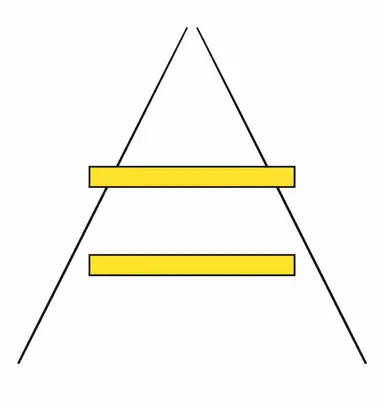
The Ponzo illusion in its simplest form — just two identical lines between converging diagonals. Even stripped of any real-world context, the upper line appears longer. The converging lines alone are enough to activate depth processing.
Ponzo Illusion vs Similar Illusions
Ponzo illusion vs Ebbinghaus illusion — both illusions distort perceived size, but through different mechanisms. The Ponzo illusion uses linear perspective cues (converging lines suggesting depth) to trigger size constancy scaling. The Ebbinghaus illusion uses surrounding context objects — large circles make a central circle look small, and vice versa — operating through a relative size comparison mechanism rather than depth processing. The Ponzo illusion requires depth cues; the Ebbinghaus illusion does not. Together, they demonstrate that size perception is influenced by at least two independent contextual systems.
Ponzo illusion vs Müller-Lyer illusion — the Müller-Lyer illusion, in which lines with inward-pointing arrowheads appear shorter than lines with outward-pointing arrowheads, has also been attributed to implicit depth processing. The theory is that the arrowhead configurations resemble the inside and outside corners of rooms, triggering depth assumptions that distort length perception. If this explanation is correct, the Müller-Lyer and Ponzo illusions share a common root in the size constancy mechanism — but they use different visual cues to activate it. The Ponzo uses explicit converging lines; the Müller-Lyer uses arrowhead angles that may implicitly suggest depth.
Ponzo illusion vs Ames room — the Ames room is, in many ways, the Ponzo illusion made architectural. It uses a deliberately distorted room geometry to create converging perspective lines that are not perceived as converging because the room's shape is hidden from the viewer. The result is extreme size distortion — one person appears to be a giant while another appears tiny — all from the same depth and size constancy mechanisms that drive the Ponzo illusion. The Ames room demonstrates what happens when the Ponzo principle is applied in three-dimensional space with a real scene rather than a two-dimensional diagram.
Ponzo illusion vs Shepard Tables — Roger Shepard's famous table illusion shows two parallelogram tabletops that appear to have completely different proportions — one long and narrow, the other short and wide — but are in fact identical. The mechanism is closely related to the Ponzo illusion: the 3D perspective cues in the table drawings activate depth processing and size constancy scaling, distorting the perceived shape. Where the Ponzo illusion distorts perceived length, the Shepard Tables illusion distorts perceived proportions — but both are products of the same underlying system.
Can You Resist the Ponzo Illusion?
In a word: no. The Ponzo illusion persists even when you know exactly what is happening and why. This is because the size constancy scaling that produces the illusion operates at a level of visual processing that is inaccessible to conscious override. You can know the two bars are identical, measure them, confirm they are the same — and the moment you look at the image again, the upper bar looks larger. The knowledge does not change the percept.
Research has shown that the strength of the Ponzo illusion can vary based on factors including the angle of the converging lines, the distance between the two target objects, and the cultural and environmental experience of the viewer. A widely cited cross-cultural study by Leibowitz and Pick (1972) found that people who grew up in environments with fewer linear perspective cues (such as open, flat landscapes without roads and buildings) were somewhat less susceptible to the illusion — suggesting that while the underlying size constancy mechanism may be innate, its calibration is partly shaped by visual experience.
This finding adds a further layer of insight: the Ponzo illusion is not just a demonstration of how the brain processes depth. It is a demonstration of how the brain has been trained by a lifetime of visual experience to process depth — and how that training produces systematic errors when the visual input does not match the real-world statistics the system has been optimized for.
Explore more illusions: Müller-Lyer Illusion · Ebbinghaus Illusion · Checker Shadow Illusion · All Optical Illusions