Gaze Aversion Body Language: Meaning, Psychology & What Looking Away Really Signals
Eye Signals · Shame / Deception / Cognitive Load · Context-dependent
Think you can read body language? We've included a Body Language Test at the bottom — see how well you read the full range of nonverbal cues. Jump to the test ↓

Gaze aversion — eyes dropped downward, head angled slightly down, expression subdued. The visual system disengaging from social contact before a word of discomfort has been spoken.
Gaze aversion is one of the most commonly misread signals in body language. When someone looks away during a conversation, most observers immediately reach for the same interpretation: they're hiding something. But the research tells a more complicated story. Looking away can indicate deception — or shame, cognitive effort, emotional overwhelm, or simply the brain doing what it needs to do to think clearly without the distraction of another person's face. Getting gaze aversion right means understanding which of these processes is actually driving it — and that requires reading the full context rather than treating any single instance of averted eyes as conclusive. This page is part of the body language resources available through Cognitive Train and the Mind Training Hub.
The reflexive assumption that averted gaze means deception is so deeply embedded in popular understanding that it has become a liability rather than an asset — people who avoid eye contact for entirely innocent reasons are frequently judged as dishonest, while skilled liars maintain steady gaze precisely because they know the association. Understanding what gaze aversion actually reflects, and under what conditions it is and isn't diagnostic, is one of the more practically useful things body language literacy can offer.
What Does Gaze Aversion Signal? The Psychology Behind It
The most important finding from the research on gaze aversion is that it is primarily a mechanism for managing cognitive and emotional load — not a reliable indicator of deception on its own. A study examining gaze aversion in adults and children found that people avert their gaze most consistently when questions are difficult, when they need to retrieve information from memory, or when the cognitive demands of a task exceed what they can handle while simultaneously processing another person's face. In these contexts, breaking eye contact actually improves performance on the task at hand — the brain trading one source of information for another. This is the mundane, cognitively-motivated gaze aversion that accounts for a large portion of everyday eye contact breaks, and it is frequently misread as evasion.
The emotional drivers of gaze aversion are equally well documented. Research on self-conscious emotions identifies gaze aversion as a defining feature of the shame response — one of the cluster of signals including blushing, head lowering, and body contraction that communicate deference, submission, and social disengagement. A systematic review of shame, guilt, embarrassment and pride published in Frontiers in Psychology found that slumped posture, head lowering, and gaze aversion reliably co-occur as indicators of shame, and that these signals function to communicate submission and disengagement from social interaction. This shame-driven gaze aversion is structurally and contextually different from cognitively-motivated gaze aversion — it tends to involve a downward rather than lateral gaze direction, accompanies other shame-cluster signals, and occurs in response to social evaluation rather than difficult questions.
The deception link is weaker than popular belief suggests. One mock crime study found that liars exhibited a longer duration of gaze aversion compared to truth-tellers, attributing this to the heightened emotional arousal and cognitive load that deception produces. But this finding sits against a much larger body of evidence. A review of the deception literature by Vrij (2019) in the Annual Review of Psychology notes that gaze aversion is the behavior most strongly associated with deception in popular belief — yet the DePaulo et al. (2003) meta-analysis found it is actually not associated with deception. Gaze aversion is the most widely believed deception cue globally and among the least diagnostically valid in the experimental literature.
What Does Gaze Aversion Mean in Different Contexts?
Shame and social pain — the most reliable context for interpreting gaze aversion as emotionally meaningful is the shame response. When a person has committed a social violation, received public criticism, or is experiencing the feeling of being negatively evaluated, the gaze will often drop — downward and away, not laterally. This is accompanied by head lowering, often some degree of postural contraction, and sometimes blushing or self-touch. The cluster reading is more informative than the gaze direction alone. Shame-driven gaze aversion communicates submission and social withdrawal — it is an appeasement signal, reducing the intensity of the social confrontation by removing eye contact. Research comparing shame and guilt has consistently found that gaze aversion belongs to shame's behavioral signature rather than guilt's — guilt tends to drive reparative action rather than withdrawal.
Embarrassment — embarrassment produces a recognizable gaze aversion pattern that can be distinguished from shame by its brevity and its accompaniment by other signals. The embarrassment cluster typically involves a downward gaze break, a partial or suppressed smile, often a lip press or controlled mouth, and frequently some form of face touch or head turn. The gaze aversion in embarrassment tends to be transient — a brief break from eye contact rather than sustained avoidance — and is accompanied by the social-appeasement signals that mark the emotion as acknowledgment of a norm violation rather than concealment of intent.
Cognitive effort — this is the category that generates the most false positives in gaze aversion reading. When someone looks away while answering a question, they may simply be retrieving information from memory or managing the cognitive demands of formulating a response. This type of gaze aversion tends to be brief, resolves once the cognitive task is complete, and is not accompanied by the broader emotional signals — no postural contraction, no blushing, no self-touch, no change in vocal quality. Context is the primary guide: if the question being answered is genuinely difficult, lateral or upward gaze aversion is more likely to be cognitive than evasive. If the question is simple and the person nonetheless averts their gaze, other explanations become more plausible.
Deception — when gaze aversion is driven by deception, it tends to appear as part of a broader cluster rather than in isolation. The emotional burden of lying — nervousness, guilt, and the cognitive load of managing a false narrative — creates elevated arousal that can manifest in gaze breaks alongside other signals: increased self-touch, changes in blink rate, vocal hesitation, and microexpressions of the emotional state being concealed. High-stakes deception, where the consequences of being caught are significant, tends to produce more gaze aversion than low-stakes deception. But the relationship is not linear, and relying on gaze aversion alone as a deception indicator produces a level of accuracy that is barely above chance in the research literature.
Social anxiety — gaze aversion is a documented behavioral feature of social anxiety and social phobia. Research using eye-tracking technology found that individuals with social phobia showed significantly lower fixation frequency and reduced dwell time on others' eyes compared to control subjects, and that the severity of the phobia correlated with the degree of gaze avoidance. Gaze aversion in social anxiety is driven by the threatening quality of direct eye contact rather than by shame or deception — it is an avoidance behavior aimed at reducing the aversive arousal that social evaluation produces. Recognizing this context matters: persistent gaze avoidance in an otherwise cooperative conversation partner is more likely to reflect anxiety than concealment.
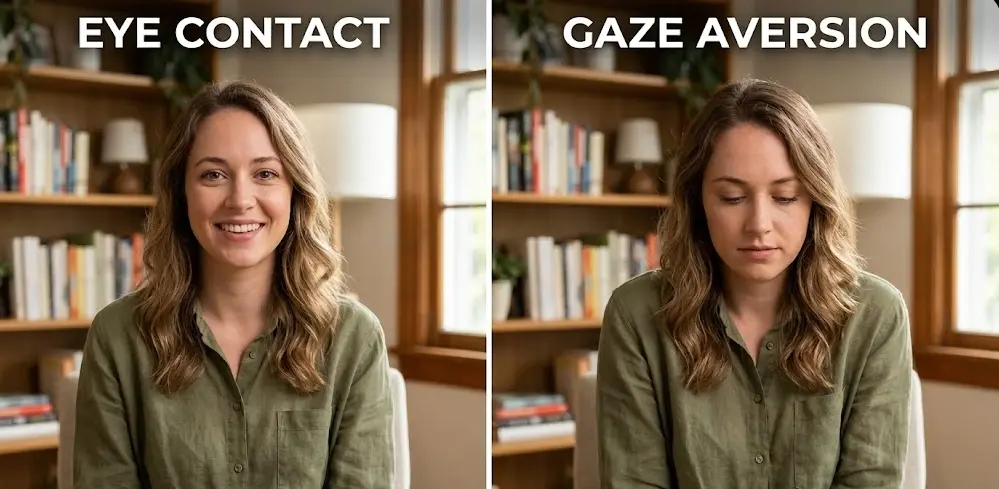
Left: direct eye contact — gaze forward, open expression, full social engagement. Right: gaze aversion — eyes dropped downward, head tilted down, social contact withdrawn. The same person, two different states of the attentional system.
Gaze aversion is only one signal in the cluster. The Body Language Test below ↓ trains you to read eye signals alongside posture, facial expression, and the full nonverbal context.
Direction Matters: What the Gaze Direction Tells You
Not all gaze aversion is equal — where the eyes go when they break contact carries additional information. Downward gaze is most consistently associated with shame, submission, and defeat. It appears reliably in the shame cluster alongside head lowering and postural contraction, and it communicates social withdrawal and deference. Lateral gaze — eyes moving to the side rather than downward — tends to occur more with cognitive effort, discomfort in the immediate interaction, or the processing of emotionally charged material. Upward gaze aversion is the least socially loaded and most often reflects retrieval of visual or spatial memory. These directional tendencies are probabilistic rather than deterministic — context, accompanying signals, and individual baseline differences all modulate what any single gaze direction indicates. But when reading a cluster, direction is one additional data point that can help distinguish shame from anxiety from cognitive effort from deception.
Gaze Aversion vs Similar Signals
Gaze aversion vs chin raise — chin raise and gaze aversion are near opposites in their social communication. The chin raise involves elevating the head and directing the gaze forward or slightly downward from a raised position — a signal of dominance, confidence, and social presence. Gaze aversion involves the gaze breaking from the interaction entirely. When someone moves from sustained eye contact into a chin raise, they are asserting social elevation; when they move from eye contact into gaze aversion, they are disengaging from it. The two signals occupy different ends of the social dominance axis and rarely appear in combination.
Gaze aversion vs narrowed eyes — narrowed eyes during eye contact signal active scrutiny, suspicion, or evaluative attention — the gaze is still directed at the other person but is processing them differently. Gaze aversion removes the gaze from the interaction entirely. Both can appear in uncomfortable or adversarial interactions, but they represent opposite responses: narrowed eyes represent engagement and analysis; gaze aversion represents withdrawal and disengagement. When narrowed eyes transition into gaze aversion, the person may be moving from active evaluation into a shame or submission response.
Gaze aversion vs widened eyes — widened eyes represent the visual system opening to take in more information — an alerting and threat-monitoring response. Gaze aversion closes down social engagement rather than amplifying it. In fear responses, widened eyes frequently appear first as the threat is detected, followed by gaze aversion if the threat is felt to be social and the person shifts into a submission or avoidance response. The transition from wide eyes to gaze aversion in the space of a conversation can indicate a shift from alarm to shame or anxiety.
Gaze aversion vs brow furrow — brow furrow accompanying gaze aversion can help clarify which process is driving the averted gaze. A brow furrow during gaze aversion suggests active cognitive processing — the person is concentrating on something rather than avoiding something. Gaze aversion without a brow furrow, in the context of social evaluation or emotional content, is more likely to reflect shame, anxiety, or emotional overwhelm. The brow serves as a useful disambiguating signal alongside the direction and duration of the gaze break.
How to Read Gaze Aversion Accurately
The most important principle in reading gaze aversion accurately is that single signals rarely tell you enough. Gaze aversion as an isolated event is ambiguous — it can reflect cognitive effort, emotional discomfort, social anxiety, shame, or the elevated load of deception, and these causes are not reliably distinguishable from a single eye contact break. What disambiguates is the cluster: what is happening in the rest of the face, the posture, and the voice at the same moment the gaze breaks.
Shame-driven gaze aversion comes with a cluster. Look for head lowering, postural contraction or collapse, reduced voice volume, possible blushing, and the absence of the confident forward-facing signals that accompany normal conversation. Cognitively-motivated gaze aversion is relatively clean — the gaze breaks, the person retrieves or processes information, and the gaze returns without significant change in the rest of the body. Anxiety-driven gaze aversion tends to be persistent rather than episodic, appearing throughout the interaction rather than at specific moments of emotional relevance.
Duration matters too. Brief gaze breaks are normal in any conversation — sustained mutual gaze without any break is actually uncomfortable and atypical. It is prolonged, repeated, or contextually inappropriate gaze aversion that carries diagnostic weight. And baseline matters most of all: a person whose normal conversational pattern involves frequent brief gaze breaks is not signaling the same thing as someone who makes consistent eye contact until a specific topic arises — and then consistently averts.
The test below develops the skill of reading gaze signals in context — alongside the full range of facial expressions, posture signals, and emotional states that make the difference between an accurate reading and a confident mistake.
How Much Body Language Can You Read?
Gaze aversion is one of the most context-dependent signals in body language — isolated eye contact breaks tell you little; the surrounding cluster tells you almost everything. The test below covers the complete range of expressions, postures, and gestures with detailed explanations after every answer.