Asymmetrical Mouth Body Language: Meaning & What a Lopsided Expression Actually Reveals
Expression · Face · Conflict / Concealment family
Think you can read body language? We've included a Body Language Test at the bottom — see how well you read the full range of nonverbal cues. Jump to the test ↓
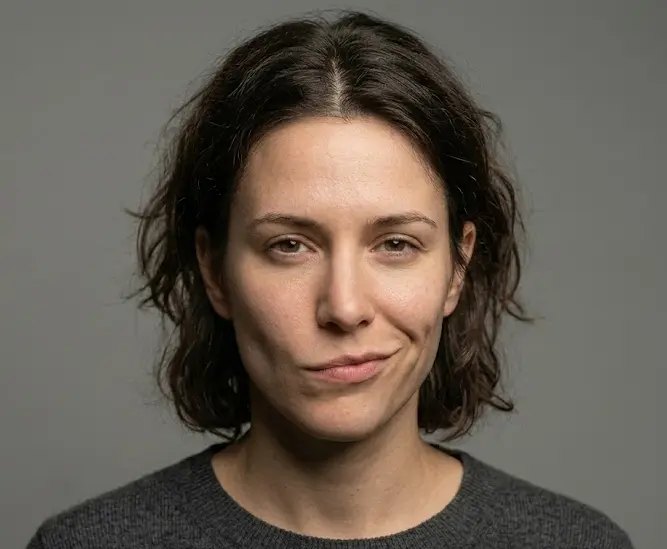
When the two sides of the mouth move differently, the face is telling two stories at once. An asymmetrical mouth — where one corner rises, tightens, pulls back, or drops independently of the other — is one of the most information-dense expressions in body language. It almost always means conflicting internal states are present: something being felt alongside something being managed, suppressed, or performed. Understanding what an asymmetrical mouth means is one of the more powerful reading skills in nonverbal communication, and one covered extensively across the brain training and cognitive assessment tools on this platform.
The face is capable of remarkable symmetry when an emotion is genuine and uncontested. When two emotional states compete — when what someone feels conflicts with what they want to express — that internal conflict tends to surface as facial asymmetry. The mouth, particularly mobile and expressive, shows this split most clearly.
What Does an Asymmetrical Mouth Mean? The Psychology Behind It
Genuine, spontaneous emotional expressions tend to be symmetrical. When someone is genuinely happy, both sides of the face activate together — the zygomaticus major fires bilaterally, the cheeks rise evenly, the Duchenne smile engages both eyes. This symmetry reflects a unified internal state driving the expression from the bottom up.
Asymmetry appears when the expression is being constructed rather than felt — or when a felt emotion is being partially suppressed. One hemisphere of the brain drives voluntary, deliberate expression; the other drives spontaneous emotional expression. When both are active simultaneously and pulling in different directions, the result is a face that does not match itself. One side smiles; the other does not fully follow. One corner tightens; the other stays neutral. The face leaks what the person is managing.
Research on facial asymmetry and emotional expression has found that the left side of the face tends to be more emotionally expressive than the right, reflecting the greater involvement of the right hemisphere in spontaneous emotional processing. This means that when reading asymmetrical expressions, the left side of the face — which is the right side as you look at someone — often carries more of the unguarded emotional meaning.
What Does an Asymmetrical Mouth Mean in Different Contexts?
Contempt — the most studied and most significant meaning of an asymmetrical mouth. Contempt is the only one of the seven universal emotions expressed primarily unilaterally. It involves a tightening and slight raising of one lip corner, coded in the Facial Action Coding System as Action Units 12 and 14 firing on one side only. Paul Ekman and Wallace Friesen identified this expression as cross-cultural and universally recognized across ten countries — from Germany to Japan to West Sumatra. It means a felt sense of superiority or moral dismissal toward another person or their actions. It is the expression that says, without words: I consider myself above this.
Sarcasm and dry humour — a lopsided smile in the context of light verbal exchange typically means sarcasm, irony, or knowing humour. One side of the mouth curls up while the other stays flat; the eyes may be slightly narrowed or accompanied by a raised eyebrow. This version of the asymmetrical mouth is not hostile — it means the person is not fully committed to the surface meaning of what they are saying, inviting the listener to read between the lines. It is common between people who know each other well.
Uncertainty and ambivalence — when someone is genuinely unsure or feels pulled in two directions, the mouth may reflect this conflict by moving asymmetrically. One corner may begin to smile — reflecting some positive engagement — while the other stays neutral or drops slightly, reflecting doubt or reluctance. The face is literally showing both possibilities at once.
Suppressed emotion — a mouth that twitches, pulls to one side briefly, or shows asymmetrical tension often means a felt emotion is being held back. Research on microexpressions and emotional concealment has shown that genuine emotional changes in the eyes and mouth can be partially masked by follow-up expressions — but the original emotion frequently leaks before the suppression is complete. A one-sided mouth movement that appears and resolves within a fraction of a second is often this kind of leakage.
Posed or performed smiling — when someone produces a smile on command rather than from genuine feeling, the expression is more likely to be asymmetrical than a spontaneous smile would be. The voluntary motor system does not fire the face as evenly as the spontaneous emotional system does. A slightly lopsided smile that otherwise looks positive often means the face is complying with a social expectation rather than expressing a felt state.
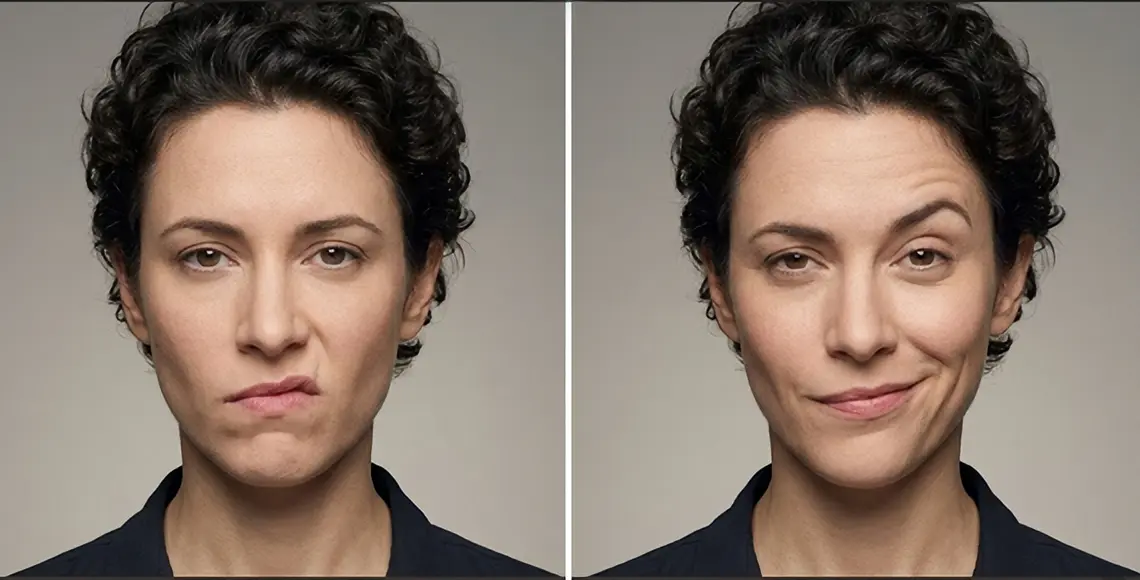
Left: Contempt — unilateral lip tightening and depression. Right: Sarcasm / Dry Humour — one-sided curl with raised eyebrow.
Reading clusters is the core skill in body language. The Body Language Test below ↓ is built around exactly this — interpreting expressions in context, not in isolation.
Asymmetrical Mouth & Deception: What It Means When Someone Is Lying
The asymmetrical mouth is one of the more reliable deception cues precisely because it is difficult to control. When someone is lying, they are typically managing two things at once — the content of what they are saying and the emotional response to the deception itself. Fear, guilt, or contempt toward the person being deceived can all surface as asymmetrical mouth movements, particularly as brief flickers that appear before the person reasserts conscious control over their expression.
Contempt is particularly common in deception contexts. It can mean the person feels superior to the one they are deceiving, or dismissive of the consequences. Anger says "what you did was wrong." Contempt says "you are beneath me" — and in a deception context, it can mean "you are easy to fool." John Gottman's research on couples found that contempt — identifiable by this unilateral lip movement — was one of the strongest predictors of relationship breakdown, precisely because it communicates not just displeasure but a fundamental devaluation of the other person.
Context matters enormously. An asymmetrical mouth during a tense conversation means something different from the same expression during a moment of shared sarcasm. The muscle movement may be identical; the meaning depends entirely on the relationship and what preceded it.
Asymmetrical Mouth vs Similar Expressions
Asymmetrical mouth vs smirk — a smirk is a specific version of the asymmetrical mouth: one corner raised with a slight tightening, often combined with a knowing or satisfied expression in the eyes. It can mean contempt, self-satisfaction, or dry humour. The smirk is the asymmetrical mouth at its most intentional — often a deliberate expression rather than an involuntary leak, which reduces its value as an authenticity cue.
Asymmetrical mouth vs nervous smile — a nervous smile can also appear lopsided, but the surrounding context differs. Nervous smiling typically shows faster onset and offset, appears alongside other stress cues like collapsed posture or averted gaze, and tends to be more diffuse across the face rather than concentrated in a single corner.
Asymmetrical mouth vs full contempt expression — the full contempt expression involves lip corner tightening and raising on one side only, held for at least a moment. A fleeting asymmetrical twitch that resolves in under a second is more likely to be emotional leakage — a microexpression. Both are informative, but the sustained version is easier to identify and more likely to mean a stable attitude rather than a passing reaction.
How to Spot an Asymmetrical Mouth Accurately
The first question is always: which direction is the asymmetry going? A corner that rises means something different from a corner that tightens without rising, or one that drops while the other stays level. Rising suggests some form of positive valence — even contempt has an element of superiority that registers as upward movement. Dropping or tightening without rising is more likely to mean disgust, suppressed anger, or reluctance.
The second question is duration. A brief flash lasting a fraction of a second is almost certainly involuntary — the face revealing something before the person manages it. A sustained asymmetrical expression that holds through a sentence or an exchange is more deliberate and its meaning is more accessible through context.
The third question is what the rest of the face is doing. An asymmetrical mouth with relaxed eyes and an open posture means something very different from the same mouth movement accompanied by slightly narrowed eyes and a tilt of the head. The mouth sets the opening cue; the full cluster delivers the meaning. That cluster-reading skill is exactly what the Body Language Test below develops.
How Much Body Language Can You Read?
The asymmetrical mouth is one expression in a much larger system. How accurately can you read the rest? The test below covers expressions, gestures, and postures across multiple contexts — with detailed explanations after every answer so you learn as you go.