Duchenne Smile: What Makes a Smile Genuine & How to Spot the Difference
Signal · Face · Enjoyment / Authenticity family
Think you can read body language? We've included a Body Language Test at the bottom — see how well you read the full range of nonverbal cues. Jump to the test ↓

Not all smiles are the same. The human face can produce dozens of distinct smile configurations, and they do not all mean the same thing. One type, however, has been studied more than any other and carries a specific meaning that cannot be easily faked: the Duchenne smile — the smile that reaches the eyes. Named after the French neurologist Guillaume-Benjamin Duchenne, who identified it in 1862, it remains one of the most reliable signals of genuine positive emotion in the entire body language repertoire, explored extensively across Cognitive Train.
Duchenne spent years using electrical stimulation to map which facial muscles produced which expressions. He discovered that the smile of genuine enjoyment requires the simultaneous contraction of two muscles — and that one of them cannot be reliably controlled voluntarily. That distinction changed how scientists think about smiling entirely.
What Is a Duchenne Smile?
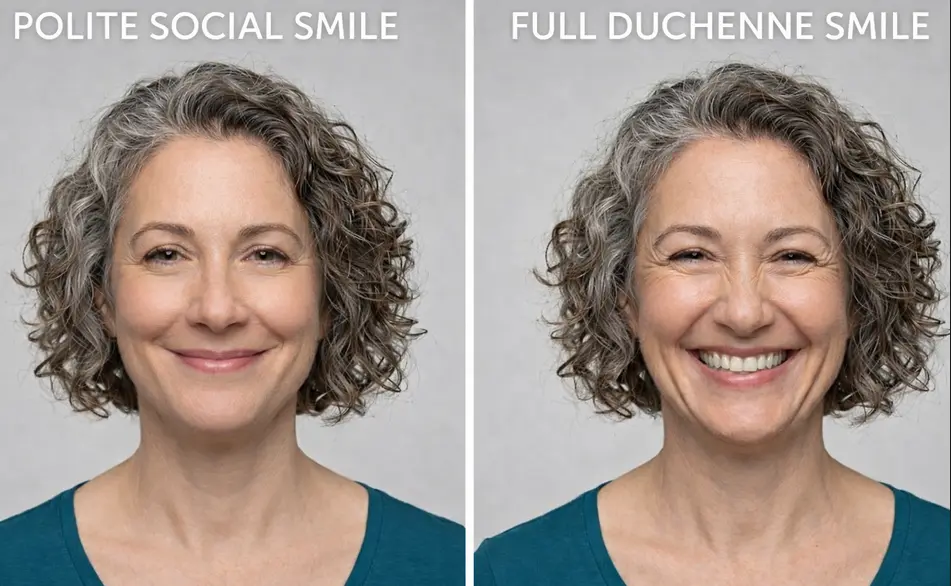
A Duchenne smile involves two facial muscles firing together. The zygomaticus major — the muscle that pulls the lip corners upward and outward — activates in both genuine and posed smiles. What distinguishes the Duchenne smile is the simultaneous activation of the orbicularis oculi, the muscle that encircles the eye. When this muscle contracts, it raises the cheeks, narrows the eye aperture slightly, and creates the characteristic creasing at the outer corners of the eyes commonly called crow's feet.
The critical detail is voluntary control. The zygomaticus major can be contracted on command — anyone can produce a mouth smile whenever they choose. The orbicularis oculi is far harder to activate deliberately. Most people cannot reliably fire this muscle without actually feeling something positive. Duchenne himself noted that this muscle "does not obey the will" and that its absence in a smile "unmasks a false friend." This involuntary quality is what makes the Duchenne smile such a valuable authenticity signal.
The Science Behind Genuine Smiles
The landmark research establishing the Duchenne smile as a marker of genuine emotion was conducted by Paul Ekman, Richard Davidson, and Wallace Friesen. In their study — now foundational in the field — participants watched pleasant and unpleasant films while their facial muscle activity, brain activity, and self-reported emotional states were recorded. The Duchenne smile occurred significantly more during the pleasant films, correlated with greater left-hemisphere brain activation associated with positive approach emotions, and aligned with subjective reports of happiness and amusement. Non-Duchenne smiles showed none of these relationships.
Research on facial and emotional reactions to Duchenne versus non-Duchenne smiles found that observers also respond differently to each type. Participants who viewed Duchenne smiles reported experiencing more pleasure themselves, and the effect correlated with empathy scores — the more empathic the observer, the stronger their response to a genuine smile. Non-Duchenne smiles produced no such effect. This suggests the Duchenne smile functions not just as a signal of the smiler's state, but as a trigger for positive emotional responses in others.
A separate line of research examined whether the physical act of Duchenne smiling affects the smiler's own physiology. Participants who held a Duchenne smile during stressful tasks showed lower heart rates during stress recovery than those with neutral expressions — even when they were unaware they were smiling. The body, it appears, responds to the signal regardless of whether the emotion preceded it.
How to Spot a Duchenne Smile
Look at the eyes, not the mouth. This is the single most reliable rule. A mouth smile with flat, unchanged eyes is almost certainly a non-Duchenne smile — polite, social, or performative. The eyes in a genuine Duchenne smile narrow slightly, the lower eyelids lift, the outer corners crease, and the upper cheeks visibly rise. The whole region around the eye becomes animated rather than static.
Watch the cheeks. Duchenne smiles push the cheeks upward as the orbicularis oculi contracts. You will see a distinct rounding and elevation of the cheek mass, which can push the lower eyelids upward from below. In a non-Duchenne smile, the cheeks typically remain relatively flat even when the mouth is pulled wide.
Check the timing. Genuine Duchenne smiles tend to onset more gradually, hold at peak, and offset gradually as well. Posed or social smiles often appear and disappear more abruptly — a sharper onset, a held plateau, and a quick drop. The temporal profile of the expression carries information about its authenticity.
Look for symmetry. Genuine emotional expressions tend to be more symmetrical across the face. Posed smiles are more often asymmetrical, with one side of the mouth or eye region more activated than the other. This is not an absolute rule, but asymmetry is a useful secondary cue, particularly when combined with other signs.
Reading clusters is the core skill in body language. The Body Language Test below ↓ is built around exactly this — interpreting signals in context, not in isolation.
Can a Duchenne Smile Be Faked?
This is where the research gets more nuanced. The classical view — that the orbicularis oculi is entirely involuntary and therefore the Duchenne smile is unfakeable — has been refined by subsequent work. Some individuals can voluntarily contract the orbicularis oculi, and skilled actors can produce convincing Duchenne smiles on demand. More recent research has also raised the possibility that what distinguishes Duchenne from non-Duchenne smiles may partly reflect smile intensity rather than authenticity alone — wider, more intense smiles naturally recruit more facial muscles.
The practical implication is important: the Duchenne smile is a strong signal of genuine emotion, but not an infallible one. It should be read as part of a cluster — alongside the timing of the expression, its spontaneity relative to what triggered it, the congruence of other facial regions, and the broader postural context. A Duchenne smile that appears immediately in response to something genuinely amusing, fades naturally, and aligns with relaxed body posture is a reliable signal. A Duchenne smile held steadily throughout a structured performance, with a rigid torso and watchful eyes, warrants more careful reading.
The Social Function of the Duchenne Smile
The Duchenne smile is not just a window into internal states — it performs social work. Research has found that Duchenne smiles are implicitly associated with psychological closeness, while non-Duchenne smiles are associated with psychological distance. When someone produces a genuine smile in response to you, the response it triggers in your nervous system is different from the response produced by a polite smile — even if you cannot articulate the difference consciously.
This is why the Duchenne smile matters in high-stakes social contexts: job interviews, negotiations, first impressions, and relationships. The face can produce a smile that says "I am being socially appropriate" and a smile that says "I am genuinely glad to be here." Most people can detect the difference at an instinctive level. The Duchenne smile is the body's way of making that distinction legible — the signal that the positive emotion is real, not performed.
Combined with open palms and forward-oriented posture, a Duchenne smile forms one of the strongest clusters of genuine warmth and openness available in the body language repertoire. Each signal reinforces the others, and the combination is correspondingly harder to sustain falsely across an extended interaction.
Duchenne Smile vs Social Smile
The social smile — also called the Pan Am smile after flight attendants trained to maintain it — uses the zygomaticus major alone. It is the smile of courtesy, of professional warmth, of appropriate social response. It is not deceptive in any morally significant sense; it is simply a different signal serving a different function. Most social interactions run entirely on social smiles, and there is nothing wrong with that.
The distinction becomes relevant when you are trying to read whether someone's positive response to you is genuine or performed. A colleague who smiles when you enter the room with eyes fully engaged is responding differently from one whose smile is confined to the lower face. Neither is necessarily problematic — but they communicate different things about the internal state behind the expression.
How Much Body Language Can You Read?
The Duchenne smile is one signal in a much larger system. How accurately can you read the rest? The test below covers expressions, gestures, and postures across multiple contexts — with detailed explanations after every answer so you learn as you go.