Psychological Reactance — Meaning, Examples & How to Overcome It
Mind · Cognitive Biases · Social & Self-Perception family
Test yourself — can you spot the bias in each scenario? Take the Cognitive Bias Spotter Test. Jump to the test ↓
What Is Psychological Reactance? Simple Definition
Psychological reactance is what happens when being told you cannot do something — or must do something — makes you want to do the opposite. When someone restricts your choices, your instinct is often to push back, resist, or want the restricted thing even more. The restriction backfires. The harder the push, the stronger the pushback.
It is familiar from everyday life: a child told not to touch something immediately wants to touch it; a person told what to think digs in harder; a consumer told a product is nearly sold out suddenly wants it more. Psychological reactance explains why heavy-handed persuasion so often produces the opposite of its intended effect.
This page is part of the cognitive biases guide on our free cognitive training and brain testing tools, alongside interactive tools covering memory, attention, reaction time, and decision-making.
Psychological Reactance Meaning & Psychology
Psychological reactance theory was developed by Jack W. Brehm, who proposed in his foundational 1966 monograph that people believe they have certain freedoms — things they are able to do, choose, or feel — and that when those freedoms are threatened or removed, they are driven to get them back. The more important the freedom and the more completely it is threatened, the stronger the reaction.
An early experimental test came from Brehm & Sensenig (1966), who found that when someone in a group tried to pressure others into agreeing with their view — phrasing it as something the group was expected to accept — participants actually shifted away from that position. The same view, expressed as a personal opinion rather than a directive, produced far less resistance. The attempt to force agreement produced the opposite. Brehm & Brehm (1981) later expanded the theory, mapping out when and why the effect is stronger or weaker across different situations and types of people.
Two ways reactance shows up
Reactance tends to produce one of two responses, sometimes both at once. The first is the boomerang effect: people do the opposite of what they were told — engaging in the forbidden behaviour, rejecting the recommended one, or hardening against a view they were pushed to adopt. The second is the forbidden fruit effect: the restricted option becomes more attractive simply because access to it has been limited. Both serve the same purpose — recovering the sense of freedom that the restriction took away.
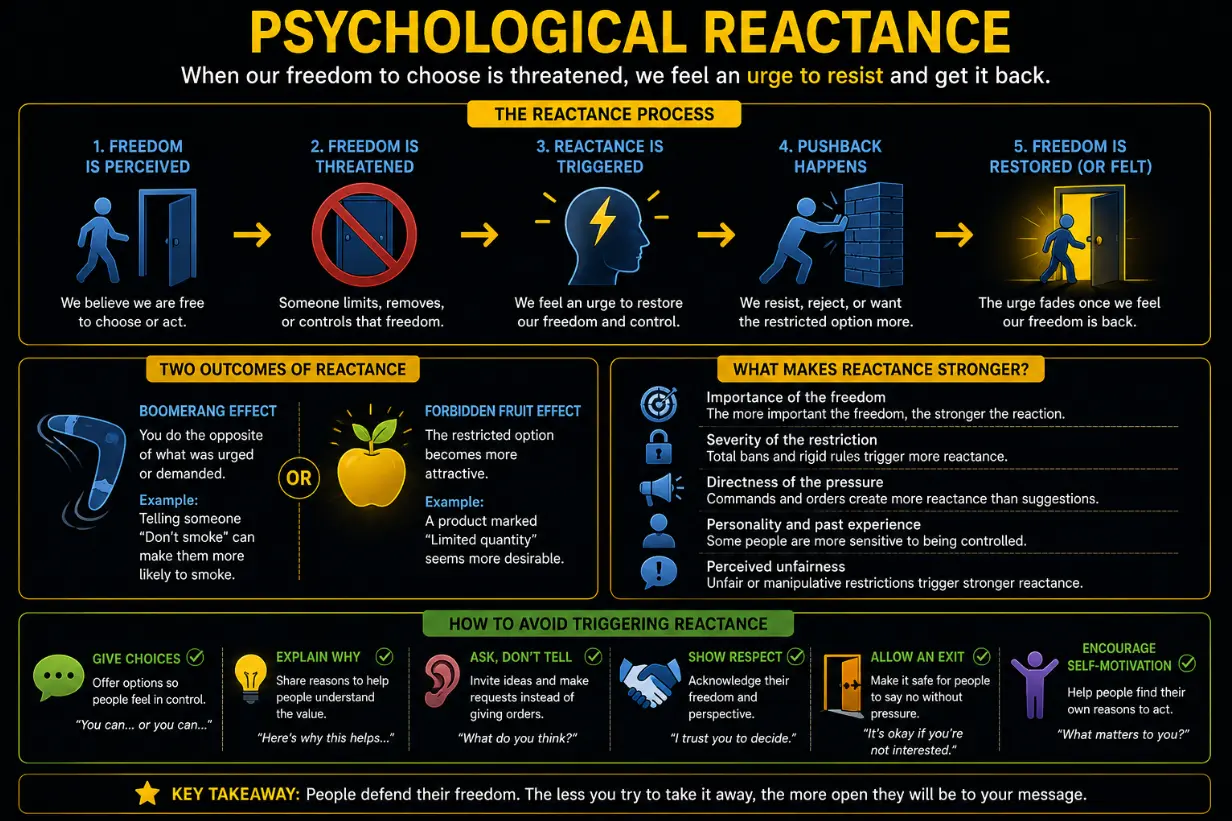
Psychological reactance: when freedom to choose is threatened, people feel an urge to resist and get it back — either by doing the opposite of what was demanded, or by wanting the restricted option more. The less you try to take freedom away, the more open people will be to your message.
Psychological Reactance in Real Life — Examples
In parenting and education, reactance is one of the most common reasons why telling children what to do produces the opposite result. Commands framed as directives — "you must," "you cannot," "you have to" — reliably generate more resistance than requests framed as choices. A teenager told they are forbidden from seeing a friend, listening to a certain kind of music, or holding a particular view will often become more attached to those very things as a direct result of the prohibition. The restriction signals that the freedom to choose matters, and the urge to defend it kicks in.
In public health, reactance is a well-studied reason why some campaigns produce worse results than expected. Anti-smoking and other health messages that feel preachy, controlling, or coercive tend to produce less behaviour change — and sometimes push people in the wrong direction — compared to messages that present the same information in a way that leaves the audience feeling they are making their own choice. The issue is not the facts; it is the tone. Research in this area consistently finds that messages perceived as restricting personal freedom can trigger resistance that works against the campaign's goals.
In sales and marketing, scarcity messaging taps into the forbidden fruit side of reactance. "Limited time only," "while stocks last," and "only 3 remaining" signal restricted access, which tends to make the product feel more desirable. The product has not changed; the perceived threat to the freedom to acquire it has. This is why scarcity framing is so widely used — it reliably increases the attractiveness of the restricted option.
Psychological Reactance in Politics
In political contexts, reactance helps explain why attempts to tell people what to think so often backfire. When a political message feels like an attempt to control the audience's view rather than inform it, people who value their independence become more resistant — not less. The message not only fails to persuade but can actively harden the existing position, because agreeing would feel like giving in.
This pairs closely with confirmation bias: when a message challenges an existing belief and also feels controlling, both tendencies work together to reject it — one by selectively processing information, the other by treating agreement as a loss of independence. The combination is particularly hard to shift. Similarly, even accurate fact-checks or corrections can trigger resistance when the tone is condescending or the delivery feels like a lecture — how something is said can matter as much as what is said.
Do Some People React More Strongly Than Others?
Yes. While everyone can experience reactance in the right circumstances, some people are generally more sensitive to perceived attempts to control their choices. These individuals tend to push back in a wider range of situations, react more strongly to the same level of pressure, and are less persuaded by approaches that feel directive. This is worth keeping in mind when communicating with others: a message or style that works well for most people can misfire badly with someone who has a strong independent streak and reads even mild suggestions as encroachments on their freedom.
How to Reduce Psychological Reactance
Offer choices rather than issue commands
The most reliable way to reduce reactance is to frame messages so that they preserve rather than threaten the other person's sense of choice. Presenting options, acknowledging the right to decide, and offering information rather than instructions all reduce the sense of being controlled that triggers pushback. The same substantive content — the same health advice, the same product information, the same factual correction — produces less resistance when delivered in a way that leaves the audience feeling they reached their own conclusion. This applies in parenting, management, healthcare, and everyday conversation alike.
Explain the reason when a restriction exists
When a restriction genuinely exists and needs to be communicated, giving a clear and honest reason for it reduces reactance more than stating the restriction without explanation. People react most strongly when a freedom is removed without apparent justification — it feels arbitrary and controlling. Explaining why, and acknowledging that a real imposition is being asked of them, reduces the sense of arbitrary control that drives the strongest resistance.
Notice when you are pushing back on something for the wrong reason
For the individual, the most useful check on reactance is to notice when a strong urge to resist may be driven by feeling pushed rather than by genuine disagreement with the substance. Asking "would I want this if it hadn't been restricted?" or "am I resisting because the argument is weak, or because I feel controlled?" creates a pause between the impulse and the response. This is particularly relevant wherever reactance and confirmation bias interact — where the combination of "this challenges what I believe" and "someone is telling me I'm wrong" produces entrenchment that has more to do with feeling pressured than with the actual quality of the argument.
The Deeper Point
Psychological reactance is a reminder that persuasion is not just about having the right information — it is also about how the information is delivered and how the audience feels during the process. A strong argument delivered as a command can produce less change than a weaker argument delivered as an invitation. The feeling of being controlled is itself a reason to resist, independent of the content being pushed.
Understanding reactance does not mean avoiding directness or never advocating clearly for a position. It means being aware that the way a message lands — whether it feels informing or controlling, respectful or coercive — shapes whether it persuades or pushes away. That awareness is useful for anyone who needs to communicate, influence, or simply get along with people who value their independence, which is most people.
Related biases worth exploring alongside this one: confirmation bias, which amplifies reactance by selectively processing information that challenges existing beliefs; authority bias, which is in some ways reactance's mirror image — where authority bias produces compliance with perceived power, reactance produces resistance to it; and bandwagon effect, which shows the opposite pattern — people going along with the crowd rather than against it, depending on whether the social pressure feels like an invitation or a constraint.
The Cognitive Bias Spotter Test below puts that understanding to work — see if you can identify psychological reactance and the other nine biases when they appear in realistic scenarios.