Pessimism Bias — Meaning, Examples & How to Overcome It
Mind · Cognitive Biases · Self-Perception family
Test yourself — can you spot the bias in each scenario? Take the Cognitive Bias Spotter Test. Jump to the test ↓
What Is Pessimism Bias? Simple Definition
Pessimism bias is the tendency to overestimate the likelihood of negative events and underestimate the likelihood of positive ones — to expect outcomes to be worse than they are likely to be. Where optimism bias skews predictions in the positive direction, pessimism bias skews them in the negative direction, producing a systematically gloomy forecast of personal outcomes, social conditions, or future events.
Pessimism bias is less universal than optimism bias — most people, most of the time, show a mild optimistic tilt — but it is more common in people experiencing depression, anxiety, or high stress, and it appears reliably at the societal level in certain contexts, particularly in assessments of collective and global trends even among individuals who are personally optimistic about their own futures.
This page is part of the cognitive biases guide on our free cognitive tests and brain training tools, alongside interactive apps covering memory, attention, reaction time, and decision-making.
Pessimism Bias Meaning & Psychology
Research on pessimism bias distinguishes between two quite different phenomena that are both described as pessimistic. The first is unrealistic pessimism — a bias parallel to unrealistic optimism, in which predictions about outcomes are systematically worse than the statistical base rates justify. This is the form most directly comparable to optimism bias, and it is closely associated with depression. People experiencing depression consistently rate their personal risk for negative events as higher than warranted, and their probability of positive events as lower than warranted — a pattern that appears to maintain and deepen the depressive state.
The second phenomenon is defensive pessimism — a deliberate cognitive strategy studied by Norem & Cantor (1986) in which anxious individuals set deliberately low expectations before entering a challenging situation. Counter-intuitively, this strategy often improves performance: by anticipating failure in detail, defensive pessimists mobilise their anxiety as motivation, prepare more thoroughly, and are less derailed by setbacks than if they had maintained optimistic expectations. For these individuals, pessimistic expectations are not a bias distorting reality but a functional strategy for managing anxiety and achieving goals.
Personal versus societal pessimism
A consistent finding in surveys of public attitudes is that people simultaneously hold optimistic expectations for their own personal futures and pessimistic expectations for society, the economy, or the world. Individuals expect their own income, health, and relationships to improve while believing that the country is heading in the wrong direction, that economic conditions will worsen, or that the world is getting more dangerous. This pattern — sometimes called the optimism gap — means that pessimism bias and optimism bias can coexist in the same person simultaneously, applied to different domains.
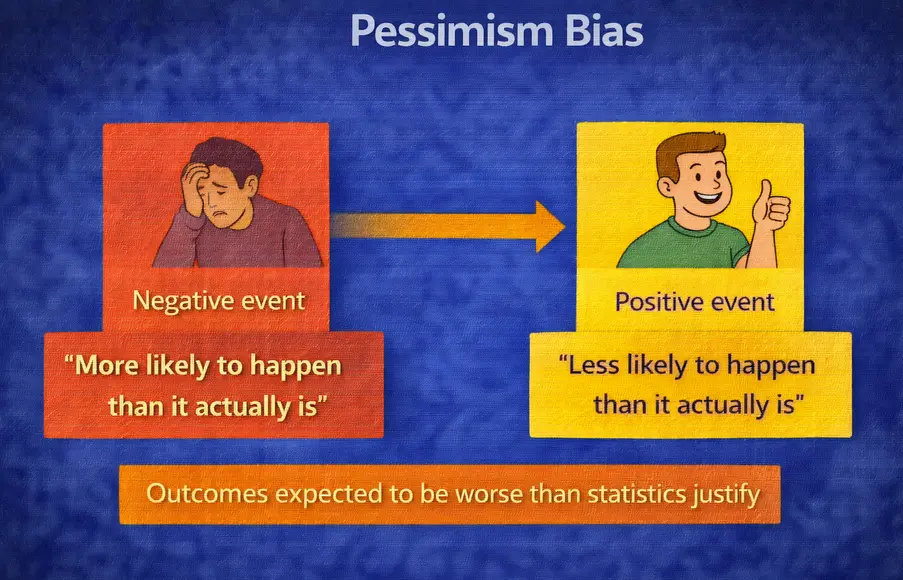
Pessimism bias: negative events feel more likely than they actually are, positive events feel less likely — so outcomes are consistently expected to be worse than the statistics justify.
Pessimism Bias in Real Life — Examples
Pessimism bias shows up in everyday life as a consistent tendency to expect the worst from ambiguous situations. A job applicant who assumes rejection before receiving a response, a student who expects to fail despite adequate preparation, a person who assumes a new relationship will end badly based on the history of previous relationships — all of these represent pessimistic predictions that are not anchored to the actual base rate probability of the outcome but to an emotionally driven expectation of negative outcomes.
At the societal level, polls consistently show that majorities in many countries believe that life is getting worse for the next generation, that crime is rising, and that economic conditions are deteriorating — even in periods when the statistics show improvement on most of these measures. Steven Pinker and Hans Rosling have documented extensively that global measures of health, poverty, violence, and living standards have improved substantially over recent decades, yet public perception overwhelmingly predicts continued deterioration. This is pessimism bias operating at the collective level, driven partly by media coverage that emphasises negative events and partly by the availability heuristic — negative events are more available in memory because they are more frequently reported.
Pessimism Bias and Depression
The relationship between pessimism bias and depression is one of the most studied areas in clinical psychology. Depressive cognition is characterised by what Aaron Beck identified as the cognitive triad: negative views of the self, the world, and the future. The future-oriented component — the systematic expectation of negative outcomes — is a direct expression of pessimism bias, and it is both a symptom and a maintaining factor of depression. People who expect negative outcomes are less likely to initiate potentially rewarding activities, less likely to persist through difficulty, and more likely to interpret ambiguous events as confirming their negative expectations through confirmation bias.
An important distinction in this domain is depressive realism — the empirically supported finding that mildly depressed individuals sometimes make more accurate probability assessments than non-depressed individuals, who are inflated by optimism bias. This suggests that the optimism of non-depressed people is itself a bias, and that the "realistic" baseline for probability assessment lies somewhere between the optimism of the average non-depressed person and the pessimism of the depressed person. Neither extreme is calibrated.
Pessimism Bias in Health Decisions
Pessimism bias in health contexts leads to underutilisation of preventive and treatment options. People who expect their health to deteriorate regardless of their actions are less likely to exercise, eat well, take prescribed medications, or attend screening appointments — because the expected outcome of these behaviours is discounted by the overriding expectation of negative health outcomes. This produces a self-fulfilling quality: the pessimistic expectation reduces health-promoting behaviour, which worsens actual health outcomes, which confirms the pessimistic expectation.
In cancer screening and treatment adherence, pessimism bias is a documented barrier. Patients who believe they will develop cancer regardless of screening, or who believe treatment is unlikely to work, are less likely to participate in screening programmes and less adherent to treatment protocols. The bias directly reduces the effectiveness of public health interventions by undermining the expected-value calculation that motivates preventive action.
Pessimism Bias in Investing and Finance
In financial decision-making, pessimism bias produces excessive risk aversion, under-investment, and missed opportunities. People who systematically overestimate the probability of market crashes, business failures, or adverse economic conditions hold less in growth assets, save less productively, and miss the long-term returns that the statistical base rates of those outcomes would justify accepting. The planning horizon shortens when negative outcomes feel imminent, which reduces the compounding benefit of long-term investment.
At the societal level, pessimism about economic conditions can become self-fulfilling: when consumers and businesses expect economic deterioration, they reduce spending and investment, which produces the economic slowdown they predicted. This is one reason why sentiment surveys — which measure pessimism and optimism about economic conditions — are themselves used as leading economic indicators.
Pessimism Bias vs Defensive Pessimism
It is important to distinguish between pessimism bias — a distortion that produces inaccurate negative predictions and reduces effective action — and defensive pessimism, which is a deliberate strategy that some anxious individuals use effectively. For defensive pessimists, setting low expectations is not a misperception of reality but a preparation ritual that mobilises effort and reduces the debilitating impact of anxiety. Telling a defensive pessimist to "think more positively" typically impairs their performance by disrupting a strategy that works for them. The distinction matters practically: interventions designed to counter pessimism bias may be counterproductive when applied to individuals who are using defensive pessimism as a functional coping mechanism.
How to Avoid and Overcome Pessimism Bias
Check predictions against base rates
The same corrective that works for optimism bias applies in reverse for pessimism bias: anchor predictions to the actual base rate probability of the outcome rather than to the emotionally driven expectation. If the base rate probability of a negative outcome is 20%, but you expect it to be 80%, the gap between the prediction and the base rate is the pessimism bias. Explicitly finding and attending to the actual statistical frequency of the outcome shifts the prediction toward calibration.
Track the ratio of expected to actual negative outcomes
People who keep a record of their pessimistic predictions and compare them to actual outcomes over time consistently find that outcomes are better than their predictions anticipated. This track record provides concrete, personal evidence of the bias that is more persuasive than abstract arguments. The pattern of outcomes being better than expected — which most pessimistically biased people will observe once they start tracking — directly challenges the felt sense that negative outcomes are as likely as they seem.
Distinguish global from personal expectations
The optimism gap — pessimism about collective conditions alongside optimism about personal outcomes — suggests that pessimism bias about the world is partly a media consumption effect rather than a calibrated assessment. Actively seeking out base rate data on global and societal trends, rather than relying on the availability of media-reported events, often produces a significantly more positive picture than the pessimistic expectation. Rosling's work on global data is a direct corrective to this form of societal pessimism bias.
The Deeper Point
Pessimism bias and optimism bias are in some respects mirror images, but they have different typical distributions, different causes, and different consequences. Optimism bias is the default for most people in most conditions; pessimism bias is more context-specific, more common in depressed and anxious individuals, and more prevalent at the societal and collective level than at the personal level.
Both biases share the same fundamental problem: predictions about the future that are not anchored to reality. The goal in both cases is calibration — predictions that accurately reflect the actual probability distribution of outcomes, neither systematically inflated nor systematically deflated. Calibrated expectations produce better decisions, better preparation, and more accurate assessments of what actions are worth taking. Both the person who expects everything to go right and the person who expects everything to go wrong are making the same type of error — replacing probability with emotion — in opposite directions.
Related biases that interact closely with this one: optimism bias, the mirror image and more common default; availability heuristic, which makes negative events more cognitively available and therefore more probable-feeling; and confirmation bias, which selectively attends to evidence confirming the pessimistic expectation once it is formed.
The Cognitive Bias Spotter Test below puts that understanding to work — see if you can identify pessimism bias and the other nine biases when they appear in realistic scenarios.