Mind Mapping for Memory: How Visual Organization Strengthens Recall
Spatial & Visual Method · Organization Strategy · Beginner-Friendly Technique
Linear notes are how most people record information — and they are one of the worst formats for remembering it. A page of sequential bullet points or paragraphs gives the brain no spatial structure, no visual landmarks, and no hierarchical relationships to anchor memories to. A mind map does the opposite. It takes the same information and arranges it radially from a central topic, with branches for subtopics, sub-branches for details, and visual elements — color, spacing, icons, curves — that give the brain spatial and visual cues for every piece of content. The result is a format that is significantly more memorable than conventional notes. This page is part of the Memory Techniques resources available through Cognitive Train.
Mind mapping was popularized by Tony Buzan in the 1970s, though the practice of arranging information visually and radially has much older roots. What Buzan contributed was a structured set of principles — a central image, curved branches, single keywords per branch, color coding, and visual elements throughout — designed specifically to maximize memorability. Whether or not you follow Buzan's specific rules, the core insight is well supported by cognitive science: information organized spatially and visually is remembered better than information organized linearly.
What Is a Mind Map?
A mind map is a diagram that organizes information around a central topic, with related ideas branching outward in a radial structure. The central topic sits in the middle of the page. Major subtopics branch out from the center as thick, curved lines. Each subtopic can have its own sub-branches for details, examples, and related concepts. The structure is hierarchical but non-linear — everything connects back to the center, and the spatial position of each branch provides an additional memory cue.
Key characteristics that distinguish a mind map from other visual organization tools:
Central topic — the main subject sits at the center, usually as an image or bold text
Radial branches — major subtopics radiate outward from the center like tree limbs
Single keywords — each branch uses one or two keywords rather than full sentences
Color coding — different branches use different colors to create visual distinction
Hierarchy — sub-branches grow from main branches, creating levels of detail
Curved lines — organic, curved branches rather than rigid straight lines (Buzan argued this is more engaging for the brain)
Images and icons — visual elements added wherever possible to strengthen encoding
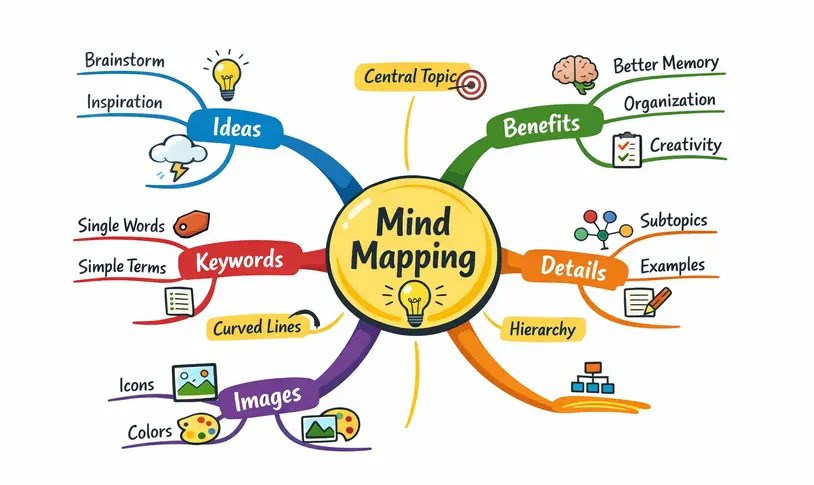
A mind map about mind mapping — demonstrating every key feature in one image: central topic, radial color-coded branches, single keywords, icons, hierarchy, and curved lines.
The format forces you to identify the hierarchical relationships between concepts — what is a main topic, what is a subtopic, what is a detail — which is itself an act of elaborative encoding. You cannot create a mind map passively; the process of deciding where each piece of information belongs requires active engagement with the material.
Why Does Mind Mapping Improve Memory?
Mind mapping draws its effectiveness from several established memory principles working simultaneously.
Spatial encoding. The brain has exceptionally strong memory for spatial layouts — where things are located relative to other things. This is the same capacity that makes the Method of Loci so powerful. A mind map gives every piece of information a spatial position on the page: this concept is in the upper right, that detail branches from the lower left. When you try to recall the information, you can often remember where on the map it appeared, even if the specific words are initially elusive. That spatial cue helps pull the verbal content back into awareness.
Dual coding. A well-constructed mind map encodes information in both verbal form (the keywords on each branch) and visual form (the colors, spatial layout, icons, and images). This is the dual coding principle — two representational formats produce stronger memory than one. Linear notes are almost exclusively verbal; mind maps are inherently dual-coded.
Active organization. Creating a mind map requires you to make decisions about how information is structured — what connects to what, which ideas are primary and which are subordinate, how different concepts relate. These decisions are forms of elaborative encoding. Research consistently shows that actively organizing information during study produces better retention than passively recording it in the order it was received.
Chunking through hierarchy. The branching structure of a mind map naturally groups related information into clusters — which is chunking. Instead of remembering 30 individual facts, you remember 5 main branches with 6 details each. The hierarchical structure reduces effective memory load while preserving the relationships between items.
Research evidence. A meta-analysis by Nesbit and Adesope (2006), published in Review of Educational Research, examined studies comparing concept mapping (a close relative of mind mapping) with other study methods. They found that visual-spatial organization strategies produced moderate to large positive effects on knowledge retention and transfer compared with reading text, attending lectures, or participating in class discussions. The benefits were consistent across different age groups and subject areas.
How to Create a Mind Map for Memory
Step 1: Start with the central topic. Write or draw the main subject in the center of a blank page (landscape orientation gives you more space for branches). Use an image if possible — a quick sketch or icon representing the topic. The center should be visually prominent: larger text, bold color, or a circled image.
Step 2: Add main branches. Identify the major subtopics or categories and draw thick, curved lines radiating outward from the center. Use a different color for each main branch — the color becomes an additional memory cue for everything on that branch. Write one or two keywords on each branch, not full sentences. The keyword should capture the essence of that subtopic.
Step 3: Add sub-branches. From each main branch, draw thinner branches for details, examples, definitions, and supporting points. These sub-branches inherit the color of their parent branch. Continue using single keywords. If a sub-branch needs further detail, add additional levels — but keep the keywords concise.
Step 4: Add visual elements. Wherever possible, add small icons, sketches, or symbols alongside keywords. These do not need to be artistic — stick figures, simple shapes, and rough icons are fine. The point is not aesthetics; it is creating an additional visual encoding for each concept. A quick sketch of a brain next to "hippocampus" is more memorable than the word alone.
Step 5: Review by reconstructing. The most effective way to review a mind map is not to stare at it — it is to try to redraw it from memory. Close the original, take a blank page, and reconstruct as much as you can. Check against the original, note what you missed, and try again. This combines the spatial encoding benefits of mind mapping with the retrieval benefits of active recall.
Mind Mapping vs Other Memory Techniques
Mind mapping vs Method of Loci — both leverage spatial memory, but in different ways. The Method of Loci uses a familiar physical environment as the spatial framework and places individual items along a route. Mind mapping creates a new spatial framework on paper (or screen) and organizes information hierarchically within it. The Method of Loci is stronger for ordered recall of sequential lists. Mind mapping is stronger for understanding and remembering the structure and relationships within a topic. They can complement each other — create a mind map to understand the material, then use the Method of Loci to memorize the key points in order.
Mind mapping vs linear notes. Linear notes record information in the order received — first point, second point, third point. Mind maps reorganize information by relationship and hierarchy. Linear notes are faster to create during a lecture but harder to remember. Mind maps require more processing during creation but produce stronger retention because the creation process involves active organization, spatial encoding, and dual coding. For study purposes, converting linear notes into mind maps is itself an effective study technique because the conversion requires deep engagement with the material.
Mind mapping vs chunking — mind mapping is essentially chunking made visual and spatial. The branches of a mind map ARE chunks — groups of related information organized under a common heading. The difference is that mind mapping adds spatial position, color, and visual elements on top of the organizational structure. Plain chunking organizes; mind mapping organizes and spatially encodes simultaneously.
Mind mapping vs elaborative encoding — creating a mind map is an act of elaborative encoding. You cannot build a mind map without actively processing the material — deciding what the main topics are, how details relate to them, what goes where. The mind map format forces elaboration. However, elaborative encoding can also occur without any visual organization (through self-questioning, example generation, etc.), so mind mapping is one specific implementation of the broader elaborative encoding principle.
Tips for Better Mind Maps
Hand-drawn often beats digital. Research on the benefits of handwriting over typing for retention suggests that the physical act of drawing branches, writing keywords, and sketching icons engages motor memory in addition to visual and verbal memory. Digital mind mapping tools have advantages for editing and sharing, but for pure memory purposes, hand-drawn maps on paper tend to be more effective.
Use keywords, not sentences. The temptation is to write detailed notes on each branch. Resist it. Single keywords force you to distill the concept to its essence, which requires deeper processing. If you need more detail, add sub-branches — do not write longer text on the same branch. The constraint of brevity is part of what makes mind mapping effective.
Make it ugly if necessary. Perfectionism kills mind mapping for memory. The map does not need to be beautiful, symmetrical, or shareable. It needs to be meaningful to you. Messy, personal, idiosyncratic maps with rough sketches and inconsistent spacing can be more memorable than clean, template-based maps because the imperfections themselves become distinctive memory cues.
One map per topic. Do not try to fit an entire course or textbook into one mind map. One map should cover one topic, chapter, or concept at a manageable level of detail. For larger subjects, create multiple maps and link them — a master map showing the overall structure with references to detailed maps for each subtopic.
Reconstruct, do not just review. Looking at a completed mind map produces familiarity but not necessarily recall ability. Trying to redraw the map from memory — and checking what you missed — is far more effective. This reconstruction practice combines spatial encoding with active recall and is the single best way to convert a mind map into long-term memory.
You can test how well your spatial and visual memory performs — the same systems that mind mapping relies on — with the Spatial Memory Test and the Visual Memory Test.
Explore more techniques: Method of Loci · Dual Coding · Chunking · Elaborative Encoding · All Memory Techniques