Implicit vs Explicit Memory: What You Know Without Knowing
You see someone on the street and feel a flash of recognition. You know you've seen them before. But where? When? You can't recall a single detail—just that familiar feeling. Meanwhile, if someone asks what you had for breakfast, you can consciously replay the memory in your mind.
These are two fundamentally different types of memory. One operates in the spotlight of consciousness. The other works entirely behind the scenes.
The Basic Distinction
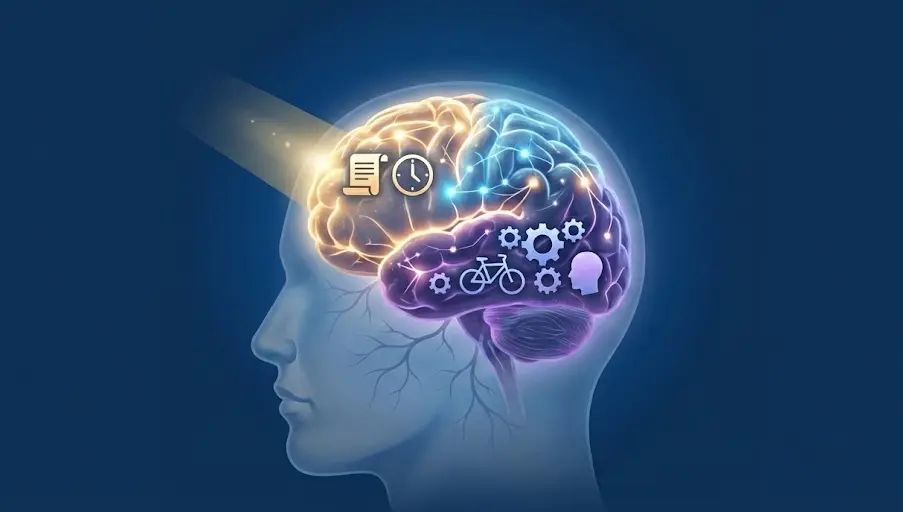
Explicit memory (also called declarative memory) is what most people think of as "memory." It's conscious recall—you deliberately retrieve information and are aware that you're remembering. This includes both episodic memory (personal experiences) and semantic memory (facts and knowledge).
Implicit memory is memory without conscious awareness. It influences your behavior, perceptions, and feelings without you realizing it. You can't "access" implicit memories the way you access explicit ones—they reveal themselves only through their effects on what you do.
Research has established that these aren't just different ways of describing memory—they're genuinely separate systems in the brain, with different neural structures, different rules, and different vulnerabilities.
Types of Implicit Memory
Implicit memory isn't a single system. It includes several distinct types:
Procedural memory stores skills and how-to knowledge. Riding a bike, typing, playing an instrument—you perform these automatically without consciously remembering how. The skill expresses itself through action, not recollection.
Priming occurs when exposure to something influences your later response to it, without you being aware of the connection. If you see the word "yellow" and are later asked to name a fruit, you're more likely to say "banana"—not because you consciously remember seeing "yellow," but because that exposure primed related concepts.
Classical conditioning creates automatic responses to stimuli. If a certain song played during a happy period of your life, hearing it now might lift your mood—even if you don't consciously connect the song to those memories.
Perceptual learning improves your ability to detect and discriminate stimuli. Experienced radiologists spot tumors that novices miss, often without being able to articulate exactly what they're seeing. The Visual Memory Test and Chimp Test both involve this kind of implicit perceptual improvement—with practice, you get faster without consciously changing your strategy.
How We Know They're Separate
The strongest evidence comes from patients with amnesia. People with damage to the hippocampus often can't form new explicit memories—they forget conversations minutes after having them—but their implicit memory remains intact.
In classic experiments, amnesic patients showed normal priming effects. After seeing a list of words, they couldn't remember any words from the list when asked directly. But when given word fragments to complete, they filled them in with words from the list at the same rate as healthy participants. The memory was there—they just couldn't consciously access it.
The same patients could learn new motor skills over days of practice, improving steadily, while having no memory of ever practicing. Each session felt like the first, yet the skill accumulated.
This dissociation proves that explicit and implicit memory aren't just different ways of retrieving the same information—they're stored and processed differently from the start.
Implicit Memory in Daily Life
Implicit memory shapes your experience more than you realize:
First impressions. When you meet someone and instantly like or dislike them without knowing why, implicit memory may be at work. They might resemble someone from your past—not enough for conscious recognition, but enough to trigger the associated feelings.
Intuition and gut feelings. That sense that something is "off" often reflects implicit pattern recognition. Your brain has detected something inconsistent with past experience, but the comparison happens below conscious awareness. You feel the conclusion without seeing the reasoning.
Preferences and tastes. Why do you prefer certain colors, foods, or music? Some preferences are explicitly learned, but many emerge from implicit associations you're not aware of. Advertisers exploit this constantly—repeated exposure creates familiarity, and familiarity breeds liking, all without conscious processing.
Skill performance. When you type, drive, or play a sport, explicit attention can actually interfere. Under pressure, athletes sometimes "choke" by consciously monitoring movements that should remain implicit. The skill runs better on autopilot.
The Interaction Between Systems
Explicit and implicit memory aren't completely independent—they often work together. When you learn a new skill, explicit memory handles the early stages: you consciously think about each step. With practice, control shifts to implicit systems, and the skill becomes automatic.
The N-Back Test illustrates this interaction. Initially, you consciously track items, using explicit working memory. With extended practice, some of the tracking becomes more automatic—you develop implicit routines that reduce the conscious load.
Learning also benefits from engaging both systems. Encoding strategies that create rich, multi-sensory experiences build both explicit memories you can consciously recall and implicit traces that influence future processing. This is why hands-on learning often beats passive reading—doing engages implicit systems that reading alone doesn't reach.
Training and Testing Each System
Standard memory tests primarily measure explicit memory. The Word Span Test, Number Memory Test, and Spatial Memory Test all require conscious recall—you know you're trying to remember, and you deliberately retrieve the information.
Implicit memory is harder to test directly because, by definition, you're not aware of it. It reveals itself through performance changes: getting faster at a task, showing preferences you can't explain, completing fragments with words you don't remember seeing.
The Sequence Memory Test and Color Memory Test engage both systems. You consciously try to remember, but performance also improves through implicit perceptual learning—your brain gets better at processing the specific patterns without conscious strategy changes.
For practical memory improvement, training explicit systems—through tests like those above—is most directly measurable. But implicit learning happens alongside it, especially when you practice consistently over time rather than cramming. Sleep helps consolidate both types, which is why spaced practice with rest beats marathon sessions.
The Bottom Line
Your memory isn't a single system—it's a collection of systems that operate by different rules. Explicit memory gives you conscious access to facts and experiences. Implicit memory works in the background, shaping your skills, perceptions, preferences, and intuitions without ever reaching awareness.
Neither is "better." Explicit memory lets you learn deliberately and communicate what you know. Implicit memory handles the vast processing that conscious attention couldn't manage. Together, they create both what you remember and who you are—the knowledge you can articulate and the instincts you can't explain.
Want to see how your conscious memory systems are performing? The tests below measure explicit encoding and recall—the memory you're aware of using.