How Many Pages Can You Read per Day?
So, unlike other articles that make you read until the end before you get to the answer, I'll be straightforward and give you the answer right now. You can read 1,340 pages per day. Done.
Of course I'm joking. As you can imagine, it all depends. How much time can you spend reading? What kind of book are you reading... or is it even a book to begin with? You might be talking about web pages or instruction manuals. Let's say you want to read a book or books. But you know the answer would be significantly different if you want to read Shakespeare versus easy readers. Possibly you might be thinking of manga. I went to medical school, and sometimes it took me a few hours to read only a few pages.
But whatever you want to read and however many pages you want to know you can read, you have to think about the basics first. You have to know how many words you can read per minute (it's called WPM). THEN you'll know roughly how many pages that translates to.
The Basic Formula: WPM to Pages
With a typical book, one page contains roughly 400 words. Now, an average person can read 200-250 words per minute (their WPM is 200-250). That means you would read roughly 0.5 pages a minute, or 1 page every 2 minutes. In other words, a typical reader would read about 30 pages per hour (or a little more, since 30 pages is based on the lower end of the average).
So if you can read for 3 hours a day, you'd be reading about 90 pages. In my own experience, sometimes I read and finish a book in one day, spending about 8 hours. Considering many books are 200-300 pages, it makes sense: 30 pages per hour equals 240 pages per day.
But How Fast Do YOU Read?
Here's the thing: the 200-250 WPM average is just that—an average. If you're an avid reader, you're probably reading much faster. This is why the answer to the general question "How many pages can you read a day?" is "it depends." But once you know how fast you can read, you'll have a much better idea of how many pages YOU can read.
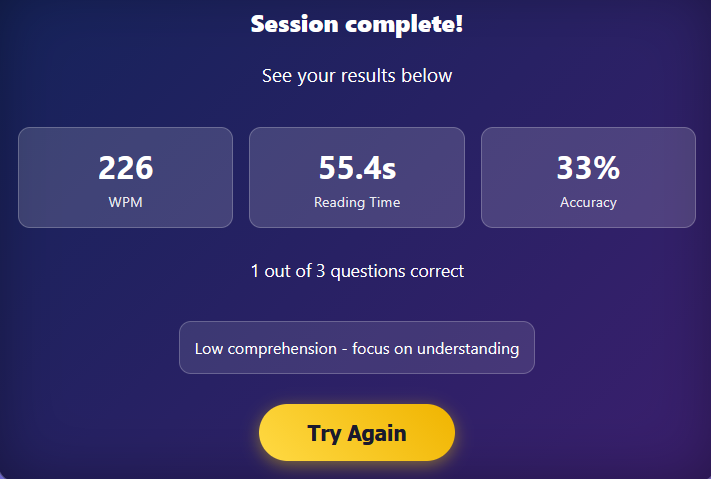
And here's a FREE tool for that. With this tool, you can test your WPM (you probably remember what it means by now). You can choose to test your comprehension too, so you can measure your most accurate reading speed, unlike some other similar tools.
What Different Readers Can Expect
Once you know your WPM, you can calculate exactly how many pages you read. But to give you some benchmarks, here's what different types of readers typically manage:
About 30 pages per day. This is someone who reads before bed or during a commute.
About 135 pages per day. This is someone who makes reading a daily priority and can finish a typical novel in 2-3 days.
About 150 pages per day. Even with less time, higher reading speed makes up for it.
If you're a very fast reader with a WPM of 400, you can read roughly 1 page per minute, or 60 pages per hour. So if you spent the entire day without sleeping, without even resting or eating, and kept reading even in the bathroom, you could technically read 1,440 pages a day. That's unrealistic, but hey, we're talking about the ideal world here!
How Can I Read More?
That's a funny question considering how unrealistic that last number was... but I know what you're thinking. You're not just asking about rearranging your schedule to find more reading time. You're wondering: if I could read FASTER, I'd be able to read more. And you're not wrong.
What we said about 200-250 WPM—that's just an average for most adult English native speakers. But some people, like lawyers or graduate students, can read faster. Why? Because they HAVE TO read a lot, so they adapt. While reading extensively, they learned how to read faster. But the question is: can you train yourself to read faster too, right?
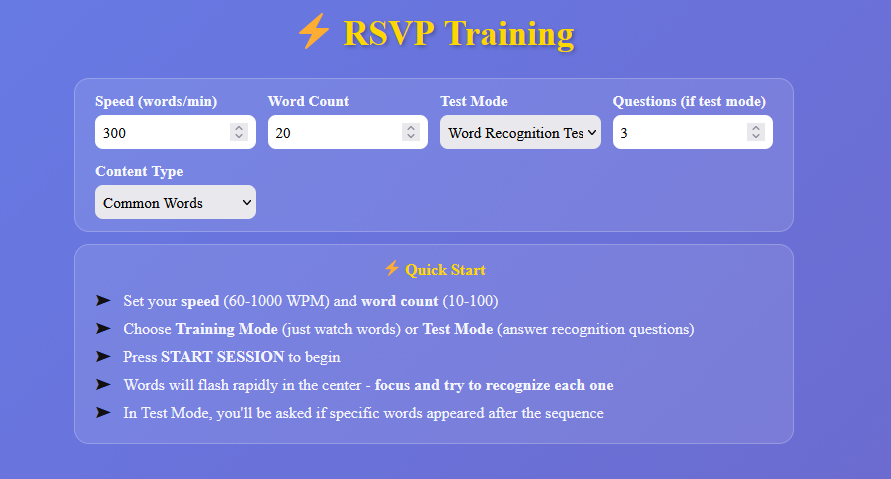
The answer is yes. There's a tool called RSVP (Rapid Serial Visual Presentation). It's a very simple method where words appear on the screen one after the other, and you try to recognize these words. It's a scientifically proven way of reading faster.
If you're interested, I actually made a free tool (REALLY free—NO login or subscription required) right here, so you can use it. If you want to know more about what RSVP actually is and how it works, read this article. I explain how it works and why it's so effective for reading faster.
Calculate Your Own Number
Once you measure your reading speed (WPM), you can calculate how many pages you read per minute and per hour. Again, the average book has 400 words per page, so you divide your WPM by 400. That's how many pages you read per minute. Then you multiply by 60 to see how many pages you read in one hour. The rest is up to how many hours you can spend reading in a day.
Now you have everything you need: the formula, the benchmark numbers, and the tools to measure and improve your own reading speed. The answer to "How many pages can you read per day?" is now entirely in your hands.