Object Barrier Body Language: Meaning, Psychology & What Holding Objects Really Signals
When a person pulls a bag across their chest, grips a coffee cup with both hands in front of their body, or holds a folder against their torso in a meeting, they are doing something the limbic system initiated before conscious thought had any input. The object is being used as a barrier — not because someone decided to use it that way, but because the brain registered discomfort and reached for the nearest available shield.
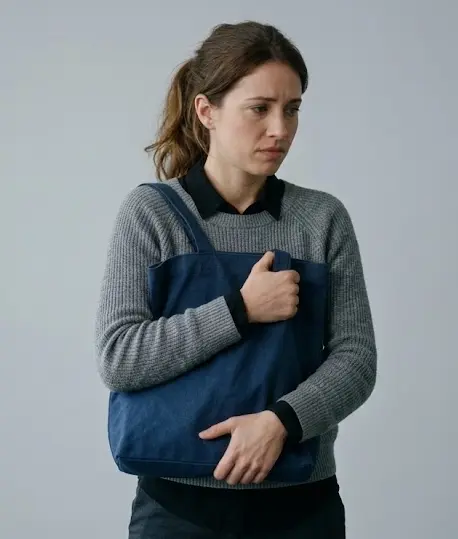
Bag pulled tight against the chest, both hands gripping it, gaze averted — the object is being used as a shield. The posture looks functional but the body is signalling discomfort.
What an Object Barrier Actually Is
An object barrier is any use of a held or repositioned object to create partial coverage of the torso — particularly the ventral (front) surface of the body. The object itself can be almost anything: a handbag, a briefcase, a drink, a phone, a book, a laptop, a cushion, a clipboard. What matters is not the object but the positioning: it ends up in front of the chest or stomach, held in a way that creates a layer between the person and their environment.
The reason this matters is rooted in what the front of the body represents neurologically. The ventral surface — chest, abdomen, throat — contains the body's most vulnerable structures, with relatively little bony protection compared to the back. Ventral denial and ventral fronting — the turning away or toward someone of this exposed surface — are among the most reliable indicators of comfort and discomfort in nonverbal communication precisely because of how the limbic system monitors and protects that region. An object barrier is essentially a portable version of the same impulse: when the arms cannot fully cross, or when crossing arms would be too socially obvious, the brain uses whatever is available.
The Psychology Behind It
The object barrier belongs to a broader family of self-protective behaviors that emerge under social discomfort or threat. Crossed arms are the most recognized version — the body using its own structure to create coverage — but crossed arms carry social meaning that many people have become conscious of and try to avoid. The object barrier serves the same psychological function with less visibility, which is precisely why it is so informative: people who avoid obvious self-protective gestures often unconsciously substitute them with object-based ones instead.
Research in clinical psychiatry has documented this behavior directly. Foley and Gentile (2010), writing in Psychiatry (Edgmont), describe a clinical case in which an anxious patient used a pillow as a "sort of protective barrier" — an object-based shielding behavior the authors flag as a meaningful nonverbal signal of discomfort. The same paper notes that many such nonverbal behaviors are unconscious and may offer a more accurate picture of a patient's emotional state than their verbal reports. (PMC2898840)
The behavior tends to emerge in predictable contexts: meeting someone new for the first time, entering a room where one feels socially outranked, receiving criticism or difficult feedback, being asked a question that produces discomfort, or simply being in a situation where the person feels exposed or evaluated. The trigger is a registered increase in social threat, and the response is the same across all these contexts — reach for something and bring it in front of the body.
Research has established that the hands and torso are among the most readable body areas for detecting anxiety in others. Waxer (1977), publishing in the Journal of Abnormal Psychology, found that raters shown silent video segments of psychiatric patients could accurately identify anxiety levels from nonverbal cues alone, with the hands and torso identified as the most salient regions. (Waxer, P.H., Journal of Abnormal Psychology, 86(3), 306–314. DOI: 10.1037/0021-843X.86.3.306)
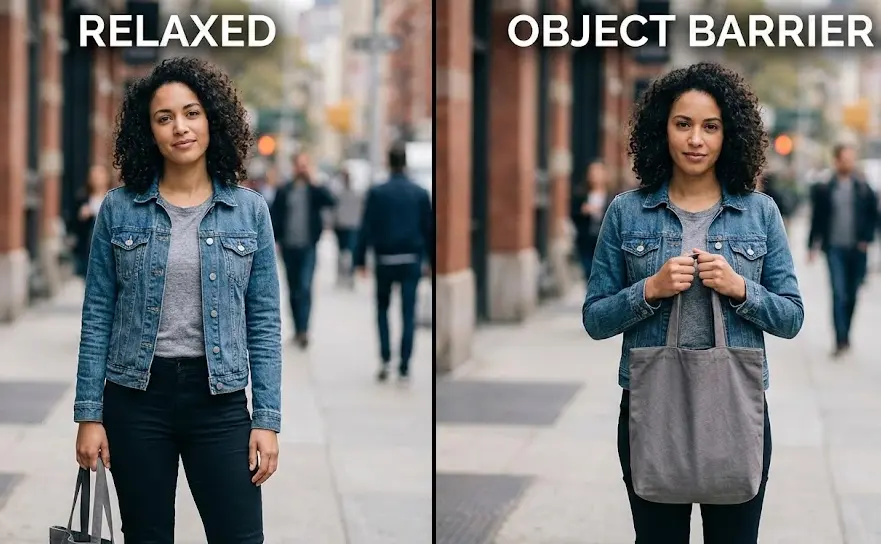
Left: relaxed posture — bag held loosely at the side, open stance, arms free. Right: object barrier — bag pulled up and held against the chest with both hands, torso covered. Same person, same environment; the difference is internal.
How It Differs from Casual Object Holding
Not every person holding a coffee cup is using it as a barrier. The distinction lies in the positioning and the accompanying signals. Casual object holding tends to be relaxed: the cup rests at the side, hangs from one hand, or sits on a surface. Object-barrier use involves the object being held with both hands, or positioned centrally in front of the torso, or clutched with more grip tension than the task of holding it requires.
The accompanying signals are what confirm the reading. An object barrier combined with self-touch, reduced eye contact, raised or tightened shoulders, or a backward lean is a strong signal cluster indicating genuine discomfort. An object held loosely in front while the person is fully engaged, leaning in, and making natural eye contact is much more likely to be incidental.
Reading any single signal in isolation is unreliable. Object barriers are most informative when they appear in response to something — a question, a new person entering the room, a topic shift in conversation — and when they accompany other signals that point in the same direction.
Timing as the Key Variable
One of the most useful aspects of the object barrier as a signal is that it is often possible to observe the timing of when it appears. If someone is holding an object casually and then repositions it in front of their chest at a specific moment in the conversation, that moment is informative. The repositioning is a real-time marker of when the discomfort was registered.
This is similar to how gaze aversion becomes more meaningful when it appears in direct response to a specific stimulus rather than being present throughout. The baseline-plus-change pattern is what gives any nonverbal signal its interpretive value, and object barriers are no exception. A person who enters a room with a bag already clutched to their chest may simply be cold or in a hurry. A person who reaches for a bag and pulls it across their chest mid-conversation has given you a data point.
Gender Differences in Expression
Research on comfort-seeking behaviors under social stress suggests that the specific form of object barrier used tends to differ between men and women, largely because of what objects are typically available. Women more frequently carry handbags, which can be repositioned across the body as a barrier relatively naturally. Men, who less frequently carry bags, tend to use held drinks, phones, or whatever object is available — or substitute with partial arm barriers, such as one arm crossing the body to grip the opposite forearm.
The underlying function is the same across all these variations. What changes is the available prop, not the psychological process driving its use.
What It Does Not Mean
Object barriers, like all body language signals, are probabilistic rather than definitive. The behavior increases the likelihood of discomfort or social anxiety — it does not confirm deception, hostility, or any specific emotion. A person holding a folder across their chest in a presentation may be cold, may be managing a physical discomfort, may be following a habitual pattern with no current emotional load.
Context is the necessary frame. A person who uses an object barrier consistently across all situations is likely a habitual self-protective posture user — their baseline includes more physical coverage than most people. A person who specifically repositions an object in response to a topic or person has provided a situational signal worth noting.
The brow furrow, lip compression, and other stress indicators are the signals that, when combined with an object barrier, move the reading from "possible discomfort" to "probable discomfort." No single signal does that work alone.
Reading Object Barriers in Practice
In everyday social situations, object barriers are easy to overlook precisely because they look functional — the person is just holding something. Training yourself to notice them means tracking positioning rather than presence: where is the object relative to the torso, how is it being held, and did its position change in response to something specific?
Once you develop the habit of noticing, object barriers become one of the more readable signals in the repertoire — not because they are dramatic, but because they are so common and so unconscious. The person using one almost never knows they are doing it, which is exactly what makes it worth paying attention to. For more body language signals and mind training resources, explore the rest of the tools available on Cognitive Train.