Facial Grimace Body Language: Meaning, Pain Expression & What It Reveals
Response · Face · Pain / Discomfort family
Think you can read body language? We've included a Body Language Test at the bottom — see how well you read the full range of nonverbal cues. Jump to the test ↓
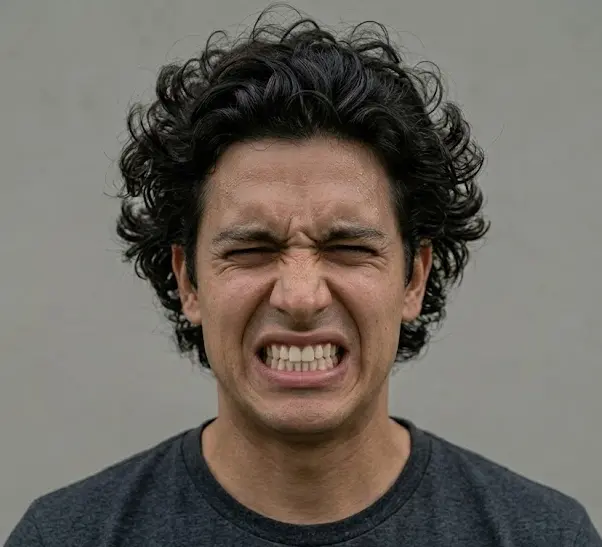
The facial grimace is one of the most cross-culturally consistent expressions in the entire range of human nonverbal behavior. Across populations, age groups, and cultures, the face responds to pain with the same cluster of involuntary muscle contractions — and unlike most facial expressions, it cannot be completely suppressed even when a person is actively trying to conceal what they feel. This page covers the full psychology of the facial grimace, what it signals, and how to read it accurately, as part of the broader body language resources available through the brain training and cognitive assessment platform and its Mind hub.
Research into pain expression has established that the grimace is not random or idiosyncratic — it follows a predictable anatomical pattern driven by the same facial muscle groups regardless of what type of pain is being experienced. Understanding that pattern is what allows the grimace to be read accurately, and what makes it so difficult to fake convincingly.
What Does a Facial Grimace Mean? The Psychology Behind It
A facial grimace is the face's involuntary response to nociceptive input — the neurological signal that something in the body is being damaged or threatened. When pain is registered, the nervous system activates a characteristic set of facial muscle contractions that have been documented across every human population studied. The brows lower and pull together, the eyelids tighten and close, the nose wrinkles, and the upper lip raises. At higher pain intensities, the mouth opens. This cluster of movements is not learned or culturally acquired — it emerges from the same underlying neural architecture across all humans, which is why it reads as recognizable to observers even across cultural boundaries.
Decades of systematic research using the Facial Action Coding System (FACS) — a framework that maps facial expressions to specific underlying muscle contractions — has confirmed the consistency of this pattern. Work by Prkachin and colleagues, examining facial responses to four different types of pain stimulation (cold, pressure, ischemia, and electric shock), identified four muscle actions that appeared consistently across all modalities: brow lowering, eyelid tightening and closure, and nose wrinkling combined with upper lip raising. These four actions form what researchers describe as the core signal of pain — a reliable, cross-modal marker that the body is under nociceptive stress.
The grimace communicates something beyond just the fact of pain — it also functions as a social signal. The visibility of a grimace activates empathy responses in observers, triggering a rapid, near-automatic assessment of another person's distress and a corresponding motivation to respond. This is part of why pain expression evolved as a visible signal rather than remaining purely internal: displaying pain recruits social support, communicates incapacity, and modulates the behavior of those nearby.
What Does a Facial Grimace Mean in Different Contexts?
Acute physical pain — the most direct form of the grimace is the immediate, involuntary response to a sudden noxious stimulus. A cut, impact, injection, or sudden injury produces a rapid contraction of the pain expression muscles that the person typically cannot suppress in the moment of onset, even if they manage to control it afterward. This version is brief, intense at onset, and typically resolves or reduces once the acute stimulus subsides or the person begins managing the pain consciously.
Chronic or sustained pain — people experiencing persistent pain often show a modified version of the grimace: the full expression is rarely displayed continuously, but appears in micro-bursts or during movement that exacerbates the pain. The face may look relatively neutral at rest but grimaces briefly during specific actions — shifting position, reaching, standing up — that momentarily intensify the pain. These brief, movement-triggered grimaces are among the most reliable indicators of genuine ongoing pain because they are difficult to time artificially.
Emotional and psychological pain — the same muscle pattern that responds to physical pain is also activated by intense emotional distress. Grief, anguish, and deep sadness can produce grimace-like contractions, particularly around the brow and eyes, that closely resemble the physical pain expression. The common neural architecture underlying both physical and emotional pain processing means the face does not always distinguish cleanly between the two — which is one reason the expression of intense emotional suffering is so recognizable across cultures even when the cause is invisible.
Anticipatory grimacing — a grimace that appears before a painful event rather than during it reflects the anticipation of pain. Someone bracing for an injection, expecting an impact, or watching something visually aversive may show a partial grimace triggered by predicted rather than actual nociceptive input. This version tends to be softer than the genuine pain response, involving partial rather than full eyelid closure, and a squinting quality rather than the full brow furrow of active pain.
Social performance — a performed or exaggerated grimace, used to communicate pain to others in a social context, tends toward a more theatrical version of the genuine expression: more symmetric, more consistently maintained, and often more exaggerated in its mouth component than genuine pain expressions typically are. The mouth is frequently the giveaway — genuine grimaces show variable mouth opening driven by pain intensity, while performed ones tend to maintain a more uniform, deliberately held shape.
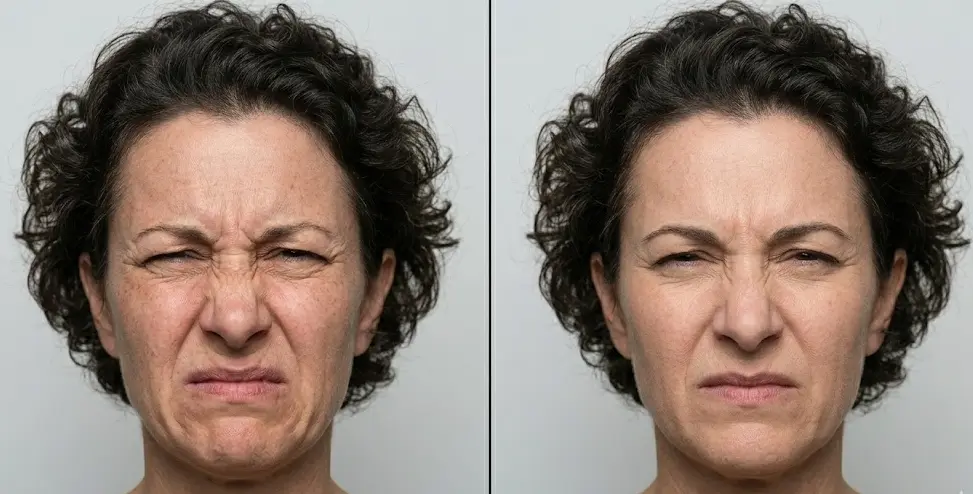
Left: Genuine pain grimace — eyes tightly shut, full brow furrow, lower face tensed. Right: Suppressed grimace — brow furrowed but eyelids squinted rather than shut, lower face controlled.
The difference between genuine and performed expressions is visible — if you know what to look for. The Body Language Test below ↓ trains exactly this skill across the full range of expressions.
Facial Grimace & Deception: Faking vs Genuine Pain Expression
The question of whether a grimace is genuine or performed matters in many real-world contexts — clinical assessment, legal proceedings, and everyday social judgment all depend on reading pain expression accurately. The research here is striking: untrained human observers are remarkably poor at distinguishing genuine from faked pain. A landmark study by researchers at UC San Diego and the University of Toronto, published in Current Biology, found that untrained observers correctly identified genuine versus faked pain at a rate barely above chance — roughly 50–55% accuracy even after an hour of training. A computer vision system applied to the same videos achieved significantly higher accuracy by detecting micro-level timing and regularity differences that human observers consistently missed.
What the computer detected — and what human observers can learn to notice — is the dynamics of the expression rather than its configuration. The same muscles are typically involved in both genuine and faked pain. What differs is the timing, regularity, and symmetry of how those muscles move. Genuine pain expressions show variable mouth opening: the duration and degree of opening fluctuates with the intensity and rhythm of the pain experience. Performed expressions tend to open the mouth with greater regularity and less variation — the consistency of a controlled movement rather than an involuntary response.
Research using FACS coding has also documented that faked pain expressions are often more symmetric and more intensified than genuine ones — essentially an exaggerated caricature of what real pain looks like. Genuine grimaces frequently show slight asymmetry between the two sides of the face, reflecting the less-than-perfect bilateral coordination of involuntary muscle activation. Performed grimaces tend to be more bilaterally even, because the person is consciously attempting to produce what they believe pain looks like. Additionally, research published in Philosophical Transactions of the Royal Society B documented that attempts to suppress a genuine grimace are rarely fully successful — residual facial activity persists even in people actively trying to mask their pain response.
Facial Grimace vs Similar Expressions
Facial grimace vs blushing — both are involuntary responses that occur despite the person's preference to conceal them. But blushing is triggered by social exposure — the awareness of being seen and evaluated — while the grimace is triggered by nociceptive input, either physical or emotional. Blushing is a vascular response; the grimace is a muscular one. Where blushing signals embarrassment or self-consciousness, the grimace signals distress or suffering of a more somatic kind.
Facial grimace vs jaw drop — the jaw drop involves an open mouth, and so does the high-intensity grimace, which can create confusion between them. The key distinction is in the rest of the face: a jaw drop involves raised brows and wide eyes, with the open mouth as part of a surprise/shock complex. A grimace involves tightened and closed or squinted eyes moving in the opposite direction — the eyelids close rather than open, and the brow furrows downward rather than rising. The jaw drop is a response to the unexpected; the grimace is a response to pain.
Facial grimace vs lip compression — lip compression is the active pressing together of the lips, often seen when something is being suppressed or withheld. It can appear at the edges of pain expression when a person is managing their reaction, or just before a grimace as the body attempts to contain the response. When pain overcomes suppression, lip compression typically gives way to the full grimace — making it a useful early signal that pain is being managed rather than absent.
Facial grimace vs asymmetrical mouth — the asymmetrical mouth reflects competing internal states expressed differentially on the two sides of the face. The grimace, by contrast, is fundamentally bilateral — both sides of the face respond to the same pain signal, though with minor natural asymmetry in intensity. Where an asymmetrical mouth suggests ambivalence or hidden sentiment, a grimace suggests an overwhelming sensation that bypasses the normal regulation of facial expression entirely.
How to Spot a Facial Grimace Accurately
The most reliable component to watch is the orbital area — the region around the eyes. Genuine pain consistently produces tightening and closure of the eyelids, driven by the orbicularis oculi muscle contracting in response to nociceptive activation. This eyelid tightening is difficult to fake smoothly and difficult to suppress entirely. When you see the eyes squint, narrow, or close in a way that does not match the social context — particularly when combined with brow lowering — pain expression is almost certainly involved.
The second most informative component is the brow. Brow lowering combined with the inner brows being pulled together and downward creates a characteristic furrowing that differs from the furrowing of concentration or confusion. In pain, the brow furrow tends to be deeper and accompanied by visible muscle tension above the nose, and occurs alongside other facial components rather than in isolation.
The third element is timing relative to context. A genuine grimace is triggered by something — a movement, a touch, a sound, an internal pain spike. Watching when the grimace appears relative to events in the environment is highly informative: grimaces that appear immediately after a relevant stimulus (a movement, a position change, a physical contact) are much more likely to be genuine than grimaces that appear during conversation or at socially convenient moments. The body language skill of tracking expression timing — not just noting that an expression occurred, but noting when it occurred and in response to what — is one of the most trainable and most useful competencies for accurate nonverbal reading.
How Much Body Language Can You Read?
The grimace is one of the clearest signals the face produces — but reading it accurately in context, and distinguishing it from similar expressions, requires practice across the full range of nonverbal cues. The test below covers expressions, gestures, and postures with detailed explanations after every answer.