Reflex vs Reaction: Understanding the Difference
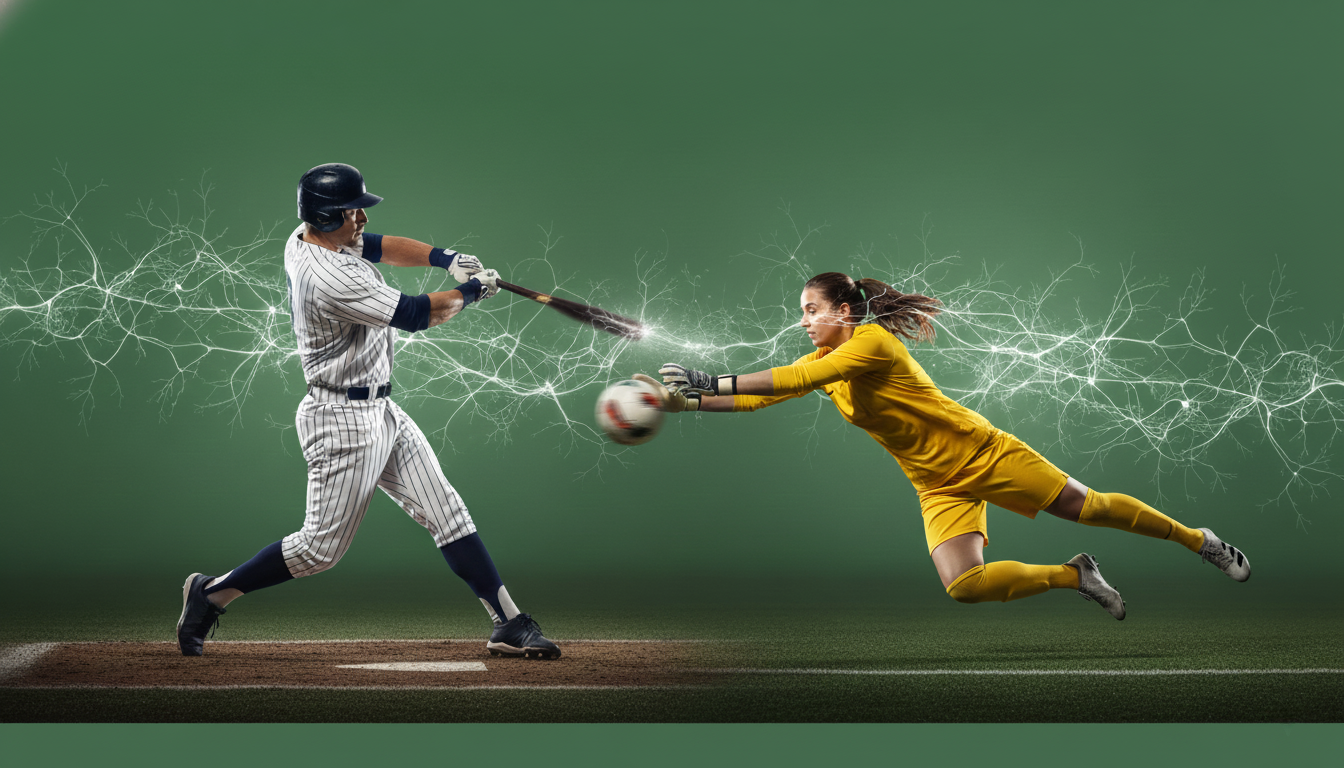
When athletes make split-second decisions on the field, we often hear commentators praise their "amazing reflexes." But here's something that might surprise you: most of what we call "reflexes" in sports aren't actually reflexes at all. They're reactions. And understanding the difference between these two concepts can completely change how you think about training, performance, and even your everyday responses to the world around you.
What Are Reflexes?
Reflexes are unconscious, involuntary, and unintentional responses to a stimulus. They're hardwired into your nervous system as protective mechanisms that bypass conscious thought entirely.
Think about what happens when a doctor taps your knee with a reflex hammer. Your leg kicks forward automatically. You can't control it, you can't stop it, and you can't learn to make it happen faster or slower. That's a true reflex—a response that travels from the sensory receptor to the spinal cord and back to the muscle without ever involving your brain's decision-making centers.
The classic example is touching something hot. When you accidentally touch a hot stove, your hand jerks away before your brain even registers the pain. The signal goes from your hand to your spinal cord, which immediately sends a command back to your arm muscles to pull away. Only after you've already pulled your hand back does your brain process what happened and you consciously feel the pain.
Other common reflexes include blinking when something flies toward your face, the gag reflex when something touches the back of your throat, and the pupillary light reflex where your pupils automatically constrict in bright light. These responses are automatic, predictable, and completely outside your conscious control.
What Are Reactions?
Reactions, on the other hand, are something entirely different. A reaction is defined as a purposeful voluntary response to an external stimulus. Unlike reflexes, reactions are deliberate, conscious responses that require your brain to process information and make decisions.
Here's what happens during a reaction: First, you perceive a stimulus through your senses (you see, hear, or feel something). Then your brain processes that information—identifying what it is, determining what it means, and deciding how to respond. Finally, your brain sends signals to your muscles to execute the chosen response. This entire process is called reaction time. Typically, it takes between 200-300 milliseconds for most people.
Consider a baseball batter facing a 90 mph fastball. The ball travels from the pitcher's hand to home plate in about 0.45 seconds. In that tiny window, the batter must see the ball leave the pitcher's hand, identify the type of pitch, predict where it's going, decide whether to swing, and execute the swing. When the announcer calls it "incredible reflexes," they're wrong. This is a reaction—a complex, learned skill involving visual processing, decision-making, and motor control. Understanding how reaction speed affects batting performance reveals why some players consistently make contact while others struggle.
The Critical Differences
The distinction between reflexes and reactions isn't just academic. It fundamentally changes what you can and can't improve through training.
Reflexes are fixed. You're born with your reflexes, and they don't get faster with practice. You can't train yourself to have a quicker knee-jerk reflex or to blink faster when something approaches your eyes. These responses are hardwired into your nervous system at the spinal cord level.
Reactions are trainable. Since reactions are cognitive and purposeful, we can learn how to react and anticipate appropriate responses. The more you practice a specific reaction, the faster and more accurate it becomes. This is why athletes spend hours drilling the same movements—they're building faster neural pathways for those specific reactions.
Think about learning to drive. When you first start, seeing brake lights ahead requires conscious thought: "Those are brake lights. That means the car is slowing down. I should brake too. Where's the brake pedal?" This entire process might take a full second or more. After years of driving, your reaction becomes much faster because you've practiced that specific response thousands of times. Your brain has created efficient neural pathways that bypass unnecessary processing steps. This is why reaction time is so critical for defensive driving—when a hazard appears, those milliseconds matter.
Why the Confusion?
So why do we constantly misuse these terms? Why does everyone talk about athletes having "great reflexes" when they really mean "fast reactions"?
Part of the confusion comes from the fact that both reflexes and reactions are fast responses to stimuli. When a goalkeeper makes an impossible save, it happens so quickly that it feels automatic—like a reflex. But it's not. That save involved the goalkeeper seeing the ball, predicting its trajectory based on the shooter's body position, deciding where to dive, and executing a complex motor pattern to reach it. All of that happened in a fraction of a second, but it still required conscious processing.
The other source of confusion is that the word "reflexive" has become synonymous with "automatic" in everyday language. When we say someone has "good reflexes," we usually just mean they respond quickly and automatically to situations. We're not making a technical distinction between reflex arcs and reactions.
Why This Distinction Matters
Understanding the difference between reflexes and reactions has practical implications for training and performance improvement.
If you're trying to improve your response speed in sports, driving, or any other activity, you need to recognize that you're training reactions, not reflexes. This means:
Practice matters immensely. Since reactions involve learned patterns, the more you practice specific scenarios, the faster your reactions become. A tennis player who has returned thousands of serves will react faster than someone new to the sport, not because they have better reflexes, but because they've built efficient neural pathways for that specific task. Training reaction time systematically can accelerate this learning process.
Task-specific skills matter, but so does your baseline. While each activity has its own unique demands—reading a pitcher's windup is different from reacting to brake lights—there's a fundamental baseline reaction speed underlying all of them. This baseline is the pure speed at which your brain processes visual information and sends motor commands. While your reflexes are fixed, this baseline reaction time can be improved through training. Regular practice with reaction time exercises can reduce your baseline from 250ms to 200ms or even lower. This improved baseline then benefits everything you do—driving, sports, gaming, or responding to unexpected situations in daily life. The fastest performers combine a strong trained baseline with thousands of hours of task-specific practice. A baseball player who trains both their general reaction speed and their batting will outperform someone who only practices batting.
The practical takeaway is this: when you hear someone praised for their "incredible reflexes," recognize that what you're really seeing is the result of countless hours of deliberate practice building faster, more automatic reactions to specific situations. And that's actually more impressive than having fast reflexes would be—because it's something they achieved through dedication and hard work, not just genetic luck. If you often feel like you're always a split second too late, the good news is that reactions can be trained and improved.
Test the Difference Yourself
Want to experience the difference firsthand? Try this simple experiment: Have a friend drop a ruler between your thumb and fingers without warning. The time it takes you to catch it measures your reaction time—you see it falling, process that information, and voluntarily close your fingers. Now try the knee-tap reflex test with a reflex hammer. Notice how you can't control or predict the reflex response, while with the ruler, you're making a conscious choice to catch it.
The ruler drop test is popular precisely because it measures reaction time, not reflexes. You can practice and improve your score because you're training your brain to process the visual information faster and send the motor command more quickly. Your actual reflexes remain unchanged.
Understanding these concepts helps you appreciate just how remarkable trained athletes really are. Their "reflexes" are actually the product of years of practice building incredibly fast, accurate reactions to complex, dynamic situations. And the good news? If you're willing to put in the practice, you can develop faster reactions too.