Ames Room Illusion
The same person can appear enormous in one corner and almost child-sized in the other.
Imagine watching one person cross an ordinary-looking room. Near one corner, they seem unusually tall. As they move toward the opposite corner, they appear to shrink.
The person has not changed. The room is warped so that one corner is much farther away than the other, but from one carefully chosen viewpoint, both corners appear to belong to a normal rectangular room.
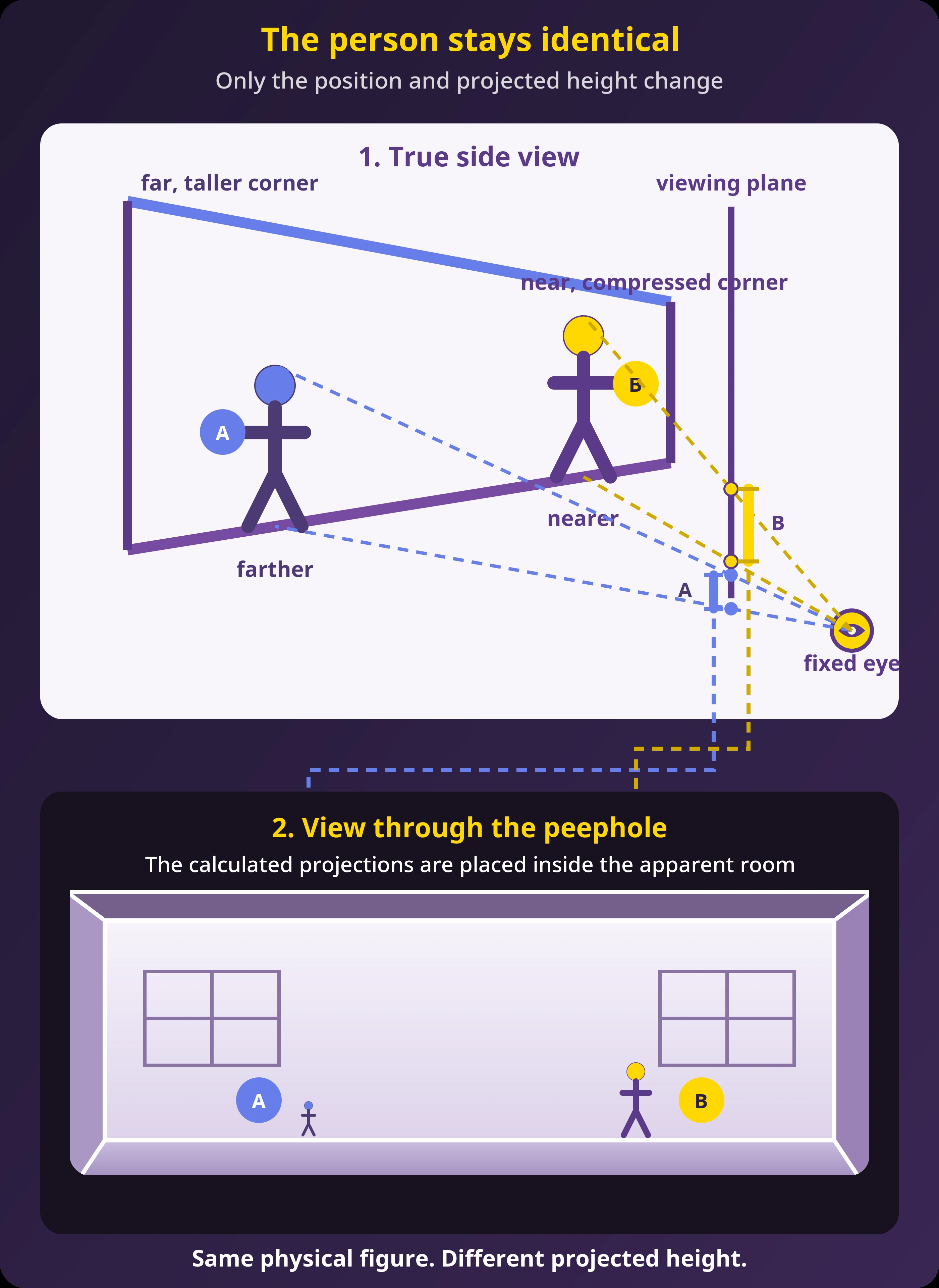
This is the Ames Room illusion. The room is not rectangular. Its floor, ceiling, walls, and rear corners are deliberately distorted so that one side is much farther from the observer than the other.
From one fixed viewpoint, the warped geometry produces the outline expected from an ordinary room. Your brain accepts that familiar interpretation and misjudges the distances of the people inside it.
How the Room Is Really Shaped
An Ames Room is an irregular three-dimensional space designed around one exact viewing position. The farther corner is vertically enlarged, with a lower floor and higher ceiling. The nearer corner is compressed, with a higher floor and lower ceiling.
The floor and ceiling therefore slant across the true room. Windows, floorboards, wall panels, and other details are stretched or compressed so that they appear normal from the peephole.
In the visual above, the physical figures are not aligned to the same absolute head and foot levels. Each figure stands on the floor at its own location. Because the near floor is higher, the nearer figure’s feet and head are also higher within the construction diagram.
The figures are still physically identical. Both reuse exactly the same unscaled shape. Their different positions, not different body dimensions, produce the different projections.
Why One Person Looks So Much Larger
The image of a person becomes smaller on the retina as the person moves farther away. Normally, your brain compensates for this through size constancy.
A friend walking away does not seem to physically shrink. The visual system combines the smaller retinal image with the greater distance and preserves a relatively stable judgment of body size.
The Ames Room supplies the wrong distance estimate. Because both corners appear to lie along one normal back wall, the brain treats the people as though they are roughly equally far away.
The larger retinal image is therefore interpreted as a larger person rather than a nearer person. The smaller retinal image is interpreted as a shorter person rather than a farther person.
The main diagram traces this directly. Rays through the farther figure’s head and feet meet the viewing plane close together. Rays through the nearer figure meet it farther apart. The resulting intervals determine the two figure scales in the peephole view.
The Ponzo Illusion uses a related relationship between apparent distance and perceived size. In both illusions, misleading depth information changes how large an unchanged object appears.
Why the Peephole Matters
The illusion is strongest when the room is viewed with one eye through a small opening.
The peephole keeps the observer at the one position where the distorted room lines up correctly. It also weakens two important sources of depth information.
Binocular disparity compares the slightly different views from the two eyes. Those differences can reveal that one corner is farther away.
Motion parallax uses changes in the scene as the head moves. Nearby surfaces shift more quickly than distant ones, exposing the room’s uneven geometry.
Viewing through one stationary eye reduces both cues. Perspective, room decoration, and the expectation that rooms are rectangular are left to dominate.
Test Your Spatial Visualization
The Ames Room works because an unusual three-dimensional construction creates a familiar two-dimensional projection. Understanding the trick requires mentally reconstructing the hidden layout behind the view.
Cognitive Train’s free test challenges a related ability by asking you to recognize objects after they rotate in three-dimensional space:
Where the Ames Room Came From
The illusion is named after American scientist and ophthalmologist Adelbert Ames Jr., who developed a series of demonstrations for studying perception during the first half of the twentieth century.
Ames was interested in situations where very different physical arrangements could send similar patterns of light to the eye. When the retinal information fits a familiar interpretation, perception may favor that interpretation even when the physical construction is radically different.
William Ittelson documented Ames’s distorted rooms and related demonstrations in his 1952 book The Ames Demonstrations in Perception.
The room is often dated to the 1940s, although historical accounts differ on the exact development date.
The Room Is the First Illusion
The apparent change in human size depends on an earlier perceptual mistake: the distorted room itself looks rectangular.
Research on three-dimensional shape constancy found that restricted monocular viewing removes information that would normally help preserve the room’s true shape. Perception instead favors the rectangular arrangement suggested by its projection.
Once the room is accepted as normal, the incorrect size judgments follow. The brain settles on an ordinary room containing unusually sized people rather than a distorted room containing ordinary people.
What Research With Afterimages Shows
The Ames Room can also change the apparent size of an afterimage, a visual image that remains briefly after staring at a bright or high-contrast stimulus.
According to Emmert’s law, an afterimage appears larger when it is perceived on a more distant surface, even though its retinal size remains fixed.
In an experiment conducted inside an Ames Room, apparent afterimage size followed the room’s perceived distance more closely than its true physical distance.
That supports the central mechanism: perceived size is scaled according to where the visual system believes an object or surface is located, not simply according to its real distance.
How the Illusion Breaks
Move away from the viewing point. The distorted corners stop lining up like a normal room.
Use both eyes. Binocular information can reveal that the corners are at different distances.
Move your head. Motion parallax exposes which surfaces are nearer and farther away.
View the room from the side. The slanted ceiling, sloping floor, and unequal corner heights become obvious.
Watch one person cross the room. The same unchanged person appears to grow or shrink as their distance and projected size change.
What It All Comes Down To
The Ames Room does not physically change anyone’s height. It hides a large difference in distance inside a room that appears normal.
The same physical figure produces a smaller projection in the farther position and a larger projection in the nearer position. Because the room conceals that distance difference, the brain interprets the projections as different body sizes.
For more examples of misleading depth, changing size, impossible geometry, and constructed surfaces, browse the full Optical Illusions guide. Cognitive Train’s brain tests explore perception, attention, and reasoning, while its free brain training tools offer more ways to challenge visual processing.