Horn Effect — Meaning, Examples & How to Overcome It
Mind · Cognitive Biases · Social & Self-Perception family
Test yourself — can you spot the bias in each scenario? Take the Cognitive Bias Spotter Test. Jump to the test ↓
What Is the Horn Effect? Simple Definition
The horn effect is the tendency for a single negative trait, behaviour, or first impression to colour the entire perception of a person, making them seem worse across all other dimensions than the evidence warrants. Where the halo effect causes one positive quality to cast a glow over everything else, the horn effect causes one negative quality to cast a shadow. One flaw — an awkward manner, a past mistake, an unflattering first impression — can suppress the perception of genuine competence, intelligence, honesty, and ability that would otherwise be credited.
Also known as the devil effect or the reverse halo effect, the horn effect is the mirror image of one of the most well-documented biases in social psychology. It is just as powerful, just as automatic, and just as invisible to the person experiencing it.
This page is part of the cognitive biases guide on our brain training and cognitive testing platform, alongside interactive tools covering memory, attention, reaction time, and decision-making.
Horn Effect Meaning & Psychology
The horn effect shares its psychological foundation with the halo effect, which was first identified by Edward Thorndike in 1920 in his study of how military officers rated their subordinates. Thorndike noticed that ratings of different traits — intelligence, physique, leadership, character — were far more highly correlated than they should be if raters were evaluating each trait independently. The pattern indicated that a general impression of a person was suppressing independent evaluation of specific attributes, pulling all trait ratings in the direction of the overall impression. Thorndike identified this as a systematic error in person perception; the positive version became the halo effect, and the negative version the horn effect.
The unconscious nature of this bias was demonstrated experimentally by Nisbett & Wilson (1977), who showed students two different videotaped interviews with the same college instructor. In one version the instructor was warm and friendly; in the other he was cold and distant. Students who watched the cold version rated the instructor's physical appearance, mannerisms, and foreign accent as significantly more irritating than those who watched the warm version — even though these attributes were identical across both videos. The global negative impression generated by the cold demeanour contaminated all specific attribute ratings. Critically, participants were unaware that their judgments of specific attributes had been influenced by their general impression at all.
Why one negative trait dominates
The horn effect is amplified by negativity bias — the well-established asymmetry in human cognition whereby negative information carries more psychological weight than equivalent positive information. Negative traits are processed more thoroughly, remembered more reliably, and given more predictive weight in social judgment than positive traits of similar intensity. This means that a single significant negative trait does not merely offset a collection of positive ones — it actively suppresses their perceived importance, creating an overall impression that is more negative than a balanced accounting would produce.
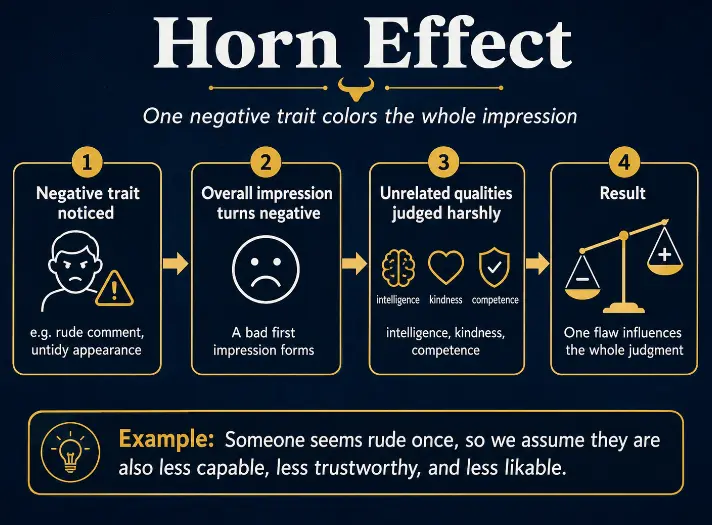
The horn effect: one negative trait — a rude comment, an untidy appearance — turns the overall impression negative, causing unrelated qualities like intelligence and competence to be judged more harshly than the evidence warrants.
Horn Effect in Real Life — Examples
In job interviews, the horn effect is one of the most consequential sources of unfair evaluation. A candidate who stumbles on an early question, arrives slightly late, or uses an awkward phrase in their opening remarks may be perceived as less competent, less professional, and less intelligent than their actual qualifications warrant — not because any of those negative inferences are supported by the subsequent evidence, but because the negative first impression has set a filter through which the rest of the interview is interpreted. Subsequent strong answers are attributed to luck or memorisation; further weaknesses are taken as confirmation of the initial impression.
In performance appraisals, the horn effect means that an employee who has recently made a visible mistake — or who has a characteristic that their manager finds personally irritating — may receive systematically lower ratings across all competencies, including those entirely unrelated to the mistake or the irritating trait. A single poor presentation can suppress ratings of analytical ability, teamwork, and strategic thinking, even when there is no logical connection between the presentation and those other domains.
In consumer and brand perception, the horn effect operates through negative experiences. A customer who has one bad interaction with a company — a rude service representative, a product defect, a billing error — may downgrade their assessment of the company's products, values, and reputation across the board, well beyond what the single negative experience logically warrants. This is why customer service failures are disproportionately damaging to brand perception: a single negative touchpoint can activate the horn effect and suppress an otherwise strong accumulated impression.
Horn Effect in Legal and Political Judgment
In legal contexts, the horn effect can influence how defendants, witnesses, and victims are perceived. A defendant whose appearance, manner, or background triggers a negative first impression may be evaluated more harshly across all dimensions of the case — their testimony judged less credible, their account of events less plausible, their character less sympathetic — than a defendant who presents more favourably. This is the horn effect operating in a context where the consequences are severe and the standard of independent, evidence-based judgment is supposed to be paramount.
In political judgment, leaders who acquire a strongly negative reputation — for a specific scandal, a policy failure, or a widely disliked personal characteristic — can become so thoroughly "horned" that their genuine achievements and positive qualities are systematically discounted or ignored. The negative overall impression acts as a filter that reframes even objectively positive actions as suspect, self-serving, or insufficient. This is the mechanism behind political demonisation: once the horn effect is fully active, it is very difficult for any positive evidence to break through.
Horn Effect vs. Halo Effect
The horn and halo effects are opposite expressions of the same underlying cognitive mechanism: the tendency to form a global impression of a person or entity and then evaluate all specific attributes through that lens rather than independently. The halo effect inflates positive evaluation; the horn effect depresses it. Both produce the same core error — the suppression of independent attribute evaluation in favour of impression-consistent generalisation. And both operate largely below awareness, as Nisbett and Wilson demonstrated: people experiencing either bias typically believe their specific attribute ratings are based on the relevant evidence rather than on their general impression.
Research consistently finds that the horn effect is somewhat stronger than the halo effect, consistent with the general principle of negativity bias — negative impressions are more powerful, more persistent, and more resistant to revision than positive ones. A strongly negative first impression is harder to overcome than a strongly positive one, and its suppressive effect on subsequent evaluation is more durable.
How to Avoid and Overcome the Horn Effect
Evaluate traits independently rather than globally
The most direct counter to the horn effect is to consciously separate the evaluation of specific traits or competencies from the overall impression. In an interview, ask: "Setting aside my overall impression of this person, what does the evidence on this specific question actually show?" In a performance review, assess each competency against specific behavioural evidence rather than allowing a global impression to determine ratings. The goal is to break the link between the global impression and the specific evaluations that impression is contaminating.
Identify the source of the negative impression
Ask explicitly where the negative impression comes from: is it a specific, relevant behaviour or trait, or is it something superficial, irrelevant, or simply different from your preferences? An awkward manner, an unfamiliar accent, or an unusual appearance may create a negative global impression without being relevant to the qualities you are actually trying to assess. Identifying the source of the impression — and asking whether it is actually predictive of the attributes you care about — reduces its power to contaminate unrelated evaluations. This same question is central to countering the fundamental attribution error, which similarly over-reads character from surface behaviour.
Actively seek disconfirming evidence
Once a negative global impression is active, the cognitive system selectively attends to evidence that confirms it and discounts evidence that challenges it — a pattern driven by confirmation bias working in tandem with the horn effect. A deliberate corrective is to actively look for evidence that contradicts the negative impression: specific instances of competence, reliability, or positive behaviour that the horn effect would otherwise cause to be underweighted. The exercise of seeking disconfirming evidence does not eliminate the initial impression but prevents it from becoming a self-confirming filter.
The Deeper Point
The horn effect is a reminder that human social judgment is not a process of independent, evidence-based evaluation of specific attributes. It is a process of impression formation — rapid, automatic, and largely unconscious — in which a global evaluation is formed early and then applied to all subsequent specific judgments. The evidence does not determine the impression; the impression determines how the evidence is read.
This is not a failure of intelligence or good intentions. It is the architecture of social cognition, which prioritises speed and coherence over accuracy. Understanding the horn effect does not eliminate it — awareness of bias does not automatically correct for it, as Nisbett and Wilson showed. But it makes possible the deliberate compensatory practices that can reduce its influence in high-stakes evaluations: the structured interview, the blind review, the independent attribute assessment, the active search for disconfirming evidence.
Related biases worth exploring alongside this one: halo effect, the positive counterpart operating through the same mechanism; confirmation bias, which amplifies the horn effect by selectively attending to negative evidence once the negative impression is established; and fundamental attribution error, which over-attributes specific negative behaviours to stable character dispositions, providing the raw material for the horn effect to work with.
The Cognitive Bias Spotter Test below puts that understanding to work — see if you can identify the horn effect and the other nine biases when they appear in realistic scenarios.