Ben Franklin Effect — Meaning, Examples & Psychology
Mind · Cognitive Biases · Social & Self-Perception family
Test yourself — can you spot the bias in each scenario? Take the Cognitive Bias Spotter Test. Jump to the test ↓
What Is the Ben Franklin Effect? Simple Definition
The Ben Franklin effect is the tendency to like someone more after doing them a favour. Intuition suggests the opposite — that we do favours for people we already like, and that receiving a favour from someone is what creates goodwill toward the giver. In reality, the causal arrow runs in both directions, and frequently in the counterintuitive direction: performing a favour for someone increases the favour-doer's positive feelings toward the recipient, even when no strong prior affection existed.
The effect is named after Benjamin Franklin, who described using the strategy deliberately in his autobiography. Facing a political rival in the Pennsylvania Assembly who had publicly spoken against him, Franklin did not attempt to win him over with flattery or by doing him a favour. Instead, he asked the rival if he could borrow a rare book from his private library. The rival agreed, Franklin returned the book with a note of appreciation, and the two men became friends. Franklin's conclusion: "He that has once done you a kindness will be more ready to do you another, than he whom you yourself have obliged."
This page is part of the cognitive biases guide on our free brain training and cognitive tests platform, alongside interactive tools covering memory, attention, reaction time, and decision-making.
Ben Franklin Effect Meaning & Psychology
The empirical foundation for the Ben Franklin effect was established by Jecker & Landy (1969), who ran a study in which participants took part in a quiz competition and could win small cash prizes. After the competition, the experimenter — who had been instructed to present himself as rather disagreeable — approached one group of winners personally and asked them to return their winnings as a personal favour, explaining that the prize money had come from his own pocket. A second group was asked to return the money by an administrative secretary. A third group was not approached at all. Participants in the first group — those who had done a personal favour directly for the experimenter — rated him significantly more positively than those in the other two groups. Doing the favour increased liking for the recipient of the favour, even though the experimenter had made himself deliberately unlikeable.
Cognitive dissonance as the mechanism
The primary explanation for the Ben Franklin effect is cognitive dissonance. When a person does a favour for someone they do not particularly like, they hold two inconsistent cognitions simultaneously: "I do not like this person" and "I just did something beneficial for this person." These cognitions are in tension — people generally do favours for people they like, not for people they dislike. To resolve the tension with minimal psychological discomfort, the easiest adjustment is to revise the attitude toward the person upward: "I must like them more than I thought, since I helped them." The behaviour shapes the attitude rather than the attitude shaping the behaviour.
Self-perception theory as an alternative account
A second explanation draws on self-perception theory: when people have no strong preexisting attitude toward someone, they observe their own behaviour and infer their attitude from it. "I helped this person, so I must feel positively toward them." This is less about resolving inconsistency and more about constructing an attitude from behavioural evidence in the absence of a strong prior attitude. Both accounts predict the same outcome — doing a favour increases liking — but through slightly different routes, and both likely contribute in different circumstances depending on the strength of the prior attitude.
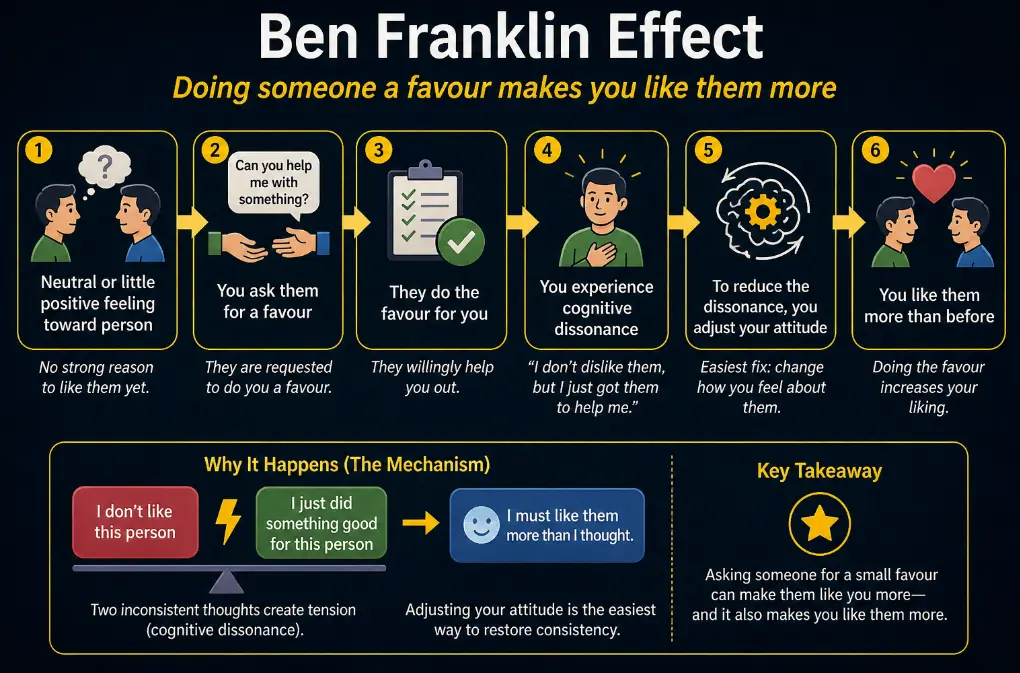
The Ben Franklin effect: when someone does you a favour, cognitive dissonance — "I don't like them, but I just helped them" — is resolved by adjusting your attitude upward. Doing the favour increases liking.
Ben Franklin Effect in Real Life — Examples
In the workplace, the Ben Franklin effect predicts that asking a colleague for help — rather than doing them a favour unprompted — is a more effective way of building rapport. When a colleague helps you with a task, their attitude toward you tends to shift in a more positive direction, because their helping behaviour creates the cognitive need to justify it through increased liking. This is counterintuitive to people who assume that doing favours for others is the route to being liked; the evidence suggests that receiving favours, under the right conditions, can be equally effective.
In sales and negotiation, the Ben Franklin effect predicts that asking a prospective customer for a small, non-transactional favour — advice, an opinion, a minor accommodation — can increase their positive feelings toward the salesperson and the interaction. The favour request creates a small act of helpfulness on the customer's part, which their cognitive system resolves through increased liking. This is distinct from the norm of reciprocity, which predicts that doing favours for customers will make them feel obligated to return them; the Ben Franklin effect operates through a different mechanism, in the opposite direction of favours.
In personal relationships, the effect explains why asking for help — with a task, a decision, a piece of advice — can be a more effective relationship-building strategy than always offering help. People who are consistently helpful to others without ever asking for anything in return do not necessarily generate the same depth of positive feeling as those who occasionally make requests, because the requests create the opportunity for the helper to experience the attitude-shaping effect of their own helpful behaviour.
Ben Franklin Effect in Politics and Persuasion
Franklin's own use of the effect was in a political context, and it remains relevant there. A politician who asks a wavering opponent or constituent for a small favour — to read a document, to share their view on a matter, to make a minor accommodation — may generate more goodwill than one who showers them with attention and benefits. The small act of helping creates the cognitive pressure to resolve the implied attitude inconsistency, and the resolution favours the person who made the request.
The effect also has implications for persuasion more broadly. Asking someone to explain your position to a third party — to act as your advocate, even neutrally — can shift their attitude toward your position, because the act of articulating an argument creates a form of commitment and the cognitive consistency pressure that follows from it. This is related to the well-established finding that writing or speaking in favour of a position increases belief in that position, even when the person knows they were assigned to argue it. Behaviour shapes attitude; the Ben Franklin effect is one instance of this broader principle.
The Limits of the Ben Franklin Effect
The effect is not unconditional. It is stronger when the favour is a genuine personal request rather than a bureaucratic or transactional one — as the Jecker & Landy study demonstrated, being asked by the experimenter personally produced more liking than being asked by a secretary. It is also stronger when the favour-doer had no strong prior negative attitude toward the recipient; if the dislike is intense and firmly established, cognitive dissonance may be resolved by rationalising the favour rather than by revising the attitude upward. And it applies primarily to the person doing the favour, not to observers — watching someone else do a favour for a person does not produce the same attitude shift as doing it yourself.
The Deeper Point
The Ben Franklin effect is one of the clearest illustrations of a broader principle in social psychology: behaviour shapes attitude at least as reliably as attitude shapes behaviour. The intuitive model — that we act on the basis of how we feel — is incomplete. We also feel on the basis of how we act. Cognitive dissonance is the mechanism that makes this happen: when our actions and our attitudes are inconsistent, we tend to revise our attitudes rather than our actions, because the action is already done and the attitude is more malleable.
For practical purposes, the Ben Franklin effect suggests that the route to being liked is not only to be generous and helpful, but also to give people the opportunity to be generous and helpful toward you. Asking for help, advice, and favours — within reason — creates the conditions for the attitude-shaping effect of helping to operate. Franklin understood this intuitively, and the subsequent psychological research has confirmed it.
Related biases worth exploring alongside this one: consistency bias and sunk cost fallacy, which similarly reflect the tendency to justify prior behaviour through subsequent attitude and commitment; halo effect, which shows how positive feelings generated in one context generalise to overall impressions of a person; and moral licensing, the mirror-image dynamic in which prior good behaviour shapes subsequent behaviour through a similar attitude-action consistency mechanism.
The Cognitive Bias Spotter Test below puts that understanding to work — see if you can identify the Ben Franklin effect and the other nine biases when they appear in realistic scenarios.