Actor-Observer Bias — Meaning, Examples & How to Overcome It
Mind · Cognitive Biases · Social & Self-Perception family
Test yourself — can you spot the bias in each scenario? Take the Cognitive Bias Spotter Test. Jump to the test ↓
What Is the Actor-Observer Bias? Simple Definition
The actor-observer bias is the tendency to explain your own behaviour by reference to the situation you are in, while explaining other people's behaviour by reference to their personality and character. When you are late, it is because of traffic. When someone else is late, it is because they are disorganised. When you make a mistake, circumstances were against you. When someone else makes the same mistake, they simply made a poor decision.
The bias describes an asymmetry in the way actors — people performing behaviour — and observers — people watching behaviour — attribute causes. Actors tend toward situational explanations; observers tend toward dispositional explanations. The result is a consistent double standard: your own actions are interpreted charitably and contextually, while others' actions are interpreted more harshly and personally.
This page is part of the cognitive biases guide on our free brain training and cognitive testing platform, alongside interactive tools covering memory, attention, reaction time, and decision-making.
Actor-Observer Bias Meaning & Psychology
The actor-observer asymmetry was first proposed by Jones and Nisbett (1971) in a widely cited book chapter arguing that actors tend to attribute their behaviour to situational requirements while observers tend to attribute the same behaviour to stable personal dispositions. The hypothesis was rapidly adopted in social psychology and became one of the field's most cited and taught concepts.
However, the empirical picture is considerably more complex than the original formulation suggested. A comprehensive meta-analysis by Malle (2006), covering 173 published studies over three decades, found that the overall actor-observer asymmetry was extremely weak — average effect sizes approaching zero across the full literature. The asymmetry did appear under specific conditions: when the actor's behaviour was negative, when the actor was portrayed as highly unusual, or when actor and observer were personally close. For positive events, a reverse pattern appeared — actors were actually more likely to claim internal causes than observers attributed to them. Across all events combined, no consistent asymmetry existed.
This does not mean the actor-observer distinction is without value — it means the simple, universal version of the hypothesis overstated the case. The tendency to explain one's own negative behaviour situationally while explaining others' negative behaviour dispositionally is real and relevant, but it is not the automatic, universal asymmetry it was originally described as being.
Why the pattern occurs for negative events
For negative outcomes — failures, mistakes, socially undesirable behaviour — the actor-observer pattern is more reliable and connects to the self-serving bias: actors have motivational reasons to attribute failures to situation rather than disposition, because dispositional attribution implies a stable flaw, while situational attribution implies a temporary and external cause. Observers, who have no stake in protecting the actor's self-esteem, apply the same dispositional attribution that the fundamental attribution error predicts for observers generally.
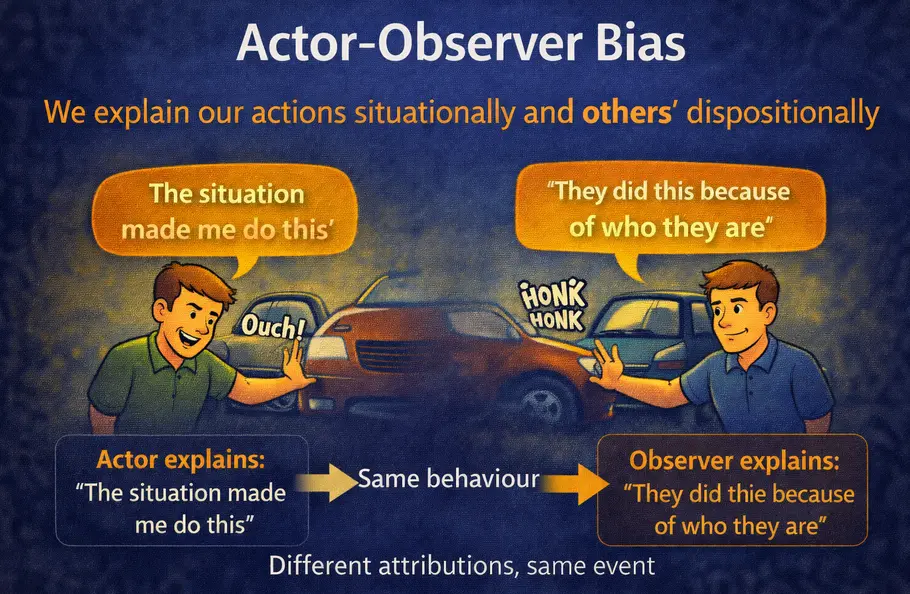
Actor-observer bias: the same behaviour produces two different attributions — the actor explains it situationally, the observer explains it dispositionally. Different attributions, same event.
Actor-Observer Bias in Real Life — Examples
The actor-observer pattern is most visible in contexts where negative outcomes are being explained. A student who performs poorly on an exam says the questions were unclear and the material was poorly taught; observers — other students, the teacher — may attribute the performance to the student's preparation or ability. An employee who misses a target explains the competitive market conditions and the lack of resources; their manager attributes the miss to the employee's strategy or effort. A driver who gets into an accident explains the road conditions and the other driver's behaviour; witnesses attribute the accident to the driver's skill or attention.
In each case, the actor and observer are interpreting the same event with systematically different emphases — the actor on situation, the observer on disposition. The asymmetry is not about honesty or accuracy; both the actor and the observer may be sincere. It reflects the different information available to each and the different motivational stakes involved.
Actor-Observer Bias in Relationships
Interpersonal relationships provide a particularly clear context for the actor-observer bias, because the same person is alternately actor and observer across different situations — and the shift between roles does not produce a consistent shift in attribution. Research has found that in troubled relationships, each partner tends to explain their own problematic behaviour situationally ("I was stressed," "You provoked me") while explaining their partner's problematic behaviour dispositionally ("You are selfish," "You never listen"). This asymmetric attribution pattern is a documented contributor to relationship conflict and a barrier to productive resolution.
Interestingly, in happily functioning relationships, the pattern can reverse: satisfied partners sometimes show a positive attribution bias, interpreting their partner's behaviour more charitably than the partner interprets their own. The actor-observer asymmetry is not simply about being unfair to others — it is modulated by relationship quality and emotional valence in ways the original simple hypothesis did not capture.
Actor-Observer Bias in the Workplace
In professional settings, the actor-observer pattern shapes how mistakes, failures, and conflicts are explained across the organisation. Employees who underperform explain their performance situationally — the resources, the targets, the management. Managers who observe the same underperformance explain it dispositionally — the employee's skill, motivation, or attitude. Both explanations are partially valid, and both are partially incomplete, but the systematic asymmetry means that the situational factors employees raise are systematically discounted by observers, while the dispositional factors observers identify are experienced as unfair by actors.
This dynamic also operates at the organisational level. When a business unit underperforms, those within it explain the outcome situationally — market conditions, competitive dynamics, resource constraints. Those outside it — other business units, the board — explain it dispositionally, attributing the underperformance to the quality of the leadership or team. Both perspectives capture something real, but the systematic bias in each direction means neither is fully accurate on its own.
Actor-Observer Bias vs Related Biases
The actor-observer bias is closely related to but distinct from both the fundamental attribution error and the self-serving bias. The fundamental attribution error describes the observer's tendency to over-attribute others' behaviour to disposition — it is an observer-side bias. The actor-observer bias describes the asymmetry between actor and observer explanations — it requires comparing both. The self-serving bias describes the actor's tendency to attribute successes to disposition and failures to situation — it is an actor-side bias about valence. All three overlap and interact, but each captures a distinct aspect of how attribution differs across roles and outcomes.
How to Avoid and Overcome the Actor-Observer Bias
Take the actor's perspective when judging others
The most direct corrective for the observer side of the asymmetry is to actively consider what situational factors might be driving the behaviour you are observing. Before attributing someone's failure, mistake, or undesirable behaviour to their character, explicitly ask what circumstances they may be in that you do not have visibility into. This is the same corrective recommended for the fundamental attribution error — deliberately taking the actor's perspective reduces the automatic dispositional attribution that characterises the observer role.
Apply situational scrutiny to your own behaviour too
The actor side of the asymmetry — explaining your own negative behaviour purely situationally — can be corrected by applying the same dispositional scrutiny to yourself that you would apply to others. If you would attribute someone else's lateness to their disorganisation, it is worth genuinely asking whether your own lateness reflects anything about your planning or prioritisation, in addition to the situational factors you are aware of. Symmetric attribution standards — applying the same balance of dispositional and situational factors to yourself and others — produce more accurate self-assessment and fairer judgment of others.
Seek shared context in disagreements
In conflicts and disagreements where actor-observer asymmetry is operating, the most productive approach is to actively share the situational context that is driving your own behaviour, rather than assuming the other person understands it. Actors have privileged access to their situational context; observers do not. Explicitly communicating the situational pressures, constraints, and context that explain your behaviour — and genuinely asking about the other person's context before attributing their behaviour to disposition — breaks the asymmetry that the information gap would otherwise produce.
The Deeper Point
The actor-observer bias, in its most robust form, is less about a universal asymmetry between actors and observers and more about a specific pattern in how negative outcomes are explained: actors protect themselves with situational explanations while observers apply dispositional ones. This pattern is real, consequential, and closely connected to the self-serving bias and the fundamental attribution error — all three reflecting different aspects of the same underlying tendency to interpret social events in ways that protect and enhance the self while judging others by stricter standards.
The practical lesson is symmetric: the situational factors that you readily use to explain your own shortcomings are also present in others' behaviour, even when you cannot see them. And the dispositional factors that observers readily attribute to you are also present in your own behaviour, even when you have access to compelling situational explanations. Accurate attribution requires holding both simultaneously — which is cognitively demanding and motivationally difficult, but essential for fair judgment and productive relationship.
Related biases that interact closely with this one: fundamental attribution error, which captures the observer-side over-attribution to disposition; self-serving bias, which captures the actor-side pattern of taking credit for successes and deflecting blame for failures; and bias blind spot, which makes the asymmetric attribution pattern difficult to recognise in oneself while clearly visible in others.
The Cognitive Bias Spotter Test below puts that understanding to work — see if you can identify the actor-observer bias and the other nine biases when they appear in realistic scenarios.