Peg System: The Mnemonic That Gives You Instant Ordered Recall
Association & Linking Method · Ordered Recall · Intermediate Technique
Some memory techniques — like the Link Method — require you to recall items in sequence, running through items 1 through 6 to reach item #7. The peg system works differently. It gives you direct access to any position in a memorized list. Someone asks "what was item number 4?" and you can answer immediately, without mentally walking through the preceding items. This makes it one of the clearest mnemonic techniques for numbered, indexed recall — from shopping lists to presentation points to study material that needs to stay in a specific order. This page is part of the Memory Techniques resources available through Cognitive Train.
The system works by pre-memorizing a fixed set of "pegs" — concrete, vivid images permanently attached to each number. When you need to memorize a new list, you create a mental image linking each list item to its corresponding peg. Because the pegs are already locked in memory, the new items inherit their structure. The rhyming peg system has roots going back several centuries and remains one of the standard tools in the mnemonic toolkit.
How the Peg System Works
The peg system has two stages: first, you memorize the pegs themselves (a one-time investment), and second, you use those pegs to memorize any new list on demand.
Stage 1: Learn the pegs. The most common version is the rhyming peg system, where each number is paired with a word that rhymes with it. A standard set looks like this:
1 = Sun 2 = Shoe 3 = Tree 4 = Door 5 = Hive 6 = Sticks 7 = Heaven 8 = Gate 9 = Vine 10 = Hen
The rhymes make the pegs easy to learn — most people can memorize all ten in a few minutes. Once they are in long-term memory, they never change. They become permanent mental hooks.
There is no single "correct" peg list — different sources use different words, and the best pegs are whichever ones produce the most vivid images for you. Some common alternatives: 1 = bun or gun, 2 = zoo or glue, 4 = floor or store, 5 = dive or drive, 6 = chicks or bricks, 8 = weight or plate, 9 = wine or line, 10 = pen or den. Pick the words that create the most immediate, vivid mental images for you personally.
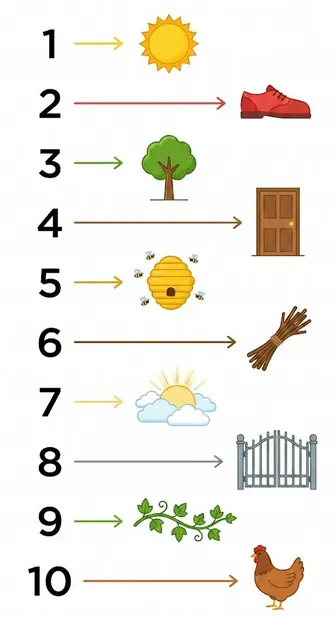
The rhyming peg system visualized — each number permanently paired with a rhyming image. Once memorized, these pegs become mental "hooks" you can hang any information on.
Stage 2: Hang new items on the pegs. To memorize a list, you create a vivid, exaggerated mental image linking each list item to its corresponding peg. The key is making the interaction between the peg and the item as bizarre, dramatic, or absurd as possible — the more unusual the image, the stronger the memory.
For example, imagine you need to remember this grocery list in order: milk, bread, apples, chicken, rice.
1 (Sun) + Milk → A giant sun melting a carton of milk, milk evaporating into steam
2 (Shoe) + Bread → A loaf of bread stuffed inside a shoe, squishing out the sides
3 (Tree) + Apples → A tree growing enormous bright red apples the size of basketballs
4 (Door) + Chicken → Opening a door and a live chicken runs out squawking
5 (Hive) + Rice → Bees carrying individual grains of rice back to their hive
Now, if someone asks "what was item 4?" you think: 4 = door → a chicken running out of a door → chicken. No need to run through items 1, 2, and 3 first. That direct, numbered access is the peg system's core strength.
Why Does the Peg System Work? The Science
The peg system's effectiveness rests on several well-established memory principles working together.
Pre-established retrieval cues. The most fundamental advantage is that the pegs provide guaranteed retrieval cues. In a normal list-memorization scenario, recalling item #5 requires some chain of associations back to the beginning of the list. With the peg system, the number itself triggers the peg (5 → hive), and the peg triggers the item (hive → rice). The retrieval path is short, direct, and reliable because the first link (number → peg) is already permanently encoded.
Visual imagery. The system forces you to create vivid mental images — the interaction between the peg and the item. Research consistently shows that information encoded as visual imagery is recalled significantly better than information encoded verbally alone. This is the dual coding principle: two encoding formats (verbal + visual) produce stronger traces than one.
Bizarreness effect. The instruction to make images as unusual and exaggerated as possible exploits the brain's preference for distinctive information. A study by McDaniel and Einstein (1986) demonstrated that bizarre imagery produces better recall than common imagery when both are present in the same list — the unusual images stand out and receive stronger encoding. A giant sun melting milk is more memorable than a sun next to milk because it violates expectations.
Organizational structure. The numbered pegs provide a built-in organizational framework. Rather than memorizing ten disconnected items, you are memorizing ten items within a pre-existing structure. This is related to the benefits of chunking — organized material is consistently recalled better than unorganized material because the structure itself provides additional retrieval cues.
Variations of the Peg System
Rhyming pegs — the version described above, where pegs rhyme with their numbers (one-sun, two-shoe, etc.). This is the easiest to learn and the most commonly taught version. It works well for lists up to 10 or 20 items.
Shape pegs — each number is associated with an object that resembles the number's shape. 1 = candle (tall and thin), 2 = swan (curved neck), 3 = handcuffs (two loops), 4 = sailboat (triangular sail), and so on. This version uses visual similarity rather than phonetic rhyme and can be easier for visual thinkers.
Major System pegs — for users who have learned the Major System (which converts numbers to consonant sounds), the peg words are derived from the phonetic code rather than from rhymes. This allows the system to scale to 100 or even 1,000 pegs, making it suitable for memorizing very long lists or large quantities of information. Most competitive memory athletes use Major System-derived pegs rather than simple rhyming pegs.
Alphabet pegs — instead of numbers, pegs are attached to letters of the alphabet (A = ape, B = bee, C = sea, etc.). This provides 26 pegs and is useful for material that is naturally organized alphabetically.
Peg System vs Other Memory Techniques
Peg system vs Method of Loci — both are powerful ordered-recall techniques, but they work differently. The Method of Loci places items along a mental route through a familiar space, and recall involves "walking" the route in sequence. The peg system attaches items to pre-numbered hooks, allowing random access to any position. The Method of Loci is generally considered more powerful for very long lists (you can create routes with hundreds of locations), while the peg system is faster to deploy for shorter lists and better when you need to access specific positions directly. Many advanced memorizers use both — pegs for quick, numbered recall and memory palaces for larger information sets.
Peg system vs Link Method — the Link Method chains items together in a story, with each item triggering the next. It is simpler to learn than the peg system (no pegs to memorize first) but has a critical weakness: it only supports sequential access. If the chain breaks at any point, everything after the break is lost. The peg system avoids this because each item has an independent connection to its numbered peg — losing one item does not affect the others.
Peg system vs chunking — chunking groups items into meaningful clusters to reduce memory load, while the peg system provides a structural framework for ordered recall. They serve different purposes and can be used together — you might chunk a 20-item list into four groups of five, then use pegs within each group for precise ordering.
How to Practice the Peg System
Step 1: Memorize your pegs. Start with the 10-item rhyming peg list. Spend a few minutes visualizing each peg vividly — don't just read the list, actually picture a bright sun, a worn-out shoe, a tall oak tree. The more vivid your peg images, the stronger the hooks will be. Test yourself: can you instantly say the image for any number 1–10 without hesitation?
Step 2: Practice with simple lists. Start with a grocery list or a to-do list. Create the most absurd, vivid interactions you can between each item and its peg. Then test yourself — both in order and out of order. The out-of-order recall is the real test of whether the peg connections are strong.
Step 3: Increase speed and complexity. Once the basic system feels natural, practice with less concrete material — vocabulary words, concepts from a textbook, presentation points. The challenge increases because abstract concepts require more creative imagery, but the principle remains the same.
Step 4: Expand your peg set. Once 10 pegs feel limiting, extend to 20 by finding rhyming words for the higher numbers, or switch to shape-based or Major System-based pegs for a larger set. Competitive memorizers typically work with 100+ pegs.
You can test your current memory span — and track improvement as you practice — with the Digit Span Test and the Number Memory Test.
Explore more techniques: Method of Loci · Major System · Link Method · Chunking · All Memory Techniques