Jaw Drop Body Language: Surprise, Shock & What an Open Mouth Actually Reveals
Expression · Face · Surprise / Shock family
Think you can read body language? We've included a Body Language Test at the bottom — see how well you read the full range of nonverbal cues. Jump to the test ↓
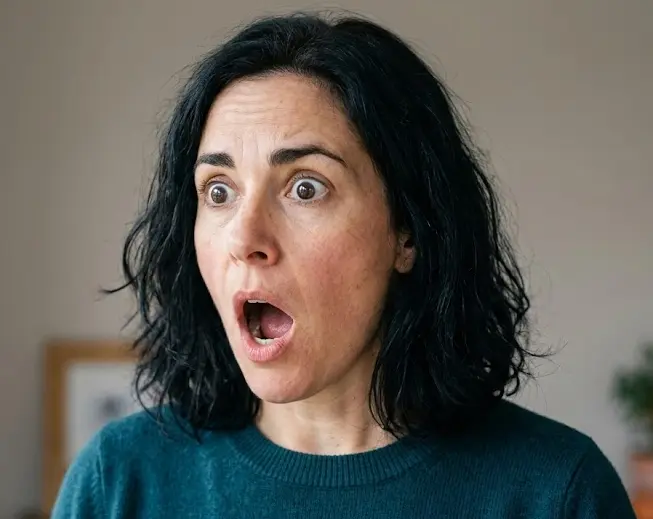
When the jaw drops, the face is doing something it cannot easily control. The mouth falls open, the eyebrows rise, the eyes widen — and for a fraction of a second, the person's internal state is completely visible. The jaw drop is one of the most recognizable expressions in body language, cross-cultural in its recognition and deeply rooted in human evolutionary history. But understanding what a jaw drop truly means requires looking beyond the obvious, because not every open mouth is the same, and not every jaw drop is genuine. This page covers the full psychology of the jaw drop and how it is read, alongside the broader range of nonverbal skills developed through the cognitive assessment tools on this platform.
The jaw drop belongs to what researchers classify as the surprise expression — a cluster of facial movements including raised inner and outer brows, widened eyes, and the dropped open mouth. But surprise itself is more complex than it first appears, and what follows the jaw drop in the next one or two seconds is often more informative than the drop itself.
What Does a Jaw Drop Mean? The Psychology Behind It
The jaw drop is primarily a response to the unexpected. When something occurs that violates our expectations — good news, bad news, a sudden revelation, an impossible outcome — the brain generates a brief orienting response that resets attention and prepares the system to process new information. The open mouth is part of this full-body reset: the body pauses, the airways open, and the face enters a configuration that communicates to those nearby that something unexpected has just been registered.
Research on the surprise expression documents an important distinction: the full prototypical surprise expression — raised brows, wide eyes, and jaw drop together — is actually observed in only a small minority of genuinely surprised people in laboratory settings. Studies by Reisenzein and colleagues found the complete three-component expression in just 0–5% of participants experiencing real surprise. What people far more commonly show is a partial expression — brow raising alone, or eye widening without the jaw component. The full jaw drop tends to appear at higher intensities of surprise, or in social contexts where the person is not suppressing their reaction.
This has a direct implication for reading jaw drops in the real world: a person who produces the full open-mouth expression in response to something you said or did is likely either genuinely and intensely surprised, or performing surprise for your benefit.
What Does a Jaw Drop Mean in Different Contexts?
Genuine shock or disbelief — the core meaning of a jaw drop is that something has violated expectations strongly enough to interrupt ongoing processing. The face falls open because the brain has paused. This version appears suddenly, with a brief freeze of other facial movement, and is followed quickly by whatever the real emotional response to the event is — fear, delight, grief, relief. The jaw drop itself is the moment of pure unexpectedness; what comes immediately after tells you the valence.
Awe and wonder — a jaw drop in response to something visually overwhelming or deeply impressive means a kind of positive cognitive overload. The face opens because the incoming information is exceeding normal processing capacity. This version typically appears with relaxed rather than tense eyes, and often softens into a smile or an expression of admiration within a second or two.
Horror and negative shock — when the unexpected event is also deeply threatening or disturbing, the jaw drop is accompanied by tension elsewhere in the face. The brow furrowing associated with distress begins to layer over the open mouth, and the eyes carry fear rather than neutral widening. The mouth may stay open longer than in a positive shock — the processing stalls because the information is difficult to integrate.
Social performance — a jaw drop produced to signal surprise to another person, rather than in response to a genuine unexpected event, is one of the more common social performances. People drop their jaws to validate someone's story, to express enthusiasm, or to avoid appearing unimpressed. This version tends to be held longer than a genuine jaw drop, is more exaggerated in its opening, and critically — is rarely followed by the involuntary micro-expressions that genuine surprise produces in the eyes and brow.
Admiration and physical attraction — a briefly dropped jaw in response to seeing someone physically striking can mean a momentary suspension of normal social composure. The face opens before the person has a chance to manage the reaction. This version is brief, usually self-corrected quickly, and is typically accompanied by sustained eye contact.
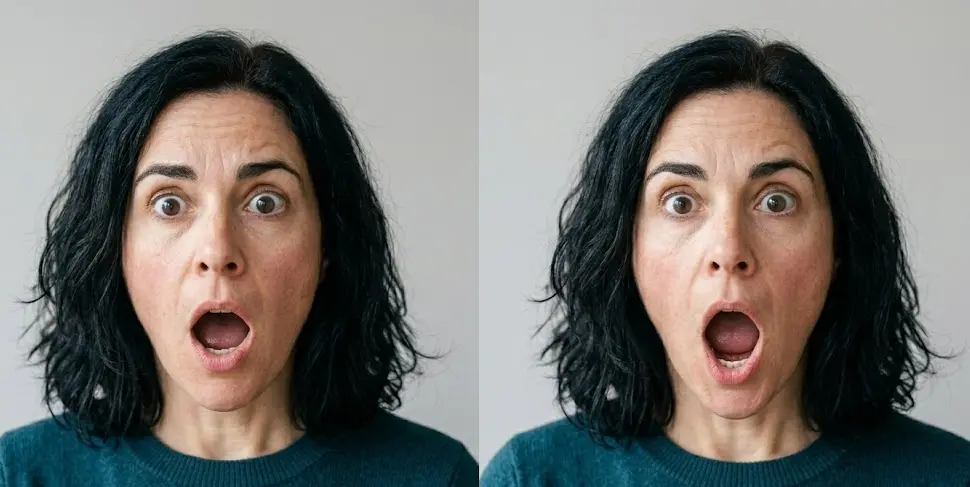
Left: Genuine jaw drop — brow tension, natural eye widening, authentic shock. Right: Performed jaw drop — wider mouth opening, smoother brow, more deliberate expression.
Reading what comes after the jaw drop is the real skill. The Body Language Test below ↓ trains exactly this — reading full expressions in context, not isolated moments.
Jaw Drop & Deception: What It Means When Someone Is Faking Surprise
Faked surprise is one of the more detectable forms of performed emotion, and the jaw drop is central to why. Research by Zloteanu, Krumhuber, and Richardson at University College London found that while people can produce convincing-looking surprise expressions — particularly if they have recently experienced genuine surprise and are re-enacting it — observers shown dynamic (video) presentations of expressions were significantly better at detecting fakes than those shown static images. The face in motion reveals what a photograph conceals: the timing.
Genuine surprise has a specific temporal signature. The expression appears rapidly — within milliseconds of the unexpected event — holds briefly, and then transitions into whatever emotion the event actually produces. A performed jaw drop tends to appear slightly too late (after the person has processed that they should look surprised), is held too long (genuine surprise resolves quickly), and lacks the involuntary micro-activity in the upper face that genuine shock generates. The eyes in particular are difficult to fake: genuine surprise widens them in a way that involves the levator palpebrae muscle firing involuntarily. Performed surprise often produces a wide-eyed look that is slightly too deliberate, held with conscious effort rather than reflexive activation.
The expression that follows the jaw drop is also diagnostic. After genuine surprise, the face transitions naturally and quickly into the emotion appropriate to the event. After performed surprise, the transition is often delayed, or the face returns to neutral rather than moving into a congruent follow-on expression. A jaw drop followed by a smile that arrives a fraction too late suggests the smile was constructed rather than felt.
Jaw Drop vs Similar Expressions
Jaw drop vs fear expression — fear and surprise share several facial components, which is why they are frequently confused. Both involve raised inner and outer brows, upper lid raising, and jaw drop. The distinction lies in what the brows do: in surprise, they rise high and curve; in fear, they rise but also pull together toward the center, creating tension between them. Fear also tends to produce horizontal lip stretching — the corners pulling back — which surprise does not. Research specifically examining the confusion between these two expressions has confirmed that the shared action units (including the jaw drop) contribute significantly to misidentification.
Jaw drop vs asymmetrical mouth — an asymmetrical mouth involves differential movement on the two sides of the face, reflecting competing internal states. A jaw drop is symmetrical — both sides of the face respond to the same overwhelming stimulus equally. The asymmetrical mouth means internal conflict; the jaw drop means the absence of any prepared response at all.
Jaw drop vs lip compression — these two expressions sit at opposite ends of the suppression spectrum. Lip compression means something is being held in; the mouth seals shut. A jaw drop means the normal holding-in has been interrupted; the mouth falls open because the system that maintains composed expression has been briefly overwhelmed. Where lip compression means containment, jaw drop means its breakdown.
How to Spot a Jaw Drop Accurately
The first question is onset speed. Genuine jaw drops appear fast — they are a reflexive response to an unexpected event, not a chosen expression. A mouth that falls open slowly, or that opens in a way that feels considered, is more likely to be a performance. Speed of onset is one of the most reliable authenticity cues available for surprise.
The second question is what the eyes are doing. In genuine surprise, the eyes widen involuntarily and the upper lids raise. The eyes look genuinely enlarged, not deliberately held open. If the jaw drops but the eyes remain relatively unchanged — retaining their normal resting shape rather than showing true widening — the expression is likely performed.
The third question is what immediately follows. Watch the one to two seconds after the jaw drop. Genuine surprise transitions into the emotional response the event produced: a smile, a frown, a look of fear, a sudden intake of breath. A jaw drop that simply resolves back to neutral, or that is followed by an expression that arrives a beat too late, suggests the surprise was manufactured rather than felt. That reading-in-sequence skill — tracking not just single expressions but how they unfold and what comes next — is precisely what the Body Language Test below develops.
How Much Body Language Can You Read?
The jaw drop is one moment in a much larger sequence. How accurately can you read the full range of expressions and what they lead to? The test below covers expressions, gestures, and postures across multiple contexts — with detailed explanations after every answer so you learn as you go.